Calm Parenting the Montessori Way: What Actually Helps
Most shouting is a design problem, not a character problem, and that is where Montessori discipline starts. The Montessori route to a calmer house is not a technique for staying serene while a three-year-old dismantles the morning — it’s removing the situations that produce the explosion, so there is less to stay calm about. Lower the things they need. Shrink the number of decisions. Build in more time than the task requires. Then, for what remains, use fewer words, hold the limit without arguing, and repair afterwards. That order matters: environment first, script second, apology third.
Step one: the room, not the willpower
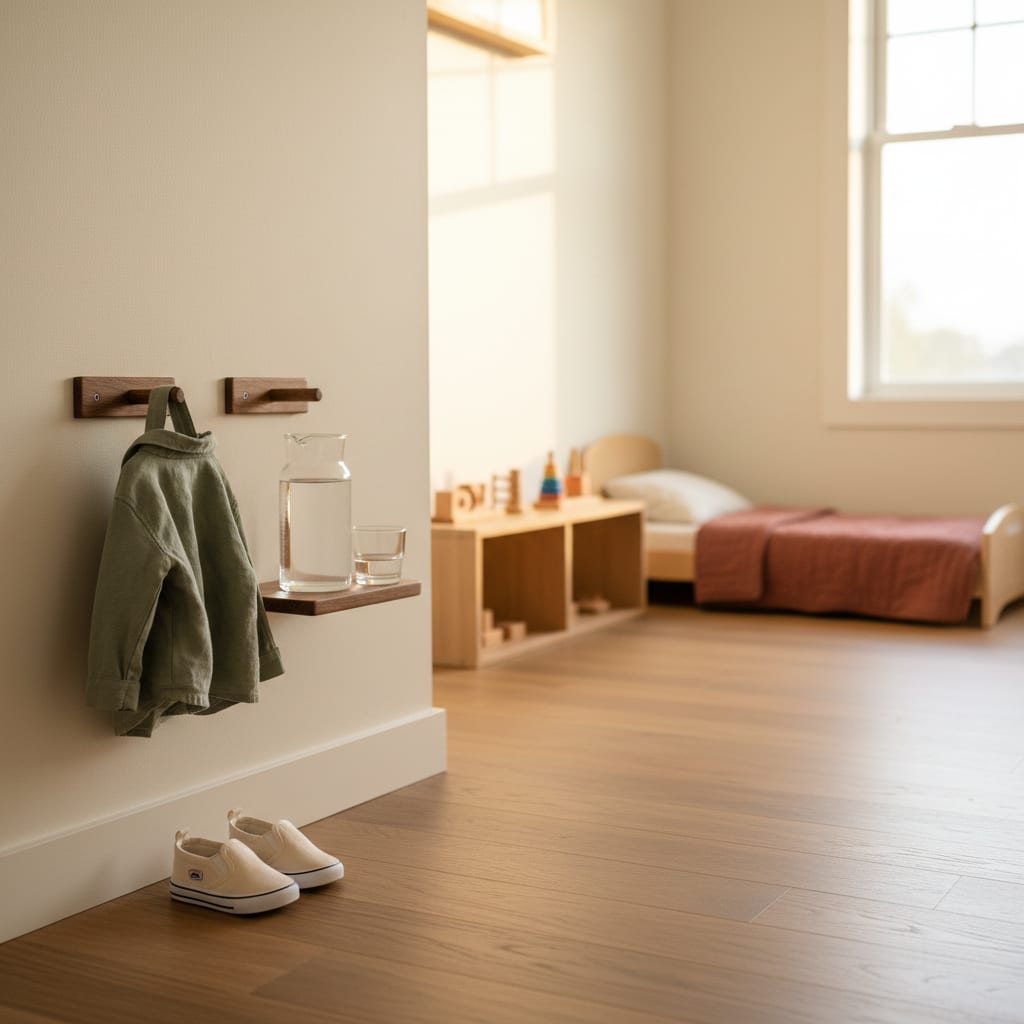
Ask what you shouted about last week and you’ll usually find a piece of furniture behind it. The coat that had to be fetched because the hook was too high. The cup that had to be poured because the water was on a counter. The shoes that had to be found because they live in a bin the child can’t see into.
Every one of those is a request for help that turns into a refusal that turns into a rush. Remove the request and the whole sequence never starts:
- Coats and shoes at child height, by the door they actually use.
- A small water jug and one cup they can reach without asking.
- Snacks in a low drawer, in quantities you’re happy for them to take.
- A stool at the sink (a plain Dreambaby step stool does it) so handwashing isn’t a lift.
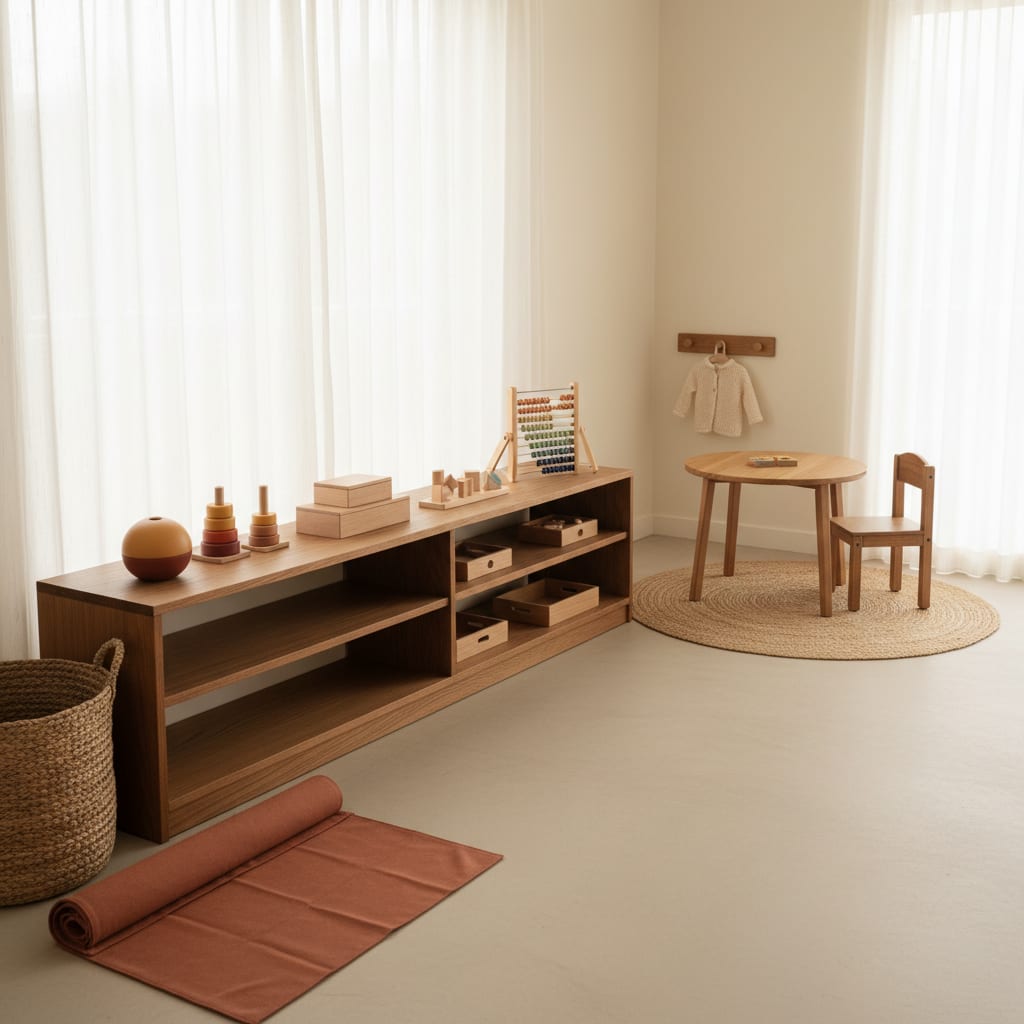
- Fewer toys visible, so tidying is a task rather than a landscape.
This is the highest-return calm-parenting intervention I know, and it’s a one-afternoon job. The rest of the shelf logic is in our toy rotation system; the wider version, room by room, is what Montessori parenting actually is.
Step two: time, the invisible cause
The second reliable source of shouting is a clock. A two-year-old putting on their own boots is not slow; the schedule is tight. Adding fifteen minutes to a morning is worth more than any script, because the vast majority of parental sharpness happens between 7:40 and 8:05.
The related fix is to stop stacking transitions. One change at a time, announced before it happens — “we’re going to put the blocks away, and then we’re going to the car” — gives a child the two seconds of processing that prevents the floor protest.
Step three: what to say instead
Montessori’s contribution to the calm-parenting conversation is mostly about fewer words, which is the opposite of most gentle-parenting scripts.
Describe, don’t judge. “The water is on the floor” leaves room for the child to act. “Look what you’ve done” does not.
Give the information once. Repeating a limit five times teaches a child that limits are negotiated by attrition. Say it, then act — hand over hand, gently, if needed.
Offer a choice you can live with, when there’s a real choice. “Blue coat or red coat” works. “Shall we get in the car?” invites the answer you can’t accept.
Say what to do, not what to stop. “Feet on the floor” lands where “don’t climb” does not.
Acknowledge the feeling and keep the limit. “You wanted to stay. We’re going home.” Both halves, every time — the acknowledgement is not a preamble to changing your mind.
Let silence do some work. Not every incident needs a sentence. A child mid-frustration usually can’t process one anyway.
Step four: limits, or what Montessori discipline actually is
Calm houses do not have fewer rules — they have fewer, firmer ones. Montessori limits are usually reduced to three tests: is it safe, is it respectful of other people, is it destructive of the environment? The American Montessori Society’s glossary of core components states the classroom version of the same ground rules: children may use anything in the room “as long as they use it respectfully. They may not harm the material, themselves, or others.” Almost everything else can be a yes.
The tradeoff is that the surviving limits have to be genuinely immovable, held identically by every adult, and never argued about. A limit that fails once a week is worse than no limit at all, because it teaches persistence rather than the rule.
Step five: when you lose it anyway
You will. I do, most weeks. The Montessori-adjacent point here is that repair is not a failure state — it’s the modelling.
What works: a short, specific, non-performative apology. “I shouted. That wasn’t fair to you. I was frustrated, and shouting isn’t how I want to speak to you.” No long explanation, no request for reassurance, no making the child manage your guilt. Then move on visibly, because a parent who stays wounded turns the repair into another thing the child has to handle.
What I’d avoid is the bargain where the apology comes bundled with a lesson — “I’m sorry I shouted, but if you had listened…”. Children hear only the second half.
What calm parenting is not
It isn’t permissive. Freedom within limits means real limits, held calmly. A house with no limits produces more shouting, not less, because the adult’s only tool is escalation.
It isn’t a feelings-only method. Naming emotions is useful and vastly overrated as a standalone technique. A child who is hungry, overtired or standing in a badly designed hallway needs the underlying problem fixed.
It isn’t the same as never being angry. Anger is information. Montessori asks you not to discharge it onto the child, not to stop having it.
It isn’t quick. The environment changes pay off in days; the response habits take months, because you’re rewiring a reflex you inherited.
The honest limits of my advice
I set up shelves in a toddler community for three years and I have two children of my own; I’m not a certified guide or a therapist, and none of this addresses a family where the shouting has become frightening or constant. That’s a real thing, it’s common, and it’s a conversation for a pediatrician or a family therapist rather than a blog post. For deeper reading from people doing this well, the Montessori blogs worth reading list points at several who write honestly about the hard weeks.
FAQ: calm parenting the Montessori way
How do I stop shouting at my toddler?
Change the situation before the technique. Lower what they need, add time to the transitions that go wrong, and cut the number of limits so the surviving ones are easy to hold. Then use short factual sentences and act rather than repeat.
Is Montessori the same as gentle parenting?
They overlap on respect and on avoiding punishment, but Montessori leans much harder on the environment doing part of the parenting, and is generally firmer about limits than the gentle-parenting label suggests.
What do you do instead of time-out?
Stay near, keep the limit, and act calmly — moving the child, removing the object, ending the activity. The consequence is the natural one where possible: spilled water gets a cloth. The point is that the adult stays connected while the limit stays put.
What is Montessori discipline?
Freedom within limits. The American Montessori Society describes classrooms designed “to encourage children to move about freely and choose their own work, within reasonable limits of appropriate behavior.” At home that means a prepared room, a few firm limits held calmly by every adult, natural consequences rather than punishments, and repair when the adult gets it wrong. It is discipline as teaching, not as penalty.
Does Montessori allow consequences?
Natural and logical ones, yes. Arbitrary punishments and sticker-chart rewards, no — both shift a child’s attention from the work itself to the adult’s reaction.
How long does it take to see a calmer house?
The environmental changes show up almost immediately, often within a week. The changes in how you respond take considerably longer, and they regress under stress, illness and travel — which is normal rather than a sign it isn’t working.