Montessori Toy Rotation System: How to Keep One Going
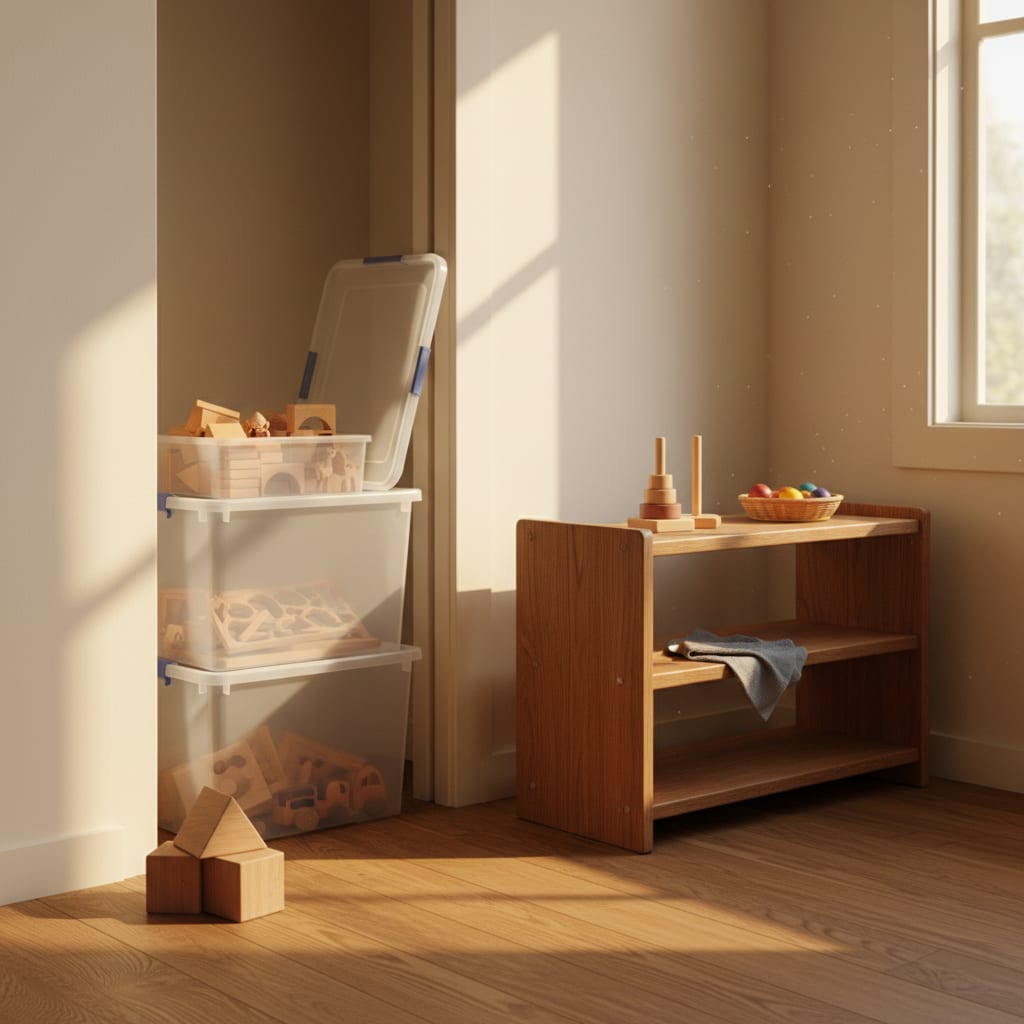
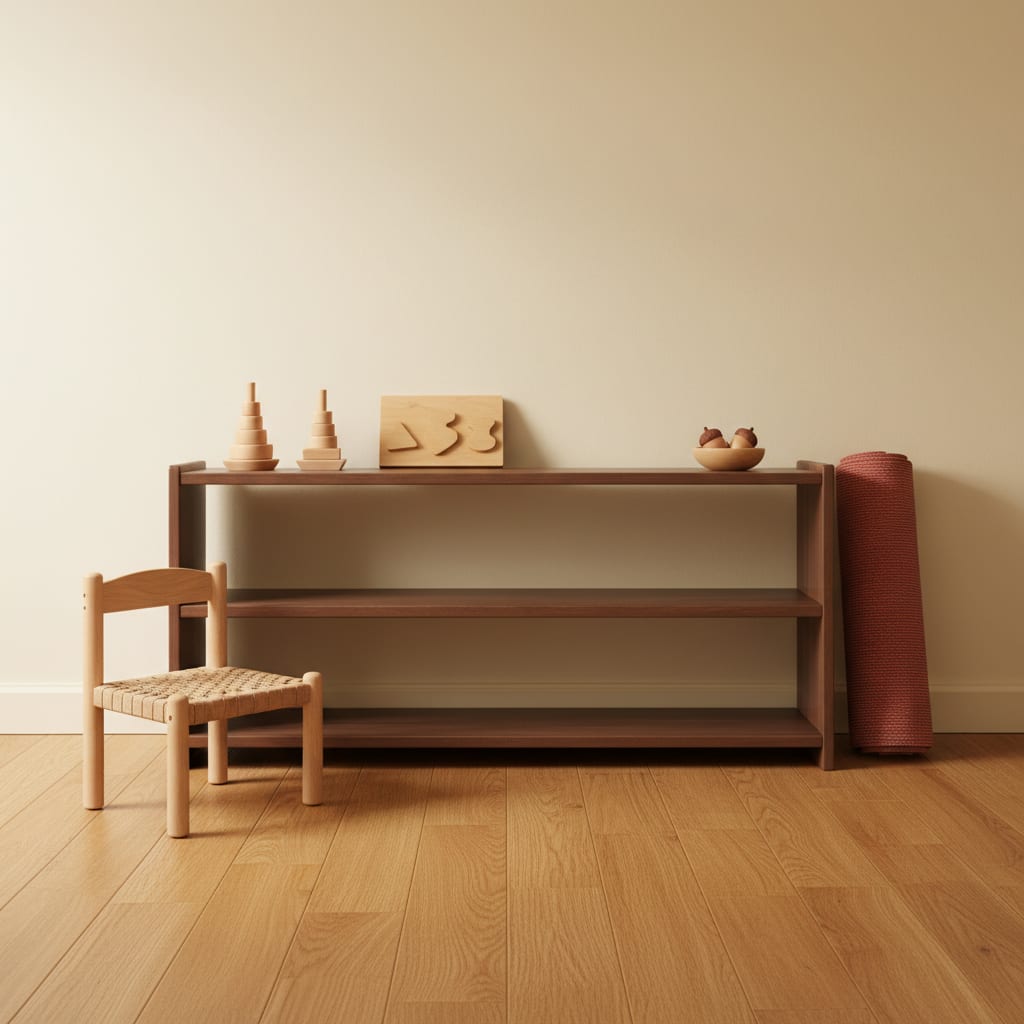
A Montessori toy rotation system is two zones and one habit. Zone one is the open shelf, holding six to ten toys the child can see and choose. Zone two is a closed store — a cupboard, a high shelf, a few lidded boxes — holding everything else, out of sight. The habit is a short weekly pass where you swap one or two items based on what’s actually being used. That’s it. Rotation fails in most houses not because the idea is wrong but because people set it up as a fortnightly ceremony with a spreadsheet, and ceremonies don’t survive a bad Tuesday.
Why rotation works at all
Two mechanisms, both boring and both real.
Fewer visible options means deeper play. A child facing forty toys samples; a child facing eight chooses. The whole Montessori interest in concentration — long, self-directed, uninterrupted work — depends on choice being possible, and choice collapses when the visual field is crowded.
Absence restores novelty. A shape sorter that vanishes for five weeks comes back as a new toy, and often as a differently used toy, because the child returning to it is more capable than the one who left it. It’s the cheapest way to have new toys ever devised.
What rotation is not: a way to own fewer toys. It makes the ones you own visible in turn. If decluttering is the actual goal, do that separately.
How often to rotate
The honest answer is when the shelf goes stale — in most houses, somewhere between one and three weeks. Fixed schedules sound tidy and tend to pull working toys off the shelf out of obedience.
Signs the shelf has gone stale:
- The child walks past it toward the kitchen drawer.
- Two or three items haven’t been touched in a week.
- Play at the shelf has gone short and scattered — pick up, drop, move on.
- Everything gets dumped rather than used.
Signs it hasn’t, and you should leave it alone:
- One work is being repeated obsessively. Never rotate out an obsession — a child doing the same puzzle eleven times is doing the most valuable thing available to them, and swapping it out to “keep things fresh” is the commonest own-goal in this system.
Ages matter a little. Babies want a swap weekly; toddlers settle into two to three weeks; a four-year-old deep in a building phase may keep the same materials out for two months.
Choosing what comes out: observe first, then swap
Spend three minutes watching before you touch anything. The rule of thumb I use: swap the ignored, keep the loved, and add one thing slightly harder than the current favorite.
That last part is what makes rotation developmental instead of decorative. If the two-year-old has mastered the three-shape sorter, the incoming item is the four-piece knobbed puzzle, not another sorter of equal difficulty. Sideways swaps keep the shelf busy and the child flat.
A practical distribution to re-check at each swap: one practical-life work, one puzzle, one open-ended material, one language basket, one fine-motor work, one movement item, plus whatever the child currently adores. The lists in Montessori toys for a 1 year old work as a stocking guide for those slots.
The three things that never rotate
- The current obsession. It leaves when the child leaves it.
- Comfort objects and the bedtime books. These aren’t works; they’re infrastructure.
- Anything open-ended and daily — usually one building material, often the mark-making tray. Blocks that come and go are blocks nobody gets good at.
Everything else is fair game.
The ten-minute reset
Rotation lives or dies on how long a swap takes. Keep it under ten minutes and it survives; make it a project and it stops happening in March.
- Clear the shelf completely onto the floor — the step that makes you look at each thing.
- Sort into three piles: used this week, ignored this week, broken or incomplete.
- Fix or bin the third pile now. Incomplete works are worse than no works.
- Put the used pile back, each in its own space, complete and ready.
- Fill the gaps from the store, following the swap rule above.
- Put the ignored items into the store box, and shut it.
Do it while the child sleeps for a fast job, or with them for a slower, more cooperative one — both are legitimate, and the second is more Montessori. From about three, children start requesting specific stored items, which is worth honoring.
Storing the off-duty half
The store needs to do two things: hide contents from the child and reveal them to you. Those pull in opposite directions, which is why open baskets in the corner of the living room never work — the child can see them, so nothing is ever actually absent.
What works: clear lidded boxes on a high shelf or in a closet, sorted loosely by type. Clear so you can find the pouring tray in twenty seconds; lidded so dust stays out; stackable because you’ll end up with three or four. A standard latching box like the IRIS USA WEATHERPRO is the sort of thing that outlives the whole toddler era, and under-bed boxes work equally well if your closets are full.
Two rules for the store. Keep sets complete in bags or small boxes inside the big one — a puzzle stored as loose pieces is a puzzle you’ll never put out again. And keep it out of the child’s sightline; a store they can see is just a second, worse shelf. Where every other category of toy lives is worked through in toy storage in a Montessori home.
A checklist you can copy onto an index card
Tape it inside the cupboard door where the store lives:
- Watch for three minutes before touching anything.
- Ignored for two weeks → store.
- Obsession → stays, no matter how long.
- Every work complete, or it doesn’t go back.
- One incoming item slightly harder than the current favorite.
- Six to ten things visible, each with space around it.
- Under ten minutes, or you won’t do it again.
The shelf itself — height, depth, what makes a good one — is covered in the Montessori shelf setup guide, and it’s worth getting right first: rotation into a shelf the child can’t see properly fixes nothing.
Why rotation systems fail
Four failure modes, in the order I see them. The system is too elaborate — themed weeks, inventory lists, photographed shelves; complexity is the enemy of a habit. The store is visible, so nothing is ever really away. Nothing is added or retired, so the same twenty items cycle for a year and the child outgrows all of them at once. And the shelf keeps growing, until you’re back to thirty visible things and wondering why nobody plays.
If it collapses, restart with one shelf, eight things, and one box — fifteen minutes, which is the best argument for the whole system.
FAQ: Montessori toy rotation
How often should you rotate toys?
When the shelf goes stale — usually every one to three weeks. Watch the child rather than the calendar: untouched items are the signal to swap, and a toy being used obsessively should stay out regardless of how long it’s been there.
How many toys should be out at once?
Six to ten for a toddler, up to about a dozen for a preschooler, each visible with space around it. Above that, most young children stop choosing deliberately and start sampling and dumping.
At what age can you start rotating toys?
From the first months, informally — babies change so fast that a weekly swap is natural. Rotation becomes most useful between about one and four, when the gap between mastered and challenging opens quickly.
Should I include my child in rotating toys?
From around three, yes — many children start asking for specific stored items, and honoring that is the point of the system. Under three, doing the swap while they sleep is faster and no less respectful.
Where should stored toys go?
Somewhere closed and out of the child’s sightline: clear lidded boxes on a high shelf, in a closet, or under a bed. Keep sets complete inside the box, or you’ll quietly retire them by accident.