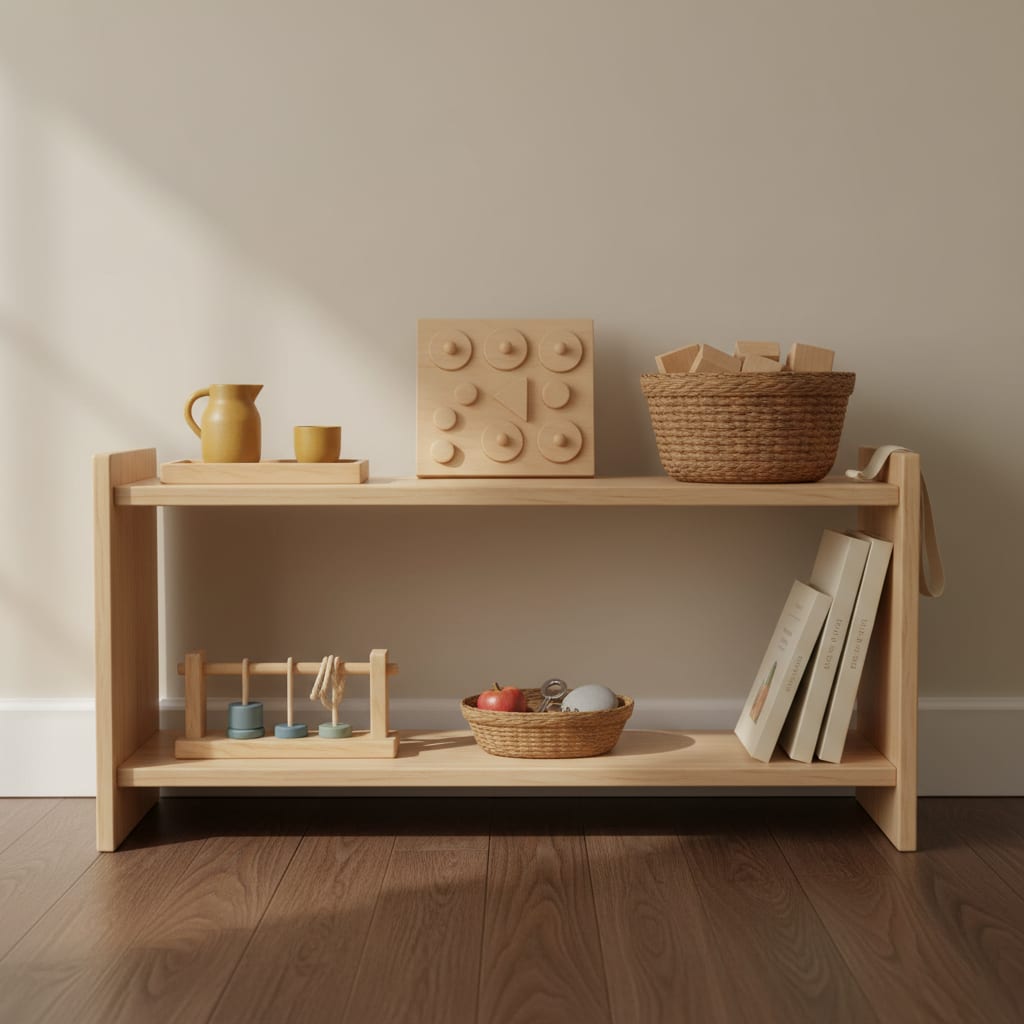
Montessori Language Activities for Toddlers

The best Montessori language activities for toddlers are almost embarrassingly low-tech: naming baskets of real objects, the three-period lesson for new words, object-to-picture matching, early sound games (“I spy something that starts with mmm”), and — outranking all equipment — slow, respectful, face-to-face conversation about real things. A toddler’s language explosion runs on input and naming, not flashcards. A decade ago this site’s most-linked language post was five tips for toddlers; this is that idea revived and expanded, from someone who spent three years watching trained guides do it properly.
The principle: real things, real words, no quiz
Montessori language work at this age has one engine: the child meets a real thing, and a calm adult gives it its true name. Not “doggie” — “dog,” and eventually “beagle.” Toddlers are vacuuming up vocabulary at a rate they’ll never repeat, and they file words fastest when the word arrives attached to a graspable referent.
The other half of the principle is what you don’t do: quiz. “What’s this? What’s this?” turns language into a test. The Montessori sequence gives words freely, invites recognition long before recall, and treats mistakes by simply reteaching later. Language should feel like being handed keys, not sitting exams.
Activity 1: the naming basket
A small basket holding four or five real objects on a theme — kitchen tools, bathroom things, three kinds of fruit. Sit together, take one out, name it plainly, let the toddler handle it, move on. Swap the contents weekly. This is the workhorse: cheap, endlessly refreshable, and better than any picture book at anchoring first vocabulary because the referent is in the child’s hand. (Miniature-object versions — tiny animals, tiny furniture — are wonderful when you find them, and lots of the classic “language miniatures” work descends from exactly this.)
Activity 2: the three-period lesson (lightly)
The classroom’s naming engine, home edition. Period one: “This is a fig.” Period two — the long, playful one: “Put the fig in the basket. Hand me the fig.” Recognition, not production. Period three — only when success is nearly certain: “What is this?” With toddlers, live in periods one and two and let period three arrive whenever it arrives. The lesson fails politely: if the child’s not getting it, you just name things again tomorrow. No correction, no ceremony.
Activity 3: object-to-picture matching
Once naming is rolling: a few objects plus simple photo cards of the same objects, matched one to one. This is the bridge from things to symbols — the first quiet step on the road that ends in reading, a road I’ve mapped in learning to read the Montessori way. Make the cards with your phone and a printer; matching your own spoon beats matching a stock photo’s.
Activity 4: sound games
The sneaky one. From around two and a half, play “I spy” with beginning sounds — “I spy something on the table that starts with sss” — using the letter’s sound, never its name. This is phonemic awareness, the actual foundation of reading, built in the car and the bath with zero materials. Start with obvious, stretchable sounds (s, m, f, a) and objects in plain view.
Activity 5: conversation, upgraded
The highest-value language activity is the one you’re already doing, done 20% more deliberately: narrate real work (“I’m slicing the apple — the knife goes through”), leave pauses a toddler can fill, get at eye level for the answer, and read the same beloved books past the point of your own sanity — repetition is how toddlers mine texts. Realistic picks that hold up to that are in Montessori books for toddlers. Handing over real jobs helps too; a child wiping a table to the sound of its vocabulary is doing language and practical life at once, and a museum morning done right is one long naming walk — see museum trips with toddlers.
None of this requires purchases, which is why the trained voices I trust — The Montessori Notebook on toddler language, Trillium Montessori on the classroom sequence — keep saying the same unfashionable thing: talk to the child, name the world, skip the apps.
FAQ: Montessori language for toddlers
When do Montessori language activities start?
From birth, honestly — narration and naming cost nothing. Structured work like naming baskets suits roughly 12–18 months onward; matching and sound games layer in through the twos and threes.
Are flashcards Montessori?
Not really. Montessori sequences go real object first, then picture, then symbol — and never as a quiz. Cards used for gentle matching are fine; cards used for drilling vocabulary out of context are the opposite of the method.
What about screens and language apps for toddlers?
Language grows through serve-and-return with humans; the research on passive screen input for under-threes is unenthusiastic, and Montessori homes generally skip it. An app can wait; the narrated grocery run can’t be replaced.
My toddler isn’t talking much — will these activities fix it?
These activities enrich normal development, but they’re not therapy. If your gut or your pediatrician flags a language delay, a speech-language evaluation is the right next step — early help works, and no blog (this one included) substitutes for it.