Floor Beds and Independent Sleep: A Montessori Guide
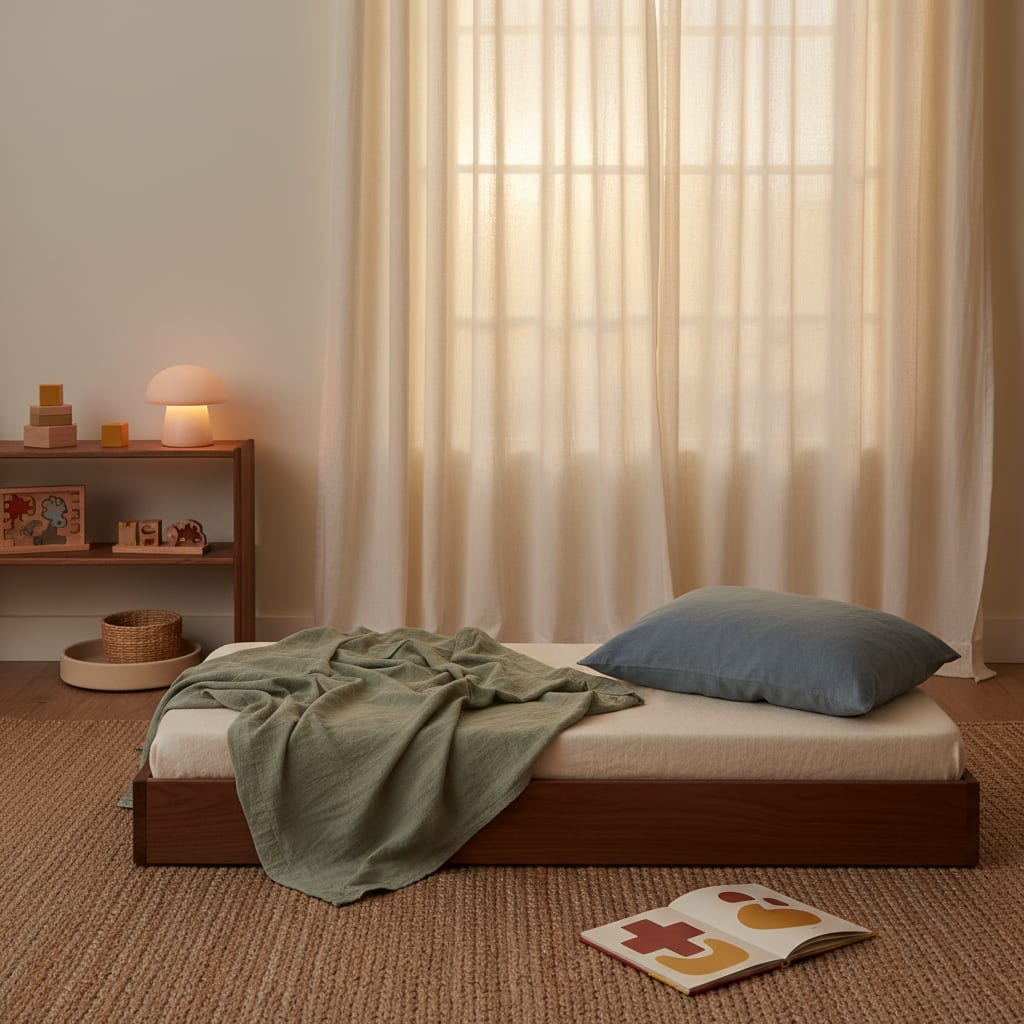
Does a Montessori floor bed help a child sleep independently? Honestly: it can — but not by itself. A floor bed gives a child the ability to fall asleep and resettle without an adult; whether they develop the habit depends on the same things it always depends on — a predictable rhythm, an age-appropriate schedule, and parents who respond consistently. The floor bed removes one obstacle (the caged wake-up that requires a rescue) and adds one responsibility (a room that must be genuinely ready for a free-range sleeper). This post is the honest version of that trade, from a house that made it twice.
What the floor bed actually changes about sleep
Montessori sleep thinking runs on independence: the child who can get into bed tired and out of bed rested is practicing self-regulation at the most basic level. In practice, the floor bed changes three real things:
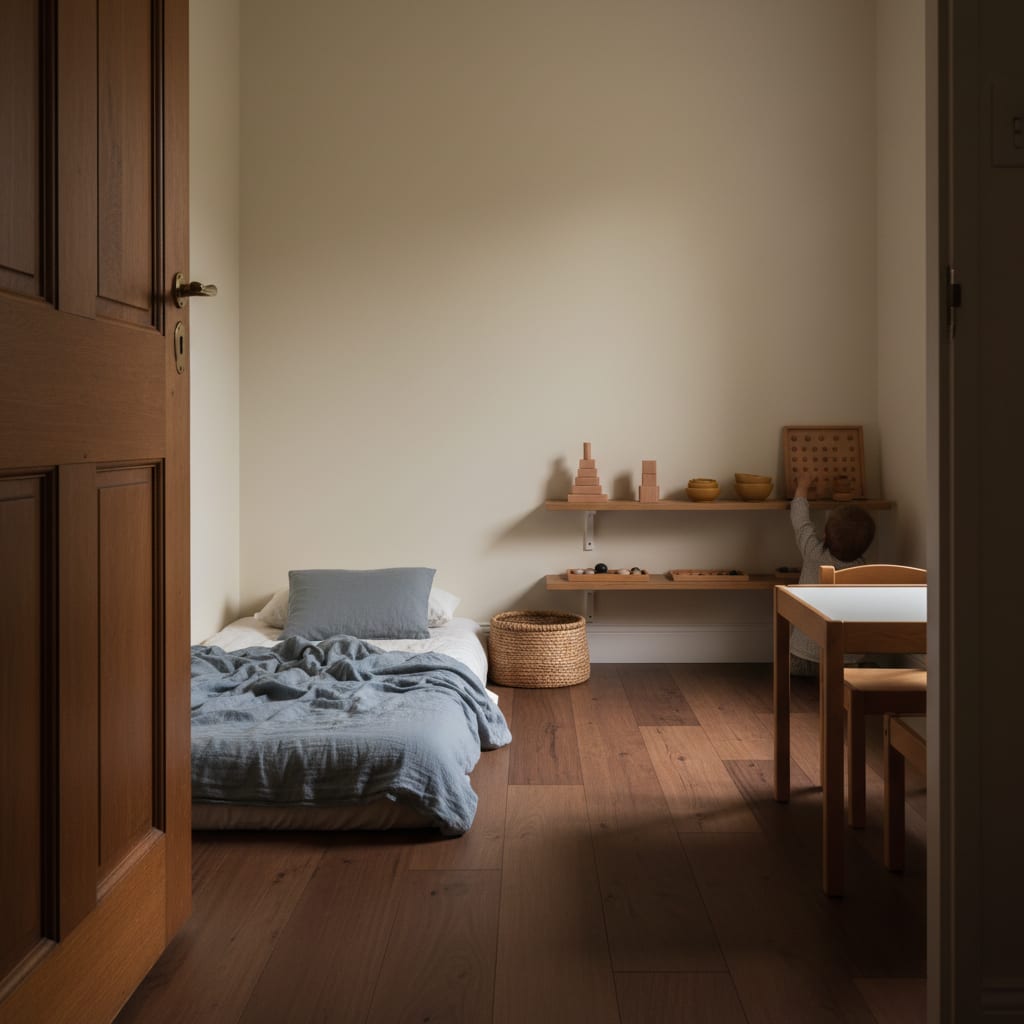
- Wake-ups get quieter. A crib wake-up is a summons — the child’s only move is to call for you. A floor-bed child who surfaces at 5:40 can potter to the book basket, and some mornings you win twenty minutes. Not every morning. Some.
- Bedtime becomes a negotiation with the room, not with you. The child can leave, so the room has to be boring enough — and the routine strong enough — that staying is the obvious choice. This is more work up front and less work forever after.
- You lose the container. There is no putting a floor-bed child “away.” If your family’s sleep survival strategy leans on containment — and no judgment, some seasons need it — a crib is the better tool, and Montessori houses have used cribs without the sky falling.
The setup half of this decision — room prep, frames, safe-sleep basics — lives in the complete floor bed guide; for babies, start with the infant room setup.
The rhythm is the real sleep tool
Here’s the part the furniture can’t do. Independent sleep — floor bed or crib — is built from a routine the child can predict to the minute: same order, same words, same small jobs (they carry the water cup, they choose between two books, they turn off the lamp). In Montessori terms you’re preparing the environment in time, not just in space. Keep the sequence short enough to survive your worst evening, then never improvise it.
What a floor bed adds is a graceful way to handle the exits. The script that worked in our house: walk back, “it’s sleeping time,” into bed, leave. No lecture the fourth time, no lecture the fourteenth. Boring is the strategy. The child is running an experiment on whether leaving the bed produces anything interesting; your job is a null result.
And the schedule underneath has to be roughly right, because no bed fixes an overtired child, and no routine survives a nap that ended at 5 p.m. This is where most floor-bed “failures” I’ve watched actually lived — the bed took the blame for wake windows that didn’t fit the kid.
If you want help with exactly that layer — the nap math, the wake windows, the what-do-I-do-at-2 a.m. decisions — Betteroo is a personalized baby-sleep app that builds a day-by-day sleep plan from questions about your child and your parenting style, and adapts it as things change. Fair report from this shelf: it plans the schedule and the routine, and it’s genuinely gentle-method-friendly, which matters to floor-bed families — but it won’t childproof your room or walk the toddler back at midnight. That part remains, as ever, you.
 A floor bed, with a plan
Betteroo builds a personalized, gentle day-by-day sleep plan — tonight's bedtime, tomorrow's naps — that fits floor-bed independence instead of fighting it.
Take the 2-minute sleep quiz →
A floor bed, with a plan
Betteroo builds a personalized, gentle day-by-day sleep plan — tonight's bedtime, tomorrow's naps — that fits floor-bed independence instead of fighting it.
Take the 2-minute sleep quiz →
Honest pros and cons
Where the floor bed earns its keep:
- Wake-ups that don’t require a rescue, and the slow growth of a child who manages their own tiredness.
- The crib-to-bed transition simply never happens — there’s nothing to transition from.
- Bedtime battles lose their audience. A child who can leave has less to prove.
Where the crib wins:
- Young babies on strict safe-sleep setups are simpler to manage in a crib, full stop.
- The floor-bed party phase (it’s real, it lasts days to a few weeks) arrives exactly when parents are most tired.
- Room-sharing, tiny bedrooms, and homes that can’t be fully childproofed all argue for containment.
Montessori writers are more relaxed about this than the internet suggests — The Kavanaugh Report has written for years about real (imperfect, adjusted) floor-bed sleep, and it’s the best reality-check reading I know.
When it isn’t working
Give any change two weeks of boring consistency before judging it. If sleep is still worse: check the schedule first (wake windows, nap length), then the room (too stimulating? too bright?), then the routine (too long? inconsistent?). And if your gut says your particular child needs the container for a season — put the crib back without ceremony. The Montessori part was never the mattress; it’s the respect. Sometimes the respectful read of a child is “not yet.”
FAQ: floor beds and independent sleep
Do floor beds make babies sleep better?
No bed makes a child sleep better by itself. A floor bed supports independent resettling and calmer wake-ups once a child is mobile, but schedule and routine do the heavy lifting. Families switch for independence, and keep it when sleep holds steady.
Can you sleep train with a floor bed?
Gentle, presence-based approaches adapt well — you can sit near the bed and gradually retreat. Cry-it-out-style methods assume a container and don’t translate. Most floor-bed families land on routine-plus-boring-walk-backs, which is slower and calmer.
What do I do when my toddler keeps getting out of the floor bed?
Walk them back, same words, no show. Check the schedule (a not-tired child will not stay), strip the room to boring, and hold the line for two weeks before concluding anything. Repetition is the treatment.
Is a floor bed required for Montessori at home?
No. It’s the classic choice because it serves independence, but a crib household that respects the child’s rhythm is more Montessori than a floor-bed household in chaos. Furniture is the smallest part of the method.