Learning to Read the Montessori Way
Learning to read the Montessori way follows a sequence most school programs run backwards: sounds before letters, writing before reading. Children play oral sound games from toddlerhood (“what starts with mmm?”), then learn letter sounds — never names first — by tracing sandpaper letters, then build words with a movable alphabet before their hands can write, and then, usually somewhere between four and six, discover almost by surprise that they can decode. It’s phonics, fundamentally — sound-symbol correspondence, the approach reading science backs — delivered through the hands, at the child’s pace, with no flashcard drills. This site’s original network covered learning to read extensively; here’s the whole arc in one honest post.
First, a credential note
I watched this sequence work across three years assisting in a Montessori environment, and I’ve started it at home — but I’m not a trained guide or a reading specialist, and this post is a map, not a manual. For doctrine, the trained sources linked throughout outrank me, and for a struggling reader, a professional evaluation outranks all of us. What a map is good for: knowing where you are and not panicking about the timeline.
Stage 1: the ear (from age 2–3)
Reading starts with no letters anywhere in sight. Sound games — “I spy something that starts with sss” — train a child to hear that words are built from separable sounds. That skill, phonemic awareness, is the strongest early predictor of reading ease, and it’s built in the car, the bath and the checkout line. Use the letter’s sound (mmm, not “em”), start with the word’s first sound, and keep it a game. This stage runs for months to years and it is reading instruction, disguised as nothing — part of the same naming-rich home as our toddler language activities.
Stage 2: the hand meets the symbol (roughly 3–4)
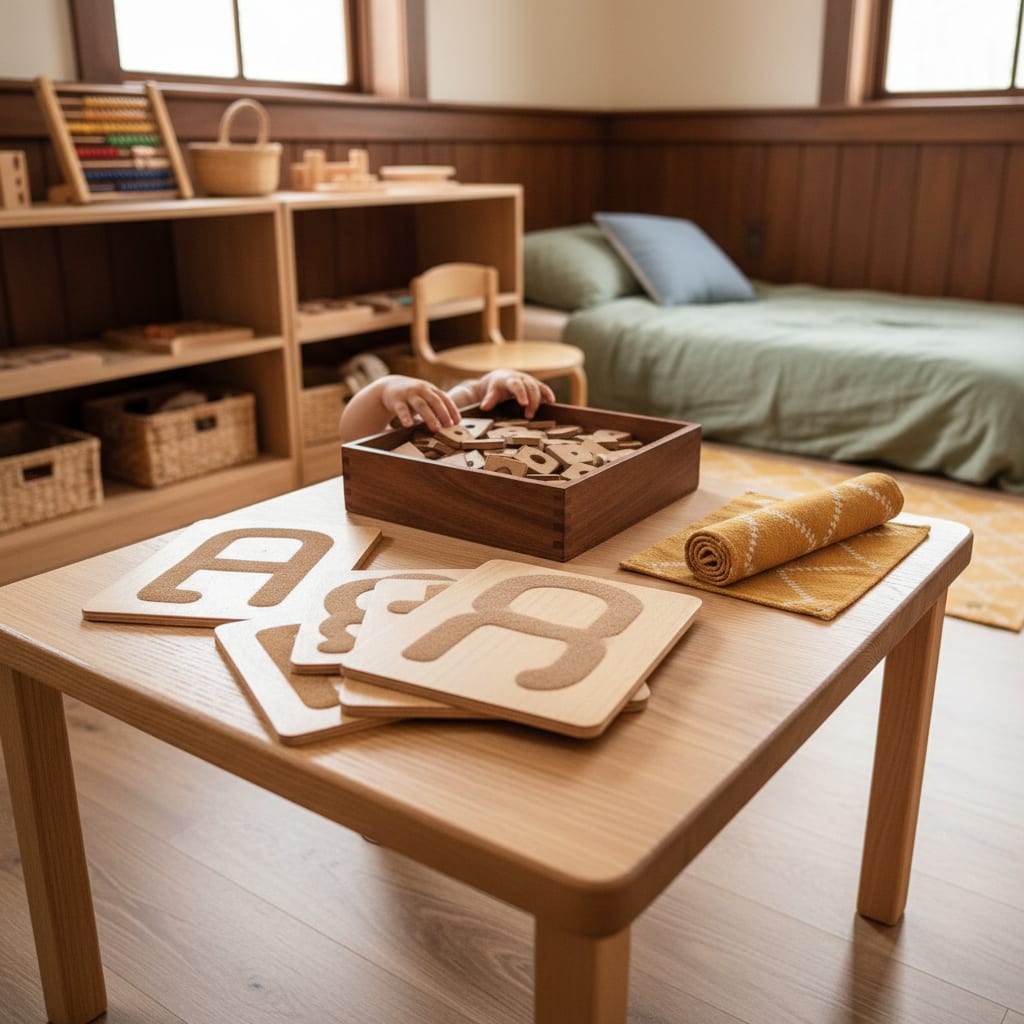
Enter sandpaper letters: rough letterforms on smooth boards. The child traces with two fingers and says the sound — seeing, touching and hearing the symbol at once. It’s the three-period lesson applied to letters (this is sss → show me sss → what is this?), a few letters at a time, sounds only. Lowercase first; names can wait until they’re trivia rather than obstacles. Montessori print-and-cursive debates rage politely; either works. A homemade set (glue-and-sand on card) is entirely legitimate, which is on-brand for this site’s whole materials philosophy.
Stage 3: writing before reading (roughly 4–5)
The counterintuitive jewel. With a movable alphabet — a box of loose letters — a child who knows a dozen sounds can build “mat” long before their hand can write it or their eye can smoothly decode it. Encoding your own word is easier and more motivating than decoding someone else’s: the child already knows what it says. Spelling at this stage is glorious phonetic chaos (“kat,” “wons a pona tym”) and is left uncorrected — the work is sound-mapping, and the conventional spellings arrive later without drama.
Stage 4: the explosion (somewhere between 4 and 6)
Decoding tends to arrive the way walking did: suddenly, after long invisible preparation. Phonetic three-letter words, then phonogram work (sh, ee, ay), then the puzzle-piece “sight” words English refuses to spell fairly — and then real books, chosen off a low shelf, read in a beloved lap. The range of “normal” here is enormous, and the Montessori position is unbothered: follow the child, keep the materials available, and refuse to turn reading into a performance with an audience and a deadline.
What to avoid mirrors the sequence: letter-name-first alphabet toys and songs as instruction (fine as furniture), drill apps that reward speed over sound-work, and comparison-shopping your four-year-old against the neighbor’s. For trained-guide depth on all four stages, Trillium Montessori is superb on early literacy, Living Montessori Now collects free phonetic materials by the hundred, and The Kavanaugh Report shows the sequence happening in a real, imperfect home.
FAQ: Montessori reading
At what age do Montessori children learn to read?
Typically somewhere between four and six, with wide, healthy variation — the sensitive period for language makes preparation start early, but the decoding click lands on the child’s own schedule. The sequence cares about order, not speed.
Is Montessori reading the same as phonics?
The engine is the same — systematic sound-symbol correspondence, which aligns with the reading-science consensus. Montessori’s distinctives are the delivery: sounds through the hands (sandpaper letters), writing before reading (movable alphabet), and self-paced discovery instead of whole-class instruction.
Why does Montessori teach writing before reading?
Building a word from letters you know the sounds of (encoding) is cognitively easier than decoding an unknown one — the child already knows the message. The movable alphabet lets composition outrun handwriting, so the “writing” starts years before pencil control catches up.
Should I teach letter names or sounds first?
Sounds. “Buh-ah-tuh” blends into “bat”; “bee-ay-tee” blends into nothing. Names are learned eventually as trivia — the alphabet song can stay, as long as nobody mistakes it for reading instruction.