Learning Tower Guide: Choosing One for a Real Kitchen
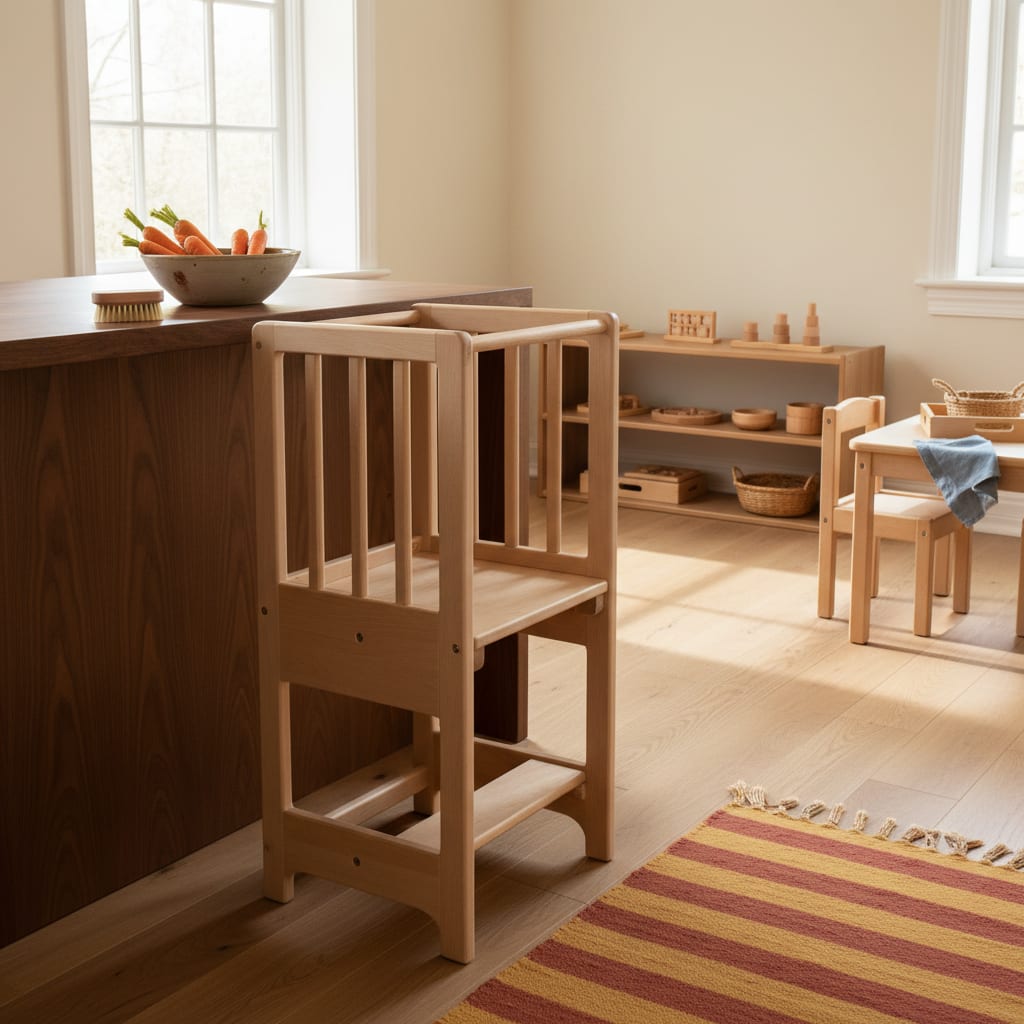
A learning tower is a step platform with rails all the way around, tall enough to put a toddler’s hands at counter height and enclosed enough that they can’t step off the edge. It exists to solve one problem: everything interesting in a house happens on a surface a two-year-old cannot see. Solid towers run roughly $100–250, most children use one from around 18 months to four or five, and the buying decision comes down to three things — stability, whether it folds, and whether your child can climb in and out without you. Here’s the whole decision from a house that uses one daily.
What a learning tower is actually for
Not cooking, exactly. The tower’s real job is access — it puts the child at the height where the work is, and then keeps them there safely enough that you can keep chopping. Everything that follows from that is the Montessori part: washing a carrot, tearing lettuce, spreading butter, pouring their own water, wiping the counter afterwards.
A step stool does the same lift for less money, and I’d never tell a family they need a tower. The difference is duration and nerve. On a stool, a toddler is one wobble from the floor and you spend the whole task hovering; in a tower, the rails do the hovering, and a child can stand there for twenty minutes of real work. That trade — your attention back — is what you’re actually buying.
It’s also the piece of furniture that makes the rest of practical life possible in a normal kitchen, which is why it turns up in almost every list of practical life activities by age.
The ages it earns its keep
- Around 16–24 months: first use, heavily supervised. Mostly washing, dumping, stirring things that don’t matter, and standing there watching. The tower is a viewing platform before it’s a workstation.
- 2–3 years: the peak. Real jobs with real tools — a small serrated knife on a banana, a whisk in a bowl, hands in the sink. This is the year the tower pays for itself.
- 3–5 years: less standing, more cooking. By four many children are steady enough on a plain stool, and the tower starts spending days folded against the wall.
Four solid years is a realistic estimate, and towers hold their resale value well, which quietly lowers the real cost.
Safety: the four checks that matter
- It must not tip when pushed sideways. Stand it on your kitchen floor and shove the top rail hard. A wide footprint and a low center of gravity beat any marketing claim about weight capacity.
- The enclosure has to be complete. Rails on all four sides, at chest height for a two-year-old, with no gap wide enough for a foot to slip through at platform level.
- The child must be able to get in and out alone. If they need lifting, the tower has just made you the ladder, and children who get lifted in are children who get stuck up there. A back opening or a climbable rung is the feature to look for.
- The adjustable platform must lock hard. Pin or bolt systems that a toddler cannot reach or release. Test the locks before the first use and again every few months.
The floor rule is the same one that applies to the Pikler triangle: what’s under it matters. Tile plus a tower is a worse fall than a rug plus a tower, and no tower is a substitute for an adult in the room.
Fixed, folding, or convertible
Fixed towers are the sturdiest and the most annoying. They live in the kitchen permanently, take up roughly two square feet of floor, and never wobble. If your kitchen has a corner to spare, this is the honest best choice.
Folding towers flatten to a few inches and hang on a hook or slide beside the fridge. The compromise is real — folding hardware is the part that develops play over a couple of years — but a good one stays rigid, and for a galley kitchen a folding tower is the only tower you’ll actually keep out.
Convertible towers flip over into a small table-and-bench or a slide. They’re clever and they’re usually a compromise on both jobs; the tower is a bit less stable and the table is a bit too low. Buy one only if you genuinely want the second function.
The models worth the money
- The Little Partners Learning Tower is the original, and the one I see survive multiple children. Four platform heights, a wide fixed base, full rails, and a frame that doesn’t creak by year three. It’s bulky — measure your floor before you commit — and it does not fold.
- The Guidecraft Kitchen Helper is the folding option with the long track record. It collapses flat, adjusts for height, and is the sensible pick for a kitchen where the tower has to disappear between meals.
- The IKEA stool hack — a Bekväm step stool plus a second stool or a length of dowel for the rails — is the version half the Montessori internet actually owns. It costs a fraction of the retail towers and requires you to be honest with yourself about your carpentry. A hack with a wobbly rail is worse than no tower.
- Unfinished local-maker towers on Etsy or from a small woodshop are frequently better built than mid-priced retail. Ask for the base dimensions and the rail height before you buy, and skip anything photographed only from the front.
What I’d avoid: anything under about $80 with thin plywood sides, any tower whose rails are decorative cut-outs rather than structural, and painted sets whose finish chips into a child’s hands. The house test is unglamorous — does it hold a determined toddler leaning on one rail — and cheap towers fail it in year one.
Where it goes, and the house rules
Position it at the counter you actually use, not at the island you photograph. Three rules cover almost everything:
- Never at the stove. The tower goes at the sink or a work counter; the child comes to the stove only in your arms, if at all.
- Push it in, or push it away. A tower left against a counter with knives, hot mugs or a running tap is a hazard whether or not a child is standing in it. Ours goes back against the wall when the work ends.
- They get in; they get out. No lifting. It’s the same independence logic that governs a low shelf — if an adult has to operate it, it isn’t the child’s.
FAQ: learning towers
What age is a learning tower for?
Most children start somewhere around 16–24 months, once they can climb in unaided and stand steadily, and use it heavily until three or four. After that a plain step stool usually takes over.
Is a learning tower worth it, or is a step stool enough?
A stool is enough for quick reaches. A tower is worth it if you want the child working at the counter for real stretches — the rails are what let you stop hovering. If a stool already works in your house, keep the money.
Are learning towers safe?
They’re safe used as designed: locked platform, complete rails, an adult in the room, and never parked at the stove. The real risks are tipping (cheap narrow bases), falls from an unlocked platform, and what’s within arm’s reach on the counter.
Do I need a Montessori-branded tower?
No — there is no such thing as a Montessori-certified product. What makes a tower Montessori is that the child gets in alone and does real work at the top of it, which a hardware-store hack achieves as well as a $250 frame.