Montessori Kitchen for Toddlers: Setting One Up
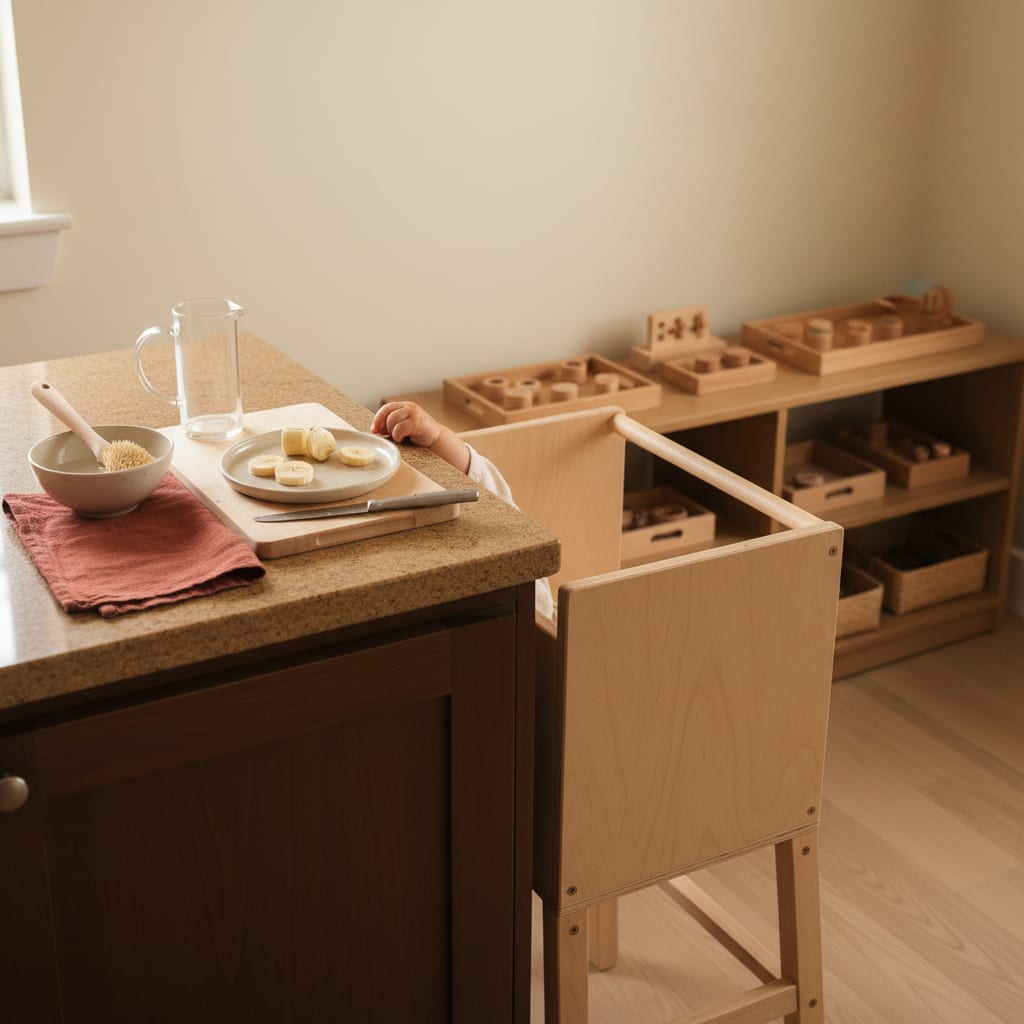
A Montessori kitchen for toddlers is not a separate room or a play kitchen. It’s your own kitchen, adjusted at three points: the child can reach a work surface, the child has a small zone that belongs to them — a drawer, a shelf of the fridge, a low cupboard — and the tools in that zone are real and small rather than plastic and pretend. Everything else is optional. You can do the whole conversion in an afternoon with a stool, one drawer emptied, and a trip to a restaurant-supply shop.
Why the kitchen is the highest-value room
Toddlers want to be where the work is, and in most houses the work is at the counter. That makes the kitchen the room where “I want to help” collides hardest with “I’m cooking with a hot pan” — and the room where solving that collision buys back the most peace.
It also happens to be the richest practical-life environment you own. Pouring, spreading, slicing, washing, carrying, sweeping up afterwards: real jobs with real results, endlessly repeatable, and the outcome gets eaten. A toddler who has spent six months buttering their own toast is a different person at the table than one who has been handed toast for six months.
The caution, and it’s a real one: none of this is safe on autopilot. Knives, heat, glass and water all live here. The setup below is designed so a two-year-old can work near you, not unsupervised.
The three access points
Pick the one that fits your room. You need exactly one to start.
- A tower at the counter. The most flexible option and the one most families end up with — an enclosed platform that puts the child at adult counter height with rails on all sides. It’s the difference between watching and participating. Which builds hold up, what the safety checks are, and the cheaper routes in are all in our learning tower guide.
- A child-height table. A small table and chair, off to the side of the kitchen, where prepared work gets carried to. Slower to set up than a tower and safer for the under-twos, because the child is seated and on the floor.
- A low counter or a deep drawer front. Some kitchens already have a step-down section or a sturdy pull-out. If yours does, use it before buying furniture.
A word on stools: a plain step stool works for hand-washing at the sink, but it’s a poor choice for knife work or anything that needs two hands, because there’s nothing to lean into. Save the open stool for the sink and the bathroom.
The child’s own zones
This is the part that changes daily life more than any piece of furniture. Three small territories, in ascending order of how much they’ll be used:
One drawer or low cupboard. Their plates, bowls, cups, cutlery, a small pitcher, a cloth. Nothing precious, nothing breakable that you’d mourn. When the table needs laying, this is where they go — and the request “can you get your bowl?” becomes possible for the first time.
One shelf of the fridge, at the bottom. A small covered pitcher of water, a bowl of washed berries or cut fruit, a couple of yogurts. It converts “I’m hungry” from a request into an action. Restock it once a day and it runs itself.
A snack basket in the cupboard. Two options, visible, replenished daily. The limit is what’s in the basket, so the answer to “can I have a snack?” is “check the basket” rather than a negotiation.
Storage logic across all three is the same as everywhere else in the house: one job per container, everything visible, nothing stacked so the top item has to move first. The longer version of that argument is in organizing practical life supplies.
Real tools, small hands
Child-size, not child-branded. Nearly all of it is cheap.
- A small heavy glass and a small pitcher. Glass tells the truth about how it’s being carried; plastic doesn’t. Expect breakage, buy the cheap tumblers — the small Duralex Picardie is the classic.
- A blunt spreader for butter, hummus and cream cheese — a wooden or plastic-handled spreader works.
- A safe first knife. A serrated child’s knife with rounded edges cuts banana, mushroom, boiled egg and soft cheese without cutting fingers. The kiddi kutter child-safe knife is the one that shows up in most classrooms I’ve worked in, and it’s genuinely blunt enough to hand over at two with you sitting alongside. A crinkle cutter does a similar job.
- A small cutting board the child can carry with two hands.
- A vegetable brush and a bowl for washing produce.
- A hand brush and dustpan, such as the Redecker horsehair set, hung low, because the floor is part of the work.
- An apron on a low hook — less about mess than about the signal that work is starting.
Classroom-grade versions of all of this are sold by specialists like Montessori Services, but restaurant-supply shops and the regular kitchen aisle cover most of it for less.
Five works that keep earning their place
Start with one. Add the next when the first is boring.
- Pouring their own water from a small pitcher, kept in the fridge zone. The first real independence job, usually workable somewhere around eighteen months to two years.
- Washing produce — a bowl of water, a brush, a towel, a colander for the finished pieces. Long, wet, absorbing, nearly impossible to do wrong.
- Spreading and slicing a snack — banana on a plate, spreader and cracker, the whole sequence including carrying it to the table.
- Table-laying, one item at a time, from their drawer. Start with the placemat alone.
- Washing up their own dish at a tub of water on the tower, or in the sink. Expect to re-wash it. Say nothing about it.
If you want the ladder of what comes before and after these by age, the full progression is in practical life activities by age.
Rules that keep it survivable
- Present it once, slowly, mostly in silence. Hands do the teaching; a running commentary splits attention.
- The cleanup lives inside the work. A cloth on the tray, a sponge in the bin, a dustpan within reach. Then the spill is a step, not a disaster.
- Never mid-cooking. Set the child’s work up before the stove is on, or hand them a job that finishes before you need the space.
- Let it be done badly. A crooked slice, a half-wiped table. Corrections in the moment tell a two-year-old the point was your approval.
- Put the sharp things back up high. Independence is granted job by job, not by leaving the knife block accessible.
FAQ: the Montessori kitchen at home
At what age can a toddler start kitchen work?
Around twelve to eighteen months for carrying, washing produce and dropping things into a bowl; around two for pouring, spreading and slicing soft food with a blunt child’s knife, always seated or on a stable tower with an adult present.
Do I need to buy a play kitchen?
No — a play kitchen is pretend work, and the real one is right there. Toddlers who can reach the actual counter generally lose interest in the toy version quickly.
Is a learning tower safe for a one-year-old?
Most makers set a minimum around eighteen months and require the child to climb in unaided and stand steadily. Under that, a seated child-height table is the safer route. Check the specific maker’s guidance rather than a general rule.
How do I stop them wanting to help every single time I cook?
You mostly don’t, so give the wanting somewhere to go: a standing job that happens at the same point every meal — laying their placemat, washing the vegetables, carrying the empty bowls to the sink. A predictable role is what settles the interruptions.