Pikler Triangle Guide: Buying It the Montessori Way
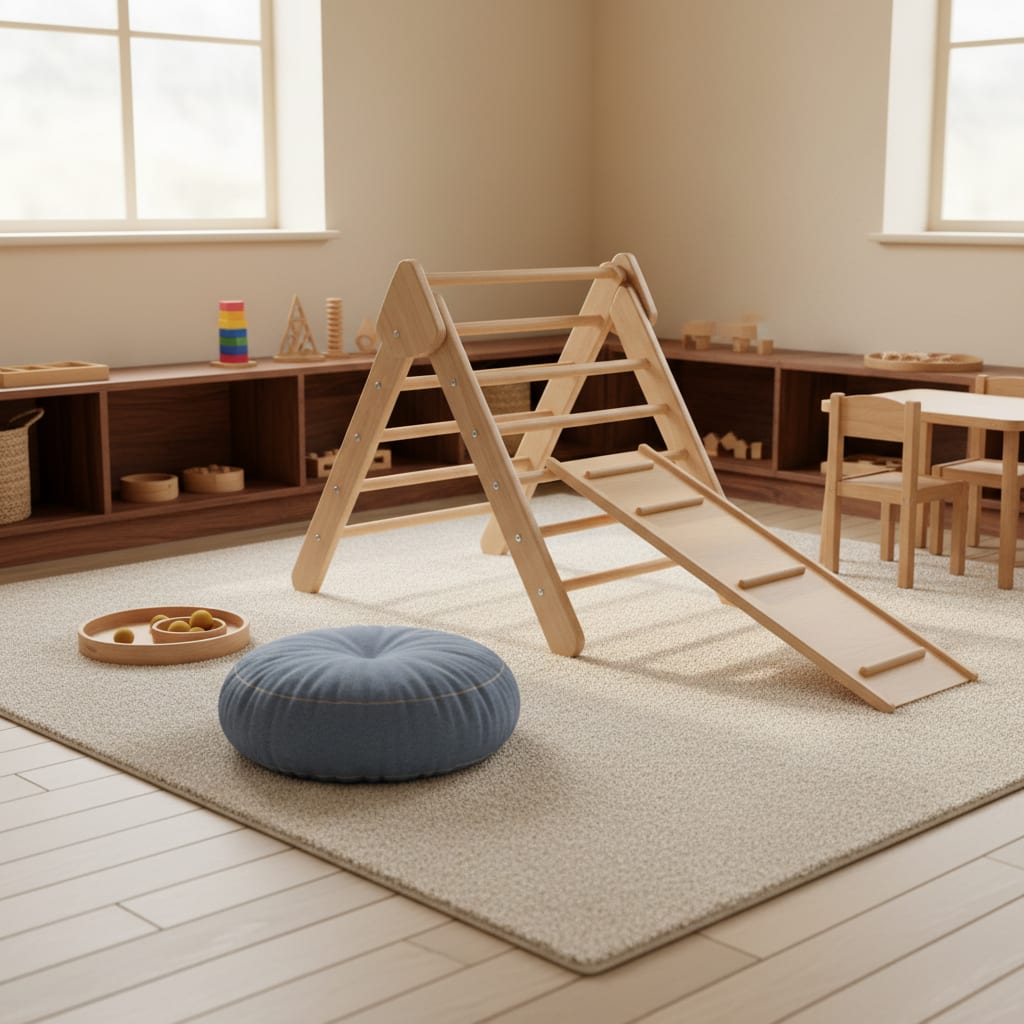
A Pikler triangle is a low, ladder-sided wooden climbing frame — most are somewhere around 30–40 inches tall — that lets babies and toddlers practice pulling up, climbing and clambering at their own pace, indoors, on equipment scaled to them. Is it worth buying? If you have the floor space and a child between about ten months and four years, it’s one of the highest-use large purchases in the Montessori-adjacent world; solid versions run roughly $80–250, a ramp accessory extends it, and the “buying it the Montessori way” part means choosing for free movement and durability, not for Instagram. Here’s the whole decision, honestly.
What it is (and the name on the box)
Credit where due: the triangle isn’t Montessori at all by pedigree. It comes from Dr. Emmi Pikler, the Hungarian pediatrician whose work on free motor development — children learn to move by moving, unassisted, at their own timetable — slots so naturally beside Montessori’s prepared environment that the two traditions share a shelf in most modern homes. The triangle is Pikler’s idea in furniture form: a climbable object low enough to be safe-ish, hard enough to be interesting, always available so the child chooses when.
That “chooses when” is the operative Montessori-way clause. The triangle works because nobody puts the child on it. They climb when their body is ready, which is exactly how you want climbing learned.
What ages actually use it
- ~10–18 months: pulling to stand at the bottom rungs, cruising along it, first cautious rung-steps. The triangle mostly gets held.
- 18 months–3 years: the golden era — up and over, down the other side, endlessly, plus ramp work (climbing side and slide side) if you add one.
- 3–5 years: less climbing, more architecture: the triangle becomes a fort frame, a puppet theater, the mountain in an obstacle course. A blanket converts it instantly.
After five-ish it retires gracefully. Four solid years of daily-ish use is the realistic budget math, which is why the price per use ends up embarrassingly low — a point The Kavanaugh Report has made across years of real-house toddler coverage.
Choosing one: the checklist that matters
- Stability first. The frame should not rack or wobble when an adult shakes it. Wide feet, solid joints, and locking hinges (on foldable models) that a toddler cannot release.
- Rung feel. Rounded, smooth, thick enough for a confident grip. Splinter-check the review photos, not just the marketing shots.
- Height honesty. Shorter (~30 in) suits small rooms and young starters; taller (~40 in) lasts longer at the top end. There is no height a determined toddler considers “too tall,” which is a supervision note, not a spec.
- Foldability, if you’re tight on space — but see stability, above. A wobbly folder is the worst of both worlds; the USA-made Lily & River Little Climber is the folding version with the long review track record, and it ships with the reversible rockwall/slide ramp.
- Finish: raw or plainly sealed wood. Paint adds nothing but a thing to chip.
- Ramp/accessories: the climbing-slide ramp roughly doubles play value; arches, cubes and rockers are nice-to-haves for enthusiast households.
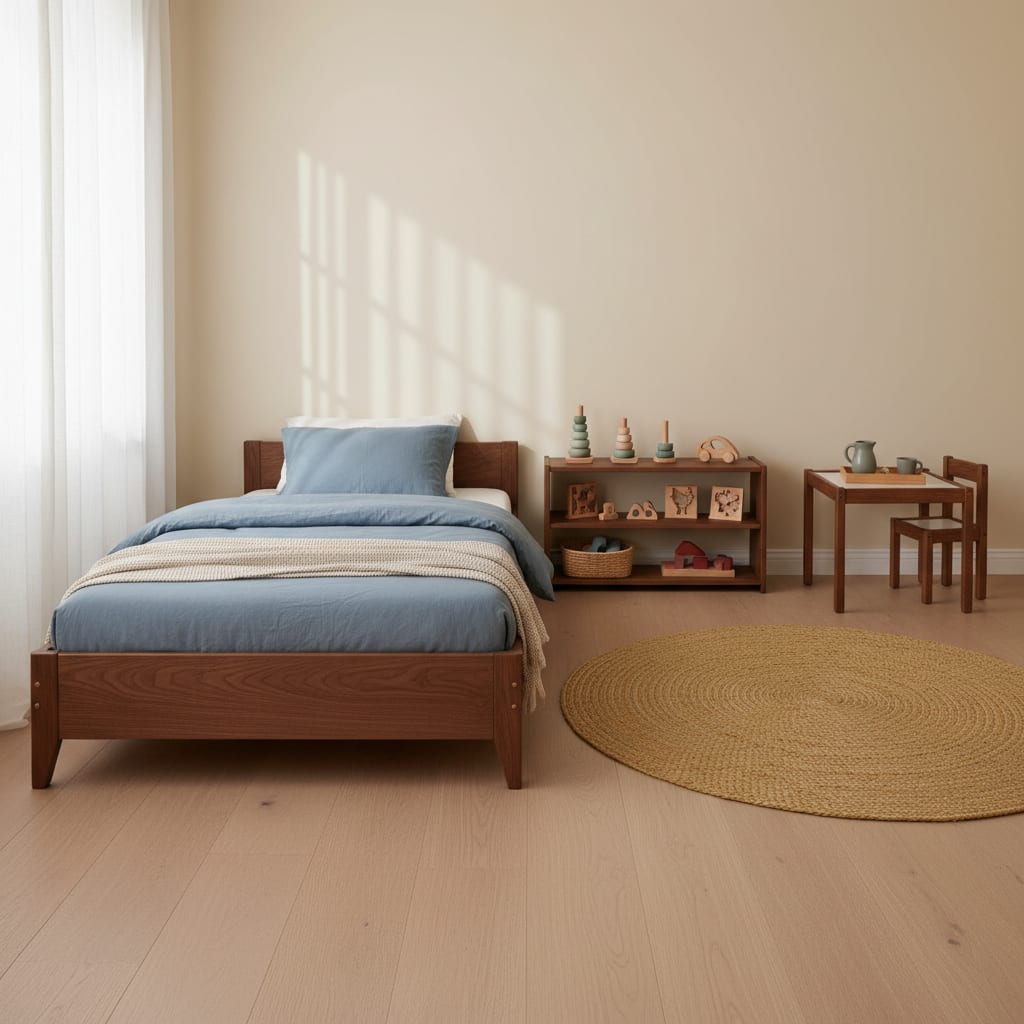
On placement: rug or mat underneath, clear fall zone around, never against a window or a shelf it can be used to summit — the same anchor-everything logic as the floor bed room prep.
The Montessori-way rules of use
Three, and they’re all restraint: don’t put the child on it (they climb what they can climb; ability and ambition stay matched), don’t lift them off the top (teach the climb-down instead — it’s the more valuable skill), and spot without narrating (hover hands if needed; skip the constant “careful!”, which teaches children to check your face instead of their grip). This is free-movement equipment; the freedom is the feature. It also pairs beautifully with a generally movement-friendly room — the philosophy runs from the infant movement area straight up this ladder, and the toy-side version of the same era lives in Montessori toys for a 1 year old.
FAQ: Pikler triangles
What age is a Pikler triangle for?
Roughly ten months to five years: pulling-up and cruising at the young end, full climbing from about 18 months to 3, fort-and-obstacle-course duty after. Most families get three to four solid years of use.
Are Pikler triangles safe?
Used as designed — on a mat, in a clear zone, child climbing by their own power, adult nearby for young climbers — they have a good real-world track record. The risks concentrate in wobbly cheap frames, bad placement, and adults placing children higher than they can climb themselves.
Is a Pikler triangle Montessori?
By origin it’s from Emmi Pikler’s free-movement tradition, not Montessori — but it fits the Montessori home’s logic (child-scaled, self-chosen, skill-building) so well that it’s become a fixture of the movement area. The traditions are friendly neighbors.
Is the ramp worth it?
If the budget allows one accessory, the reversible climb/slide ramp is the one — it roughly doubles the ways the triangle gets used and extends the golden era. Everything beyond that is enthusiast territory.