What a Montessori Floor Bed Actually Requires
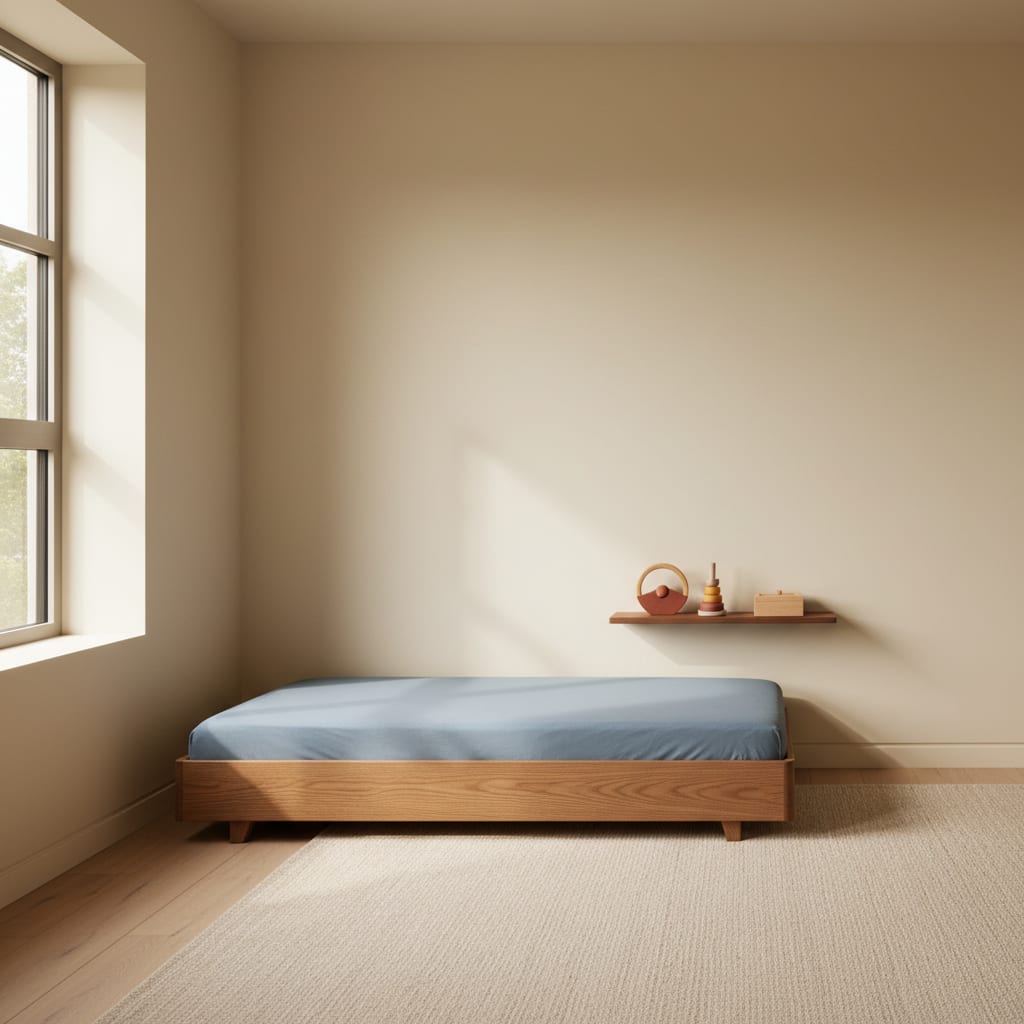
A floor bed requires far more than a mattress on the floor. It requires a room prepared to the standard a crib is held to, a firm flat mattress with nothing soft on it, a child old enough for the arrangement to be appropriate, an adult willing to do calm walk-backs for two weeks, and a household that agrees. It also requires honesty about age: for babies under a year, safe-sleep guidance points to a crib, bassinet, portable crib or play yard meeting federal safety standards — and a floor mattress is not one. Here’s the real list.
Safe sleep sets the floor, not the philosophy
The uncomfortable part first, because a lot of floor-bed content skates past it.
Current American Academy of Pediatrics guidance for the first year is specific: infants sleep on their back, on a firm, flat, non-inclined surface, in a product that meets federal infant-sleep safety standards — a crib, bassinet, portable crib or play yard — with a fitted sheet and nothing else. No pillows, no loose blankets, no bumpers, no positioners. Room-sharing on a separate surface is recommended for at least the first six months.
A mattress laid on the floor is not a regulated infant sleep product, and no amount of Montessori framing changes that. Which means:
- For a baby under about 12 months, a floor bed is not the default recommendation, and it is not a way around safe-sleep rules. If you want one in the first year, that’s a conversation with your pediatrician about your specific room and mattress — not a decision to take from a blog, including this one.
- A floor setup adds its own risks: gaps between the mattress and a wall or furniture where a small body can wedge, an adult-size mattress with adult bedding nearby, drafts and dust at floor level, and a room a mobile baby can reach that a crib would have contained.
- The most common honest path is a crib for the first year and a floor bed once the child is walking confidently. That’s what most of the families I’ve watched actually did, and nobody’s independence suffered for the delay.
If your interest comes from a baby who fights the crib, that’s a different problem with different fixes; a floor bed is not the answer to it. The comparison is laid out properly in floor bed vs crib.
The room has to become the sleep space
The defining requirement. A crib is a boundary; a floor bed hands the boundary to the room, so the room has to earn it. Before a first night, on your knees at child height:
- Every piece of furniture anchored to the wall — dressers, shelves, bookcases. Not “the tall one.” All of them.
- Cords gone or secured: blind cords cleated high, lamp and monitor cords away, outlets covered.
- Windows secured with stops or locks, and nothing climbable beneath them.
- A door plan: a gate at the doorway, or a door handled so the room is the boundary. Decide it before, not at 2 a.m.
- A floor worth landing on — a rug beside the bed, no hard-edged furniture within rolling distance.
- Very little else. A room with four things in it gets slept in; a room with forty gets explored at five in the morning.
The full walk-through is our floor bed safety checklist — run it as an audit, not a skim.
The mattress is where you can’t compromise
Firm, flat, and sized so there is no gap between the mattress and any wall, frame or furniture it touches. A fitted sheet, and for younger children nothing else on the surface: no pillow, no comforter, no toy pile.
A low frame is optional; what it buys is airflow, since a mattress flat on the floor of a humid room can grow mildew underneath. Skip the frame and you lift and air it weekly instead. What a frame must not have is a lip that can trap a limb, or rails that turn the “floor bed” into a low crib with worse sides.
The developmental window is a requirement, not a preference
The arrangement only works when the child can use it: rolling both ways confidently, then crawling or walking well enough to get on and off the mattress deliberately rather than by accident. That’s usually somewhere between around 12 and 18 months, and plenty of families start later at no cost.
The mobility milestones that matter here are the same ones that change what’s safe in the first place — Betteroo’s guide on when babies can safely sleep on their stomach covers the rolling question, which is what most parents are really asking about when they ask about floor beds. For the readiness signs specific to the switch, see when to switch to a floor bed.
Someone has to do the walk-backs
This is the requirement nobody lists, and the one that decides whether the bed lasts. A child who can leave the bed will leave the bed. The job is to walk them back calmly, with the same six words every time, as many times as it takes — no conversation, no negotiation, no new plan on night three.
That’s hard at 11 p.m., and it’s the whole method: consistency is the mechanism, and inconsistency is the only thing that reliably breaks a floor bed. If two adults are in the house, both do it the same way.
It goes better when the timing underneath it is right, because an overtired child tests everything. That layer — wake windows, nap length, where bedtime should sit — is what Betteroo’s sleep app builds into a personalized day-by-day plan from questions about your child and your approach. Fair report from this shelf: it’s good at the schedule math and gentle-method-friendly, which matters to floor-bed families — but it won’t anchor your dresser or walk anyone back at midnight. That part stays yours.
 The room is ready. Is the schedule?
Betteroo builds a personalized, gentle day-by-day sleep plan — wake windows, naps and a bedtime that fits your child's age — so a floor bed isn't competing with an overtired evening.
Take the 2-minute sleep quiz →
The room is ready. Is the schedule?
Betteroo builds a personalized, gentle day-by-day sleep plan — wake windows, naps and a bedtime that fits your child's age — so a floor bed isn't competing with an overtired evening.
Take the 2-minute sleep quiz →
Two boring weeks, and a household that agrees
Budget two weeks of novelty-testing: doors opened, lights found, a toddler asleep on the rug at an angle. Naps wobble longer than nights. That isn’t failure; it’s the transition cost, paid once.
What does mean it isn’t working: six weeks in with no settling trend, or an adult who has stopped sleeping entirely. Pausing and returning in a few months is a legitimate outcome, not a defeat — the sleep half of the picture is in floor beds and independent sleep.
What a floor bed does not require
- A house-shaped frame. The roof does nothing; nor does the canopy.
- A twin mattress. A crib mattress at floor level is a complete floor bed.
- A themed room or a renovation. The requirement is anchoring and emptiness, not aesthetics.
- Anything branded Montessori. No such certification exists — the method is in how the room is used.
- Giving up the crib forever. Plenty of houses use both: crib early, floor bed later.
FAQ: floor bed requirements
Is a floor bed safe for a newborn?
Safe-sleep guidance for the first year points to a crib, bassinet, portable crib or play yard meeting federal safety standards, with a firm flat surface and no soft bedding — a mattress on the floor is not one of those products. Raise it with your pediatrician before deciding.
What do I actually need to buy for a floor bed?
A firm mattress, a fitted sheet, furniture straps, outlet covers, a gate and a rug. A low frame is optional. That list is genuinely most of it.
How long does the adjustment take?
Usually about two weeks of testing before the routine holds, with naps settling later than nights. No improving trend after roughly six weeks is a fair reason to pause and try again later.
Does the room have to be completely empty?
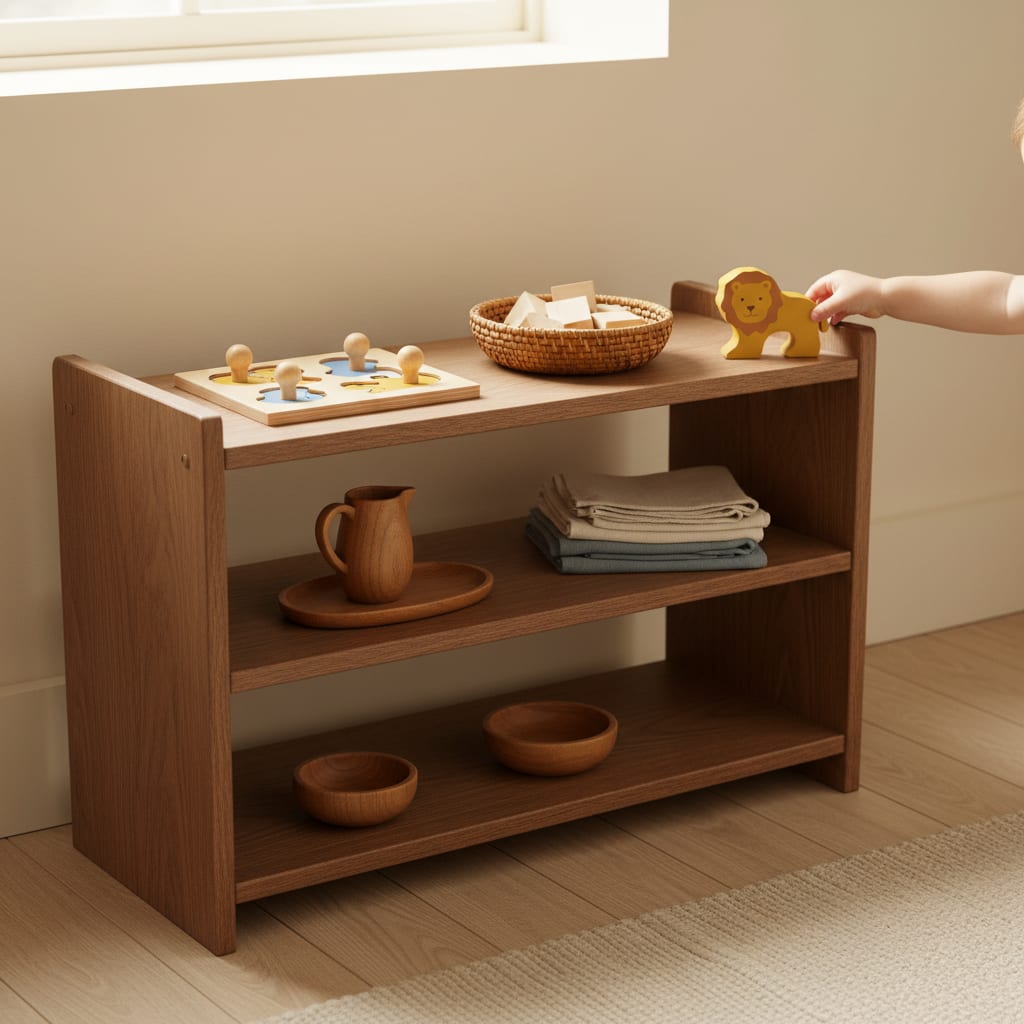
Not empty — sparse. A bed, a rug, a low shelf with a few things, anchored furniture, nothing climbable. The fewer decisions available at 5 a.m., the better everyone sleeps.