Toy Storage in a Montessori Home: What Actually Works
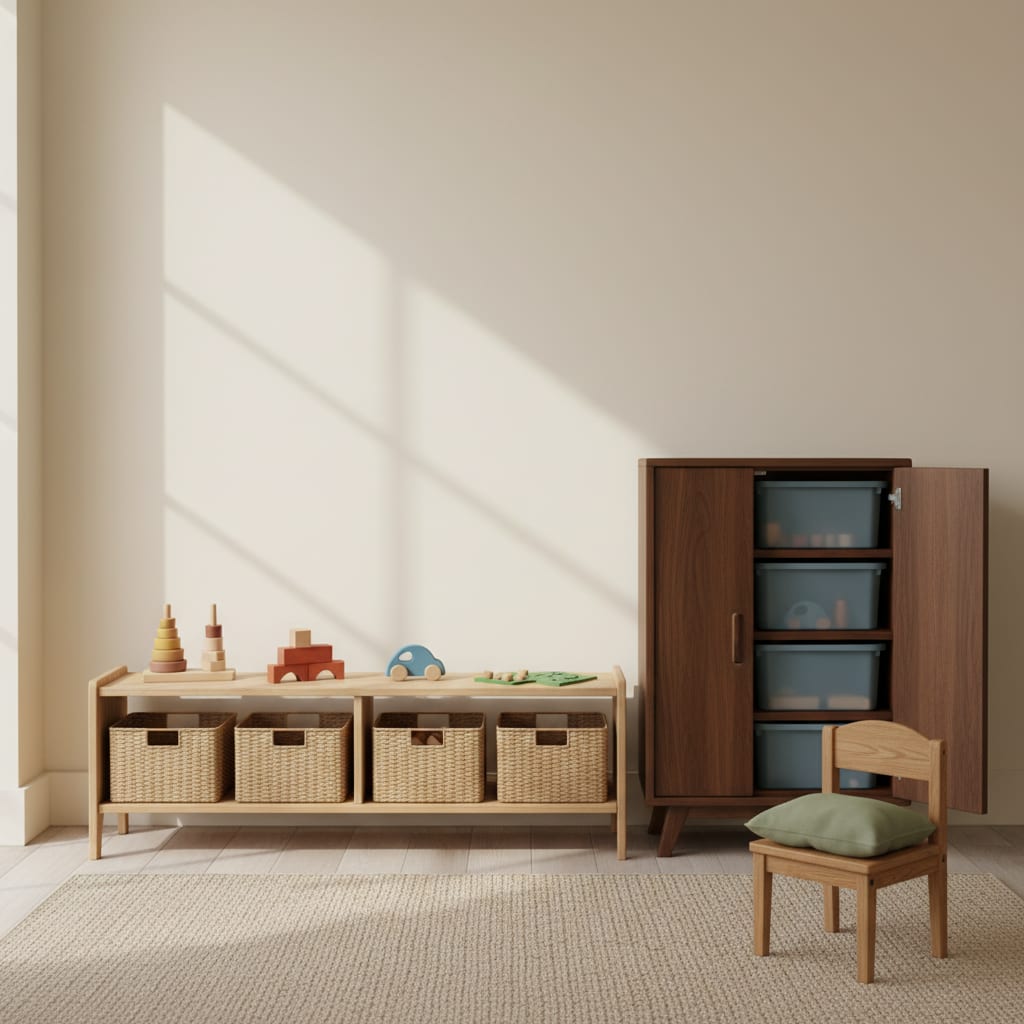
Toy storage in a Montessori home runs on two systems, not one. The first is the display shelf: a low, open shelf at child height holding a small number of toys — six to ten for a toddler is plenty — each visible, complete, and spaced so the child can see and choose. The second is the rotation store: a closed cupboard, high shelf or under-bed box where everything else waits its turn, out of sight. The shelf is for choosing; the store is for everything not currently chosen. Get those two right and the toy chaos problem mostly solves itself.
Why the toy box is the problem
The classic deep toy box fails at the exact job storage is supposed to do: it makes toys findable. A bin of forty toys is really a bin of the top four toys and a substrate of forgotten parts. Children dig, dump, and walk away — not because they’re ungrateful, but because a jumble offers no real choice. A shelf with four toys beats a toy box with forty; I’ve said it so often my four-year-old now says it back to me.
Open, spaced display does three things a box can’t. It lets the child survey their options and choose deliberately. It keeps sets complete, because a puzzle stored as a puzzle gets returned as a puzzle. And it makes tidying a matching game — everything has one home — instead of a shoveling job.
The display shelf: rules of thumb
- Low and shallow. The child should reach the top surface flat-footed and see the back of every cubby. Roughly 24–30 inches tall suits most toddlers; a simple two-shelf unit is enough. You do not need a beautiful oak shelf — a sturdy secondhand bookcase turned sideways has run many a fine toddler room, and simple low units start at roughly $40–100 if you’re buying.
- One toy per spot. Space is information. A toy with air around it reads as an invitation; a crammed shelf reads as a pile.
- Left to right, simple to complex if you want to be classic about it — but honestly, “each thing visible and complete” is 90% of the value.
- Anchor it. Any shelf in a child’s room gets strapped to the wall, with a kit like the QuakeHold furniture strap. Non-negotiable, especially once climbing starts.
- Match the load to the age. What belongs on the shelf changes fast in the early years — our materials-by-age guide and the one-year-old shelf cover the what; this post is the where.
Baskets and trays: the unsung storage layer
Between “shelf” and “toy” sits the container layer, and it does more work than the furniture. A basket turns twelve blocks into one choosable thing. A tray turns a three-part activity into one carryable thing. Rules I actually follow:
- One category per basket. Animals in one, vehicles in another. A “misc” basket is a small toy box and will behave like one.
- Trays for anything with parts that get used together — the tray defines the work and travels to the rug and back as a unit.
- Low sides. The child has to see in from standing height. Deep baskets hide; shallow ones display.
- Natural materials are nice, not required. Woven baskets are lovely; so is the dollar-store plastic tray that survives being dropped. Judge by house use.
The rotation store: where the other thirty toys live
Everything not on the shelf goes somewhere the child doesn’t browse: a closet shelf, a lidded under-bed box, the top of the wardrobe. Out of sight genuinely matters — a visible pile of off-duty toys is an argument waiting to happen.
Store toys in complete sets (zip bags and shoebox-size bins are perfect), and swap when interest goes flat: a toy that hasn’t been touched in a week or two comes off, something stored comes on. Returning toys land like new — the rotation effect is real and it’s the closest thing to free toys you’ll find. If you want the full system, including how many toys to rotate and how often, How We Montessori has photographed a decade of real rotation setups across ages, and The Kavanaugh Report writes honestly about rotation with multiple kids in a normal-sized house.
The overflow: the third pile nobody plans for
Every home accumulates toys that will never earn shelf space — the party-bag layer, the duplicate gifts, the outgrown. Montessori storage advice usually pretends this pile doesn’t exist. It does, and it needs a one-way exit: a donate box in the garage that leaves the house when full. The child can help choose what goes — that’s care of the environment, and it’s easier at two than at four, so start early. Grandparent gifts you can’t bring yourself to exit can live in deep rotation; some of them come back into fashion in a year, and the rest quietly age out of the house.
FAQ: Montessori toy storage
How many toys should be out at once?
For toddlers, roughly six to ten on the shelf works well; preschoolers can handle a few more. The honest test is the floor at the end of the day: if everything comes off the shelf and nothing gets played with twice, there’s too much out.
Do I have to buy a special Montessori shelf?
No. “Montessori shelf” describes a height and a layout — low, open, shallow, spaced — not a brand. Any stable low bookcase, cube unit used without the bins jammed full, or bench with cubbies does the job, secondhand very much included.
Where do I store toys with lots of pieces?
On a tray or in a shallow basket, as one complete set, one set per container. Big sets (the 200-block bin) can live in rotation and come out in partial portions — a basket of twenty blocks plays better than a crate of two hundred anyway.
What about books?
A small front-facing rail or basket with covers visible, a handful at a time, rotated like the toys. The full library can live on normal shelves elsewhere; the display copies are the invitation.