Montessori Toys for a 1 Year Old
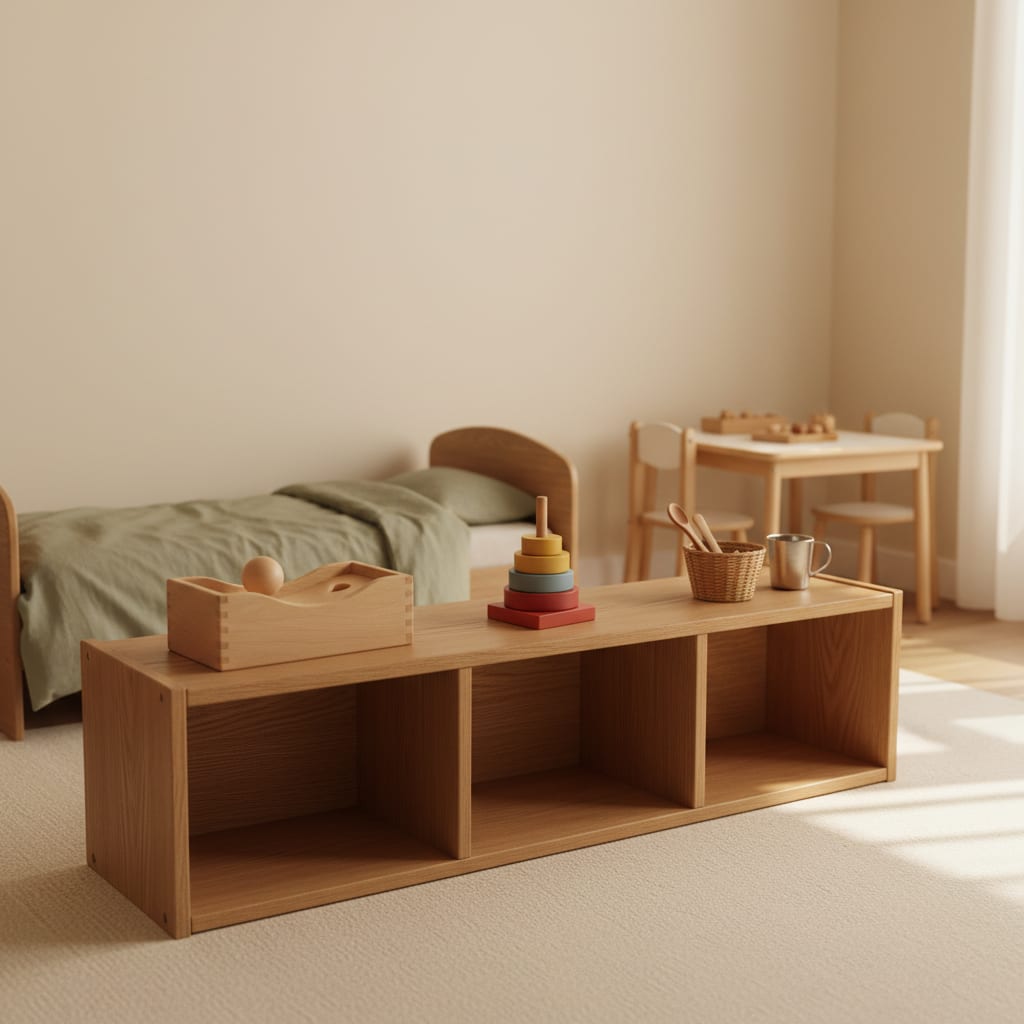
The best Montessori toys for a 1 year old are the ones that let the child do something real and repeatable: an object permanence box, a ball tracker, posting and stacking work (rings on a peg, chunky discs in a slot), a push wagon for the walking project, a first set of nesting cups or blocks, and honest household objects — a basket of real things beats most of the toy aisle. Choose toys where the child supplies the action and the toy supplies the feedback, put out four to six at a time on a low shelf, and rotate. That’s the whole strategy; here’s the annotated version.
What a one-year-old is working on
The year from twelve to twenty-four months is movement mastery (walking, carrying, climbing), hand precision (posting, stacking, opening), and the explosive beginning of language. A good toy at this age is a tool for one of those three jobs. The Montessori filter is simple and ruthless: the child acts, the toy responds — not the reverse. A ball dropped into a tracker rewards the drop; a button that triggers a song rewards nothing but the button. One builds a worker, the other an audience. (If you want the long version of that test, what makes a toy Montessori sets out the four qualities a toy needs all of.)
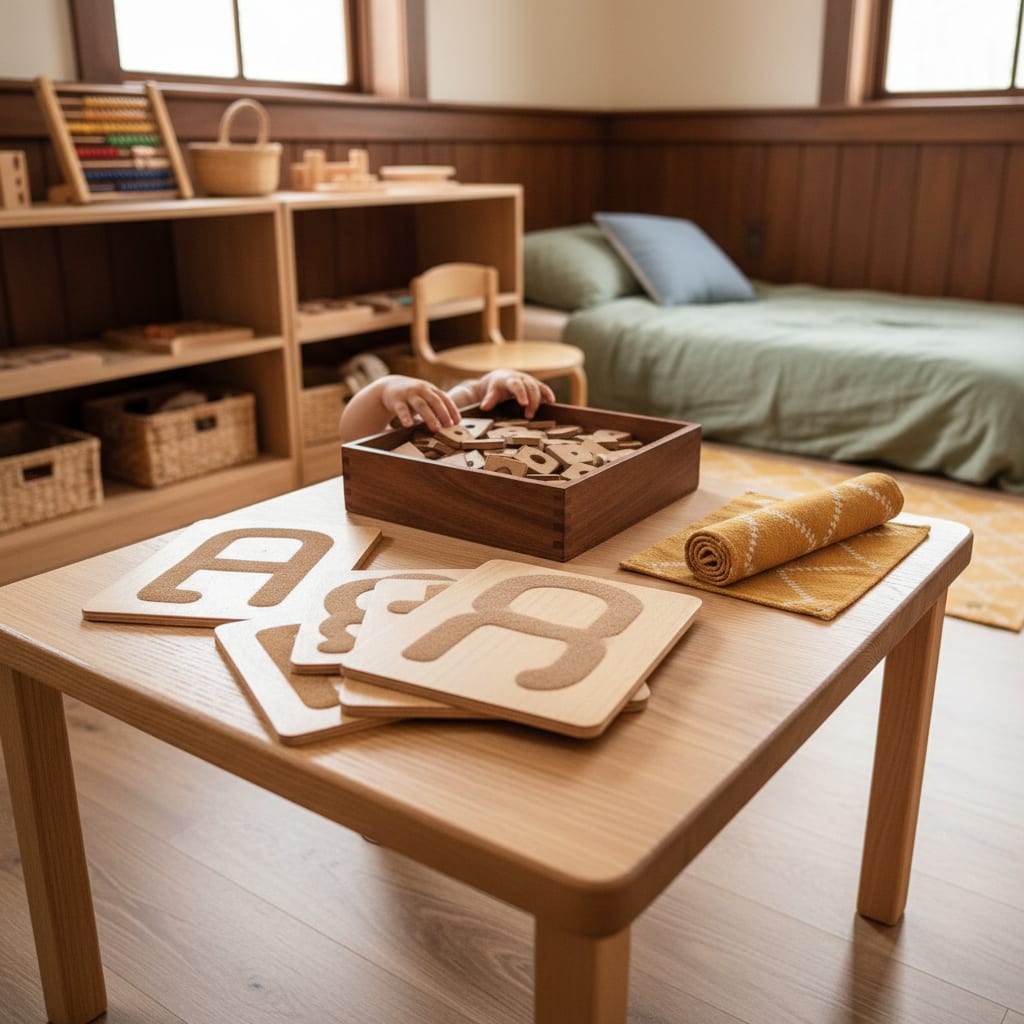
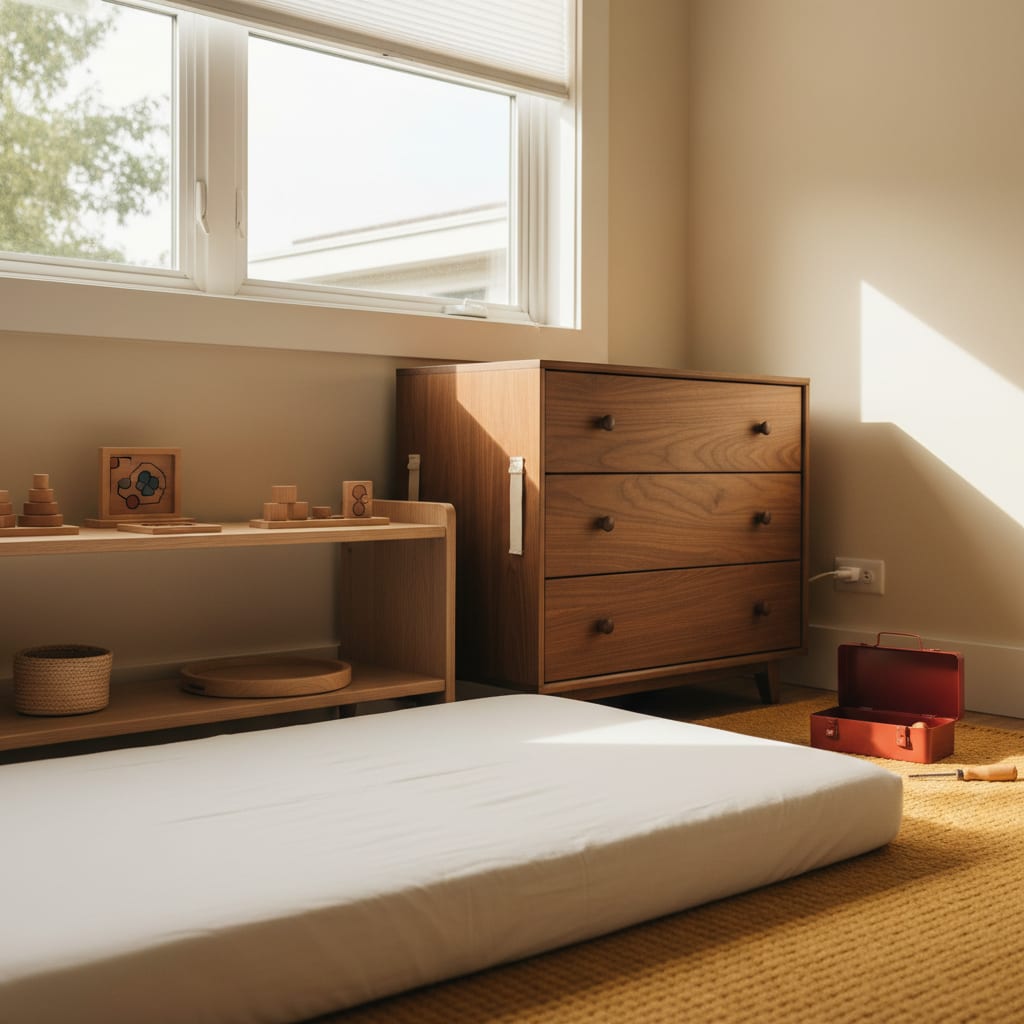
The filter matters more than any specific product below. So does the shelf: four to six choices, face-out, everything else hidden in rotation. A shelf with four toys beats a toy box with forty — it’s the house motto for a reason.
The shelf list, roughly in order of arrival
- Object permanence box — the icon of the age. Ball goes in the hole, vanishes, reappears in the tray; existential relief every time. A muffin tin plus a ball too big to swallow teaches the same lesson for free.
- Ball tracker/roller — drop, watch, retrieve, repeat. The retrieve is half the work at this age.
- Posting work — rings on a vertical peg, chunky wooden discs into a slotted box, thick straws into a bottle. Escalate the precision as the hands get better; homemade versions are often the best ones, provided every piece passes the small-parts check below.
- Nesting/stacking cups or bowls — the longest-serving toy in our house; they became pouring cups, bath toys and block accessories over two full years.
- A push wagon — for the walking project itself; a weighted, sturdy one like the wooden Radio Flyer Classic Walker Wagon, not a flimsy one that outruns its driver.
- First chunky knobbed puzzles — three to five pieces, big knobs.
- The real-things basket — a spoon, a brush, a small metal cup, a scarf, a small wooden bowl. At this age, “toys from the kitchen” is not a compromise; imitation of real life is the actual curriculum, and it flows straight into toddler practical life work.
Books, always, everywhere — sturdy board books in a face-out basket the child can raid alone.
Matching the shelf to the milestones
A useful check on any shelf is whether each item serves something the child is actually doing. The CDC’s “Learn the Signs. Act Early.” checklists for 15 months and 18 months are a fair reference here, with one caveat worth taking seriously: the CDC defines developmental milestones as “things most children (75% or more) can do by a certain age”, so they describe a floor most children have crossed, not a target to coach toward. I use them to sanity-check a shelf, not to grade a child.
| CDC milestone (wording from the CDC pages) | Age listed | What on the shelf serves it |
|---|---|---|
| ”Stacks at least two small objects, like blocks” | by 15 months | Nesting cups, rings on a peg, a few large blocks |
| ”Tries to use things the right way, like a phone, cup, or book” | by 15 months | The real-things basket; a small metal cup; board books |
| ”Takes a few steps on his own” | by 15 months | The push wagon, and floor space to use it |
| ”Plays with toys in a simple way, like pushing a toy car” | by 18 months | Ball tracker, wagon, one simple vehicle |
| ”Copies you doing chores, like sweeping with a broom” | by 18 months | A child-sized brush or broom — the handover to practical life |
| ”Climbs on and off a couch or chair without help” | by 18 months | A low, stable step or climbing piece, if your space allows |
Two things stand out. The second half of the year pulls sharply toward real work — chores, cups, climbing — so the shelf should thin out toys and fill with tools well before the second birthday. And nothing on the list asks for a talking toy. If your child is well behind the list, that’s a conversation with your pediatrician, not a reason to buy more toys.
The small-parts check, because one-year-olds taste everything
The mouthing phase and the posting phase overlap, and that is the one real safety tension on a one-year-old’s shelf. The American Academy of Pediatrics’ choking-prevention page lists the household items to keep away from infants and children, and several are exactly the things homemade Montessori posting work tends to use: “Coins”, “Marbles”, “Small balls”, “Toys with small parts”, and “Toys that can be squeezed to fit entirely into a child’s mouth”. It also asks parents to “Follow the age recommendations on toy packages”, because those age guidelines “are based on any possible choking hazard, as well as a child’s physical and mental abilities at various ages.”
In practice, for a Montessori shelf:
- Posting pieces should be chunky, never coins, beads or pom-poms. A big disc in a big slot teaches the same precision.
- Check under the shelf, too. The same AAP page tells parents to check “under furniture and between cushions” for coins, small toys and batteries, and a low open shelf is exactly where an older sibling’s pieces end up.
- An older sibling’s shelf is not a one-year-old’s shelf. The AAP notes that many choking incidents happen when older siblings hand small objects to a younger child. If you have a four-year-old with bead work, it needs a home the toddler can’t reach.
What to skip at one
Flashing/singing “learning” toys (the toy does the work, the child does the watching), activity cubes with six busy sides (six invitations to concentrate on nothing), walkers that hold the child up (the push wagon’s honest cousin — let the child hold themselves up), and anything screen-adjacent. None of it is poison; all of it is noise, and noise is the enemy of the ten-minute concentration stretch you’re trying to protect.
If you’re weighing subscription play kits against building your own shelf, I’ve written that comparison up separately in the Lovevery Play Kits review — the short version: the kits are well-designed and you’re paying for curation you can do yourself with lists like this one. For what came before this age, see Montessori toys for 0–6 months; for where the shelf goes next, Montessori toys for 2 year olds. And for endless age-by-age activity ideas from a certified source, Living Montessori Now remains the deepest archive on the internet.
FAQ: Montessori toys for one-year-olds
What makes a toy “Montessori” for a 1 year old?
The child performs the action and gets honest feedback: the ball drops, the ring stacks, the wagon rolls when pushed. Single purpose, real materials where possible, no batteries doing the child’s job. Plenty of great “Montessori” toys are ordinary household objects.
How many toys should a 1 year old have out?
Four to six on a low shelf, the rest rotated out of sight. Toddlers choose more deeply from fewer options — and “old” toys return from rotation with their novelty restored.
Is an object permanence box worth it?
It’s the single most-loved purchase of this age in most Montessori homes, ours included — though a muffin tin and a large ball teach the same peekaboo physics free. Buy it for the joy, not the necessity.
Are wooden toys required?
No. Wood earns its place by weight, durability and honest sensory feedback, not by ideology. A plastic nesting-cup set that gets used daily is a better toy than a walnut heirloom that doesn’t.