What Makes a Toy Montessori (and What Doesn't)
A Montessori toy is a real object with one clear purpose, made so the child can see and correct their own mistake without an adult saying anything. That’s the whole definition. It is not “wooden”, not “beige”, not “expensive”, and — most importantly — not a category any seller has to qualify for, because no certification exists. Most items marketed as “Montessori-inspired” borrow the look and skip the design. Here’s how to tell the difference, and where to go for the actual list at your child’s age.
What actually makes a toy Montessori
Four qualities, and a toy needs all four rather than most.
One purpose, done properly. A Montessori material does a single thing: it posts, it stacks, it threads, it nests. A cube that also flashes, sings and sorts shapes has no purpose — it has features, which is the opposite. Single purpose is what lets a child set themselves a goal and know when they’ve reached it.
Control of error built into the object. The defining property, and the one nearly every knock-off drops. The cylinder that only fits one hole, the puzzle piece that only seats one way, the ring stack that looks wrong when it’s out of order. The material corrects the child so the adult doesn’t have to, which is why a two-year-old will repeat it thirty times without being praised into it.
Grounded in reality. Real weight, real consequence, real proportion. A small glass pitcher that pours and can break teaches something a plastic one cannot. Animals are recognisable animals, not pastel abstractions with faces.
Sized and weighted for the actual child. Liftable, reachable, restorable to the shelf by the child alone. A material a child cannot put away by themselves is an adult’s toy that a child is allowed to touch.
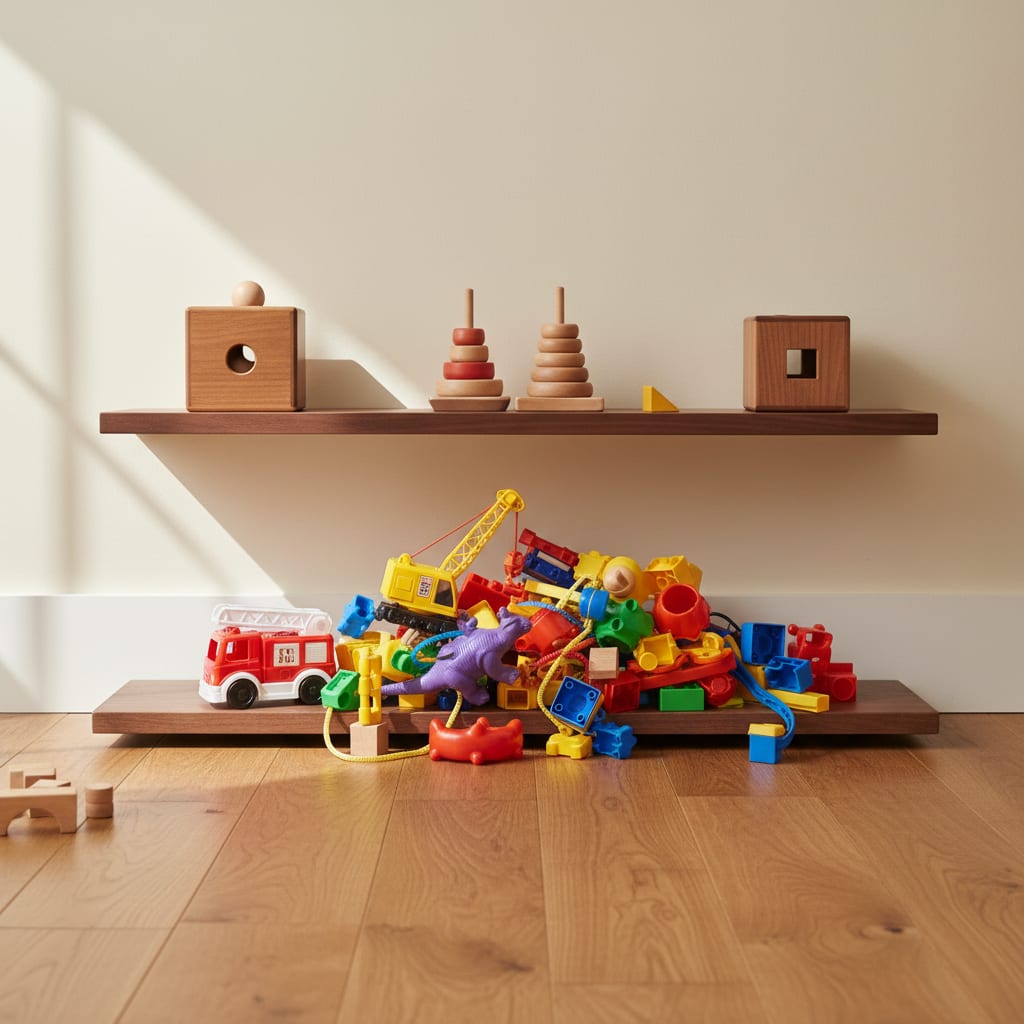
Add one non-negotiable that isn’t about the toy at all: it has to be on a low, open shelf with only a few other things, not in a box. The best material in the world is invisible at the bottom of a toy bin.
”Montessori-inspired” is a marketing phrase, not a category
Worth saying bluntly, because it’s the honest answer to the question most people are actually searching.
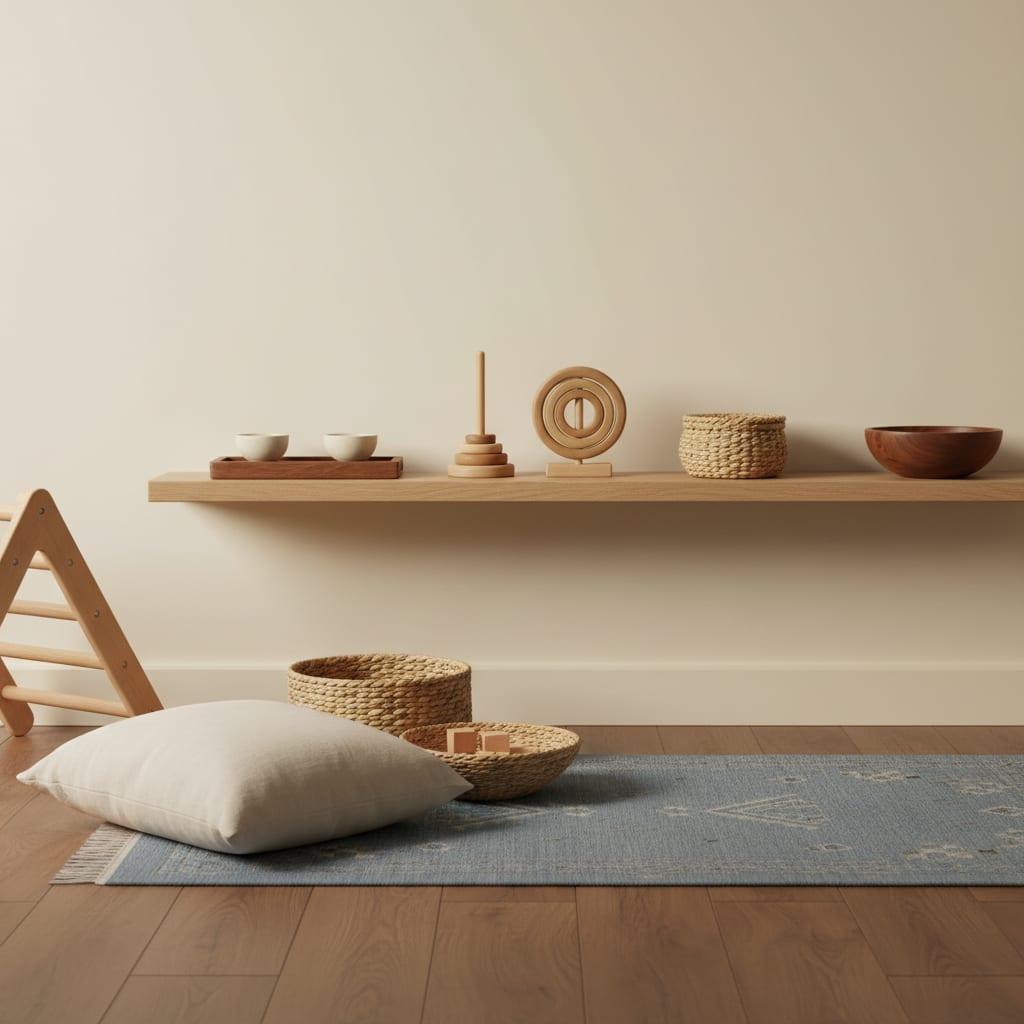
“Montessori” is a generic term in US trademark law — a 1960s ruling settled that — so it can be printed on anything. “Montessori-inspired” is looser still: it’s a description of styling. In practice it usually signals plain wood, muted colours and a photograph taken on an oak floor. None of that is the method, and a fair number of items sold under it are ordinary toys with a markup for the adjective.
Some of them are also genuinely good. The phrase isn’t a red flag, it’s just not information. Judge the object by the four qualities above and ignore the packaging entirely.
The three things that disqualify a toy
Faster than the positive test, most of the time:
- It does the work. Batteries, lights, sound, anything that performs while the child watches. The rule of thumb that has never let me down: if the toy is doing something, the child isn’t.
- It has no wrong answer. If every arrangement is equally correct, there’s no control of error, so there’s nothing to master and nothing to repeat.
- It can’t be restored alone. Ninety pieces, no container, or a size the child can’t carry back. It will be played with once and tidied by an adult forever.
Two things people wrongly treat as disqualifying: plastic, which is fine when it’s the right material for the job, and cheapness. A set of measuring cups and a jug of dry rice outperforms most of what’s sold as a material.
Where to go for the actual list, by age
This post is the definition; the buying decisions are age-specific, because the whole point is matching the object to the window the child is in. Four lists, and one of them is yours:
- 0–6 months — visual mobiles, the first grasping objects, and a much shorter list than any registry suggests: Montessori toys for 0–6 months.
- Around one — posting, object permanence, pushing and the first real-work substitutions: Montessori toys for a 1 year old.
- Two and up — practical work, language objects, puzzles and big movement, plus what to retire: Montessori toys for 2 year olds.
- Buying wooden anything — the durability and value questions, and the wooden toys that aren’t worth it: wooden toys worth buying.
If you only read one, read the one for the age you have. Buying a stage ahead is the most common and most expensive mistake in this whole category.
One worked example
To make the four qualities concrete: the object permanence box, the small wooden box with a hole in the top and a drawer or tray that catches the ball.
One purpose — the ball goes in and comes back. Control of error — either it’s in the hole or it isn’t, and the ball reappears or it doesn’t; nobody has to say “well done”. Reality — a solid ball with real weight, and an actual cause-and-effect that holds every single time. Sized right — a baby around eight or nine months can operate the whole thing sitting down and can carry it.
Adena’s solid-wood object permanence box is the version I’ve seen survive two households; it comes with balls in different materials, which extends its life by a few months. Any box built the same way works identically — the design is the point, not the brand.
What you don’t need to buy
- A “Montessori toy set.” Bundles are a merchandising unit. The method is four things on a shelf, rotated.
- A subscription, necessarily. They solve the choosing problem, not the learning problem, and they’re the most expensive way to acquire wood.
- Anything for a stage that hasn’t arrived. Materials sitting unused for eight months lose their novelty before their window opens.
- Duplicates in prettier wood. The one you already own is working.
Almost everything else can be rotated rather than added. Four to eight things out at a time, the rest away, swapped when interest drops — a rotation habit will save you more money than any buying guide.
FAQ: Montessori toys
What are Montessori toys?
Real, simple objects with a single clear purpose and a built-in way for the child to see their own error — a posting box, a ring stack, a set of graded cylinders — kept on an open shelf where the child can choose and return them independently.
What is the difference between Montessori and Montessori-inspired toys?
Nothing legally, since neither term is protected. In practice “inspired” tends to describe styling — plain wood, muted colours — rather than the design principles, so check the object for single purpose and control of error regardless of the label.
Are all wooden toys Montessori toys?
No. Wood is common in Montessori materials because it’s durable and has real weight, but a wooden toy with nine functions and no wrong answer is not a Montessori material. Plenty of plastic items — measuring cups, a small pitcher, nesting containers — work better.
Do Montessori toys have to be expensive?
No, and the method was invented for families with nothing. Household objects, a rice-and-scoop tray and a few well-chosen materials cover the first two years; the cost comes from buying a set rather than a shelf.
How many toys should be out at once?
Four to eight, spaced on an open shelf, with everything else stored and rotated in when interest drops. A crowded shelf gets ignored the same way a toy box does.