Bedtime After a Cast Comes Off: A Montessori Room Guide
When a cast comes off, expect the first free nights to be busier: a child who has been held still for weeks will roll, kick, stretch the limb, get up to look at it and try things the cast used to stop. The Montessori answer is to change the room rather than police the child. Ask the clinic what is off-limits and for how long, put those things out of the room for that window, make everything that is allowed easy to reach, and keep the rest of bedtime exactly as it was.
I set up shelves in a toddler community for three years and hold no guide’s diploma, and I am not a clinician either. Everything below is about the room. Anything about the limb itself belongs with whoever removed the cast.
What the first free weeks tend to look like
Discharge handouts from children’s hospitals describe a consistent picture. UCSF Benioff Children’s care-after-cast-removal page says it is normal “for there to be some discomfort in the bones and joints that were immobilized, for the arm or leg to be smaller than the other side, and for the skin to have some changes (dry skin and more hair)”. It adds that “It is common for children to limp for a few weeks after a leg cast is removed”.
Rady Children’s cast-removal guidance says the same about stiffness — “It is not unusual for joints to be stiff and to not move easily immediately following cast removal” — and then says something that could have been written for this site: “Active children provide their own therapy. Be patient and do not push them to increase activity until they are ready.”
Both halves matter: the child’s own movement does the work, and the adult neither stops it nor hurries it.
Freedom of movement, and whose limits
The American Montessori Society describes Montessori classrooms as “carefully and thoughtfully designed to encourage children to move about freely and choose their own work, within reasonable limits of appropriate behavior”, and its core components page states the simplest ground rule there is: children “may not harm the material, themselves, or others.”
That is the right frame for these weeks, with one change. Normally the limits in a Montessori home come from the adult who prepared the room. For a few weeks after a cast, some of them come from the clinician. UCSF’s handout says children “should avoid jumping, climbing, running or activities with a high risk of falling for a period of time after the cast is removed” and that “Your doctor will give you specific instructions on the amount of time”. Rady puts a rough length on it for vigorous activity — “about the amount of time that the patient was in the cast” — while noting that “Other specific restrictions may be given by your physician”.
So the limit is not yours to invent or mine to guess. Your part is to make the room carry it: a limit that lives in the furniture needs no repeating, while one that lives only in your voice turns bedtime into a negotiation. Montessori doesn’t have a position on fractures — nobody should claim it does — but “arrange the environment so the rule enforces itself” is about as close to its core as anything gets.
What changes in the room
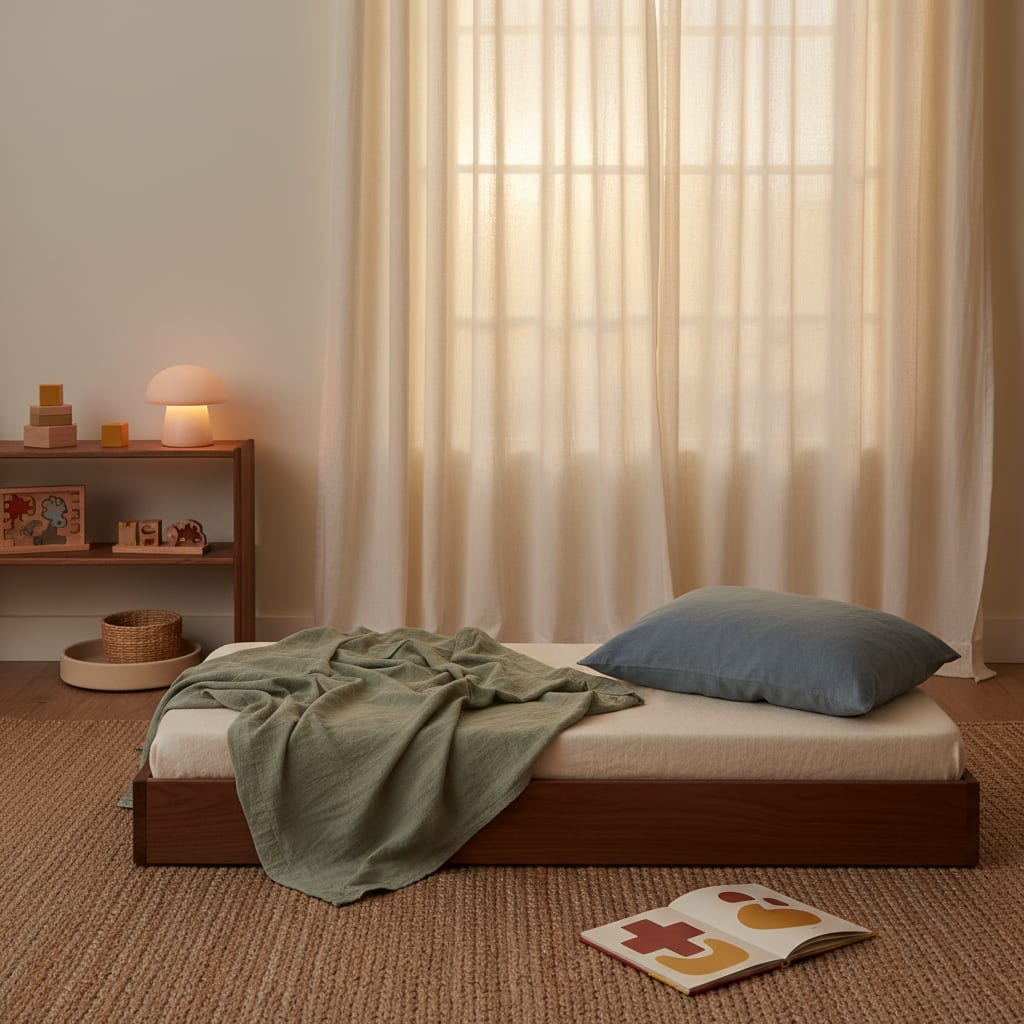
Treat this as a temporary edit to a room you already know, not a redesign. If you want the full room baseline first, the Montessori bedroom setup post covers the four zones this list assumes.
- Take the climbing things out for the window the clinic names. A Pikler triangle, a step stool left beside the bed, a sturdy box that doubles as a ledge. If climbing is off-limits, the room should not be offering it at 7pm.
- Look hard at anything that goes up. A child who was climbing out of a crib before the cast is, by definition, climbing. A top bunk has a ladder. If either applies and the clinician has ruled out climbing, raise it with them rather than solving it with a late-night bed swap — the crib to top bunk post covers why bunks are a separate question at this age anyway.
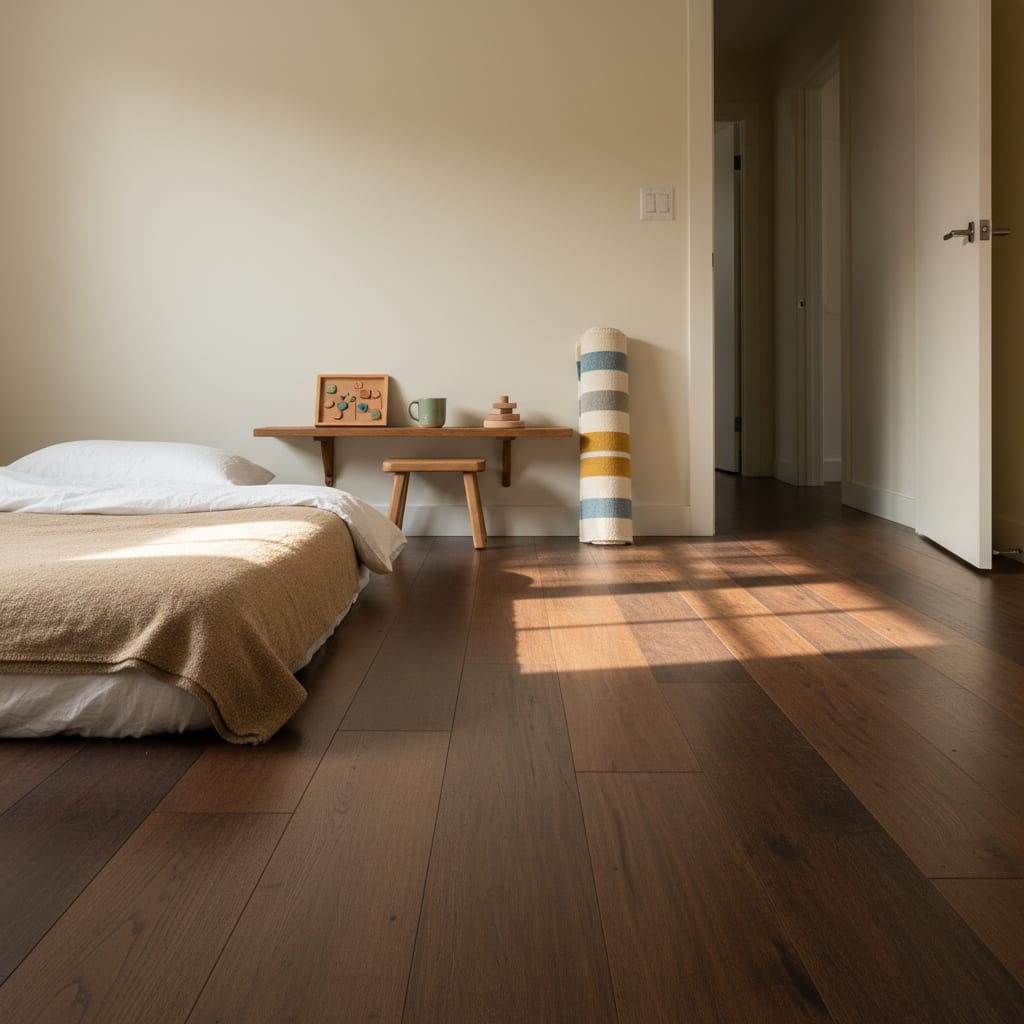
- Clear the path to the door. If it was a leg cast, the walk to your room at 2am is a stiff, possibly limping walk in the dark. Rugs flat or rolled away, toys off the floor between bed and door, the door left at the width your child already knows.
- Light the path, warmly. A low plug-in night light near the floor shows the route without waking the room. Betteroo’s explainer on which colour of light disturbs sleep least makes the case for red or amber over white; an amber unit like the GE SleepLite plug-in night light switches itself on at dusk.
- Re-run the floor-level audit. A child who can suddenly kick and roll will reach corners of the bed space they could not reach for weeks. The knee-height pass in the floor bed safety checklist takes ten minutes and catches the cord or gap that was never in range before.
What the child will do, and what to allow
Expect the limb to become the evening’s main work. Children look at it, touch the new skin, flex and point, compare it with the other side, and want to show you. Much of this happens in bed, because bed is the first quiet moment of the day.
Allow it. Rolling, kicking under the covers, stretching, getting in and out of the floor bed on their own, walking to the bathroom by themselves — this is ordinary movement, and it is exactly what Rady’s “provide their own therapy” describes. Stopping it is not your job, and neither is turning it into exercises; any the clinician gave you belong earlier in the day, not in the last ten minutes before sleep.
Give the jobs back, too. A child in an arm cast has usually had a lot done for them: pyjamas pulled on, covers straightened, the water cup carried. The first week after is the moment to hand those back, one at a time, at the pace the child sets.
Bedtime timing may need a look as well, because a week of sitting still and a week of running about are not the same day. Betteroo’s guide to the drive to sleep that builds while a child is awake explains how it accumulates across waking hours and what too little or too much of it looks like at lights-out; if settling time moves, look at the clock before you change anything else. A fortnight of notes in the two-week sleep log will show whether it has actually moved.

When it is not a room question
Both handouts name the point at which you stop adjusting furniture and call the clinic. UCSF: “If the limping becomes worse, not better, over the first 2 weeks, or if the pain persists, you should return to be rechecked”, and “Children who do not regain normal motion after a month or two should be rechecked.” Rady tells parents to notify the physician if the child “Has open sores in the area where the cast was” or “Has increased pain not relieved by Tylenol.”
The night-time version is a child waking in pain or getting worse week on week. That is a clinician conversation, however calm the room is.
FAQ: bedtime after a cast comes off
Should I stop my child climbing out of bed now the cast is off?
Getting in and out of a floor bed is ordinary movement. Climbing over rails, up ladders or onto furniture is what hospital handouts restrict for a while, and your clinician sets how long.
My child won’t stop moving the limb in bed. Is that a problem?
Usually not — it is what the Rady handout means by children providing their own therapy. What matters is direction: more pain, more limping or less movement over time is a reason to call the clinic.
Does Montessori say anything about casts or injuries?
No, and anyone presenting a Montessori doctrine on fractures is improvising. What the tradition offers is the prepared environment and freedom within limits — which is why this post is about what is in the room, and leaves the limits themselves to the person who treated your child.