Crib to Top Bunk: Age, Safety and the Montessori Room
If your child has just come out of a crib, the top bunk is not the next bed. The American Academy of Pediatrics is unambiguous: “Do not allow a child younger than 6 years to sleep in the top bunk.” The federal bunk-bed standard says the same in the warnings every set must ship with. A child leaving a crib is usually between eighteen months and three and a half, which puts the upper bunk two or three years away. The bunk can stay in the room. The child sleeps on the bottom.
That is the safety answer. Underneath sits the interesting question: what a Montessori room offers a child plainly ready for something they cannot yet have. I set up shelves in a toddler community for three years and hold no guide’s diploma, so take the pedagogy as framing and the sourced sections as the part that decides tonight.
Six is not a rounding error
The AAP, on HealthyChildren.org: “Children love bunk beds, but they can be dangerous. The child in the top bunk can fall out, and the child in the lower bunk can be injured if the upper bunk collapses.” Then the age line, because “a child younger than 6 years does not have the coordination to climb safely or to keep from falling out.”
The federal side is regulation, not advice. 16 CFR Part 1213 requires six safety warnings in the instructions with every bunk bed set. The first: “Do not allow children under 6 years of age to use the upper bunk.” The others cover guardrails both sides, no horseplay on or under the beds, one person up top, using the ladder, and the full-length guardrail against the wall to prevent entrapment. A permanent warning label must sit inside the upper bunk’s end structure, “in a location that cannot be covered by the bedding.”
One definition decides whether this applies to your bed: a bunk bed is “a bed in which the underside of any foundation is over 30 inches from the floor.” Children’s beds fall under Part 1513 rather than 1213, which states the two are “substantively identical.” The under-six warning is not one cautious manufacturer — it is the language the law puts in the box.
Why the crib is the giveaway
Nobody leaves a crib on their sixth birthday. The exit happens when a child climbs out, outgrows it, or a sibling needs it — usually between eighteen months and three — so if the crib is the bed you are leaving, the age question is answered before you ask it. The child often is ready for more freedom, and that readiness is real. It is not evidence about coordination at 2am, on a ladder, half asleep.
What Montessori actually offers here
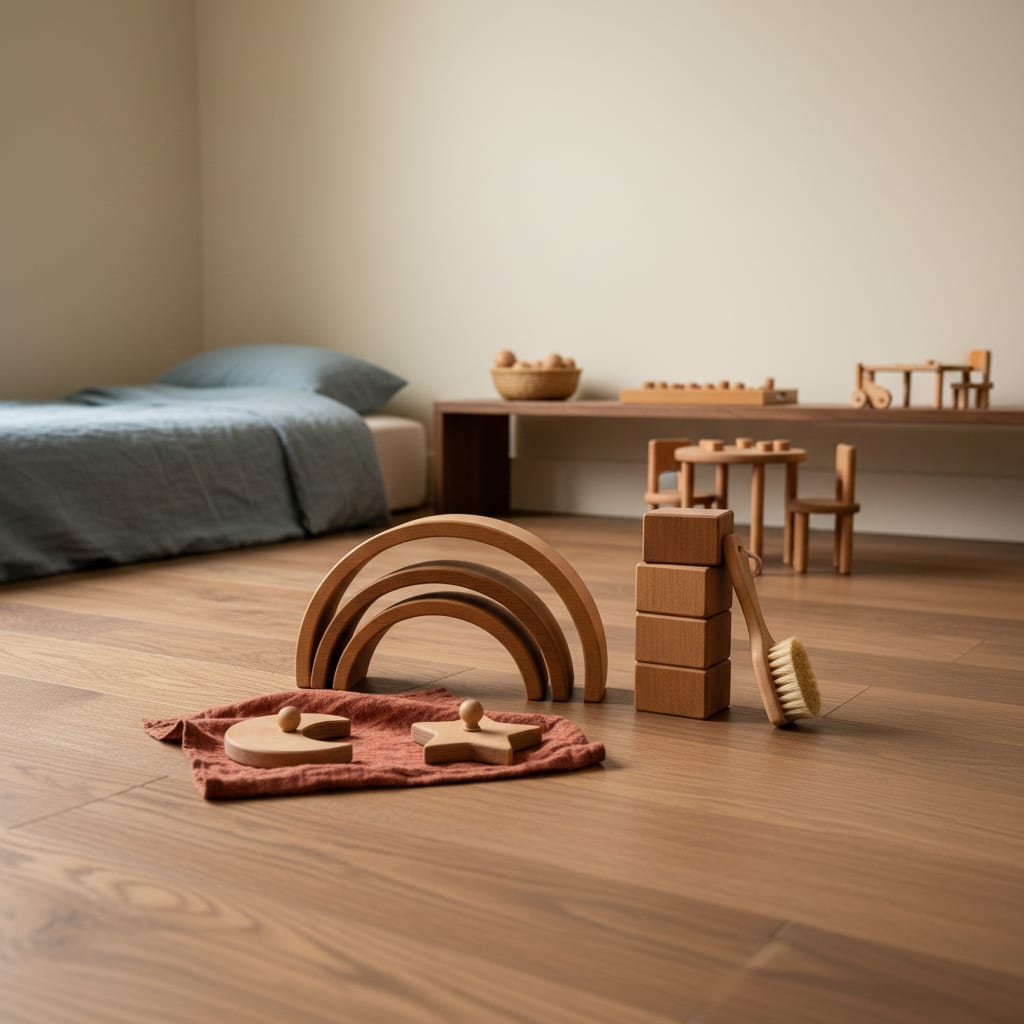
Montessori wrote no doctrine on bunk beds, and anyone who says otherwise is selling furniture. What the tradition supplies is a way of reading the situation. The American Montessori Society defines the prepared environment as one whose materials are “presented sequentially to meet the developmental needs of the children using the space”, and freedom within limits as a space designed “to encourage children to move about freely and choose their own work, within reasonable limits of appropriate behavior.” The limit lives in the room’s design rather than an adult’s vigilance — a floor bed being the classic case, since there is nothing to fall from.
One coincidence needs defusing. AMS describes the planes of development as beginning with ages 0–6, “the period of the absorbent mind,” and opening a new plane at six, “the period of reasoning and abstraction.” The guidance draws its line at the same number. That is arithmetic, not a finding: the planes were observations about learning, not about falls, and the age-six rule rests on coordination rather than pedagogy. Both see a real change around then; only one governs a ladder.
The bed that solves this tonight
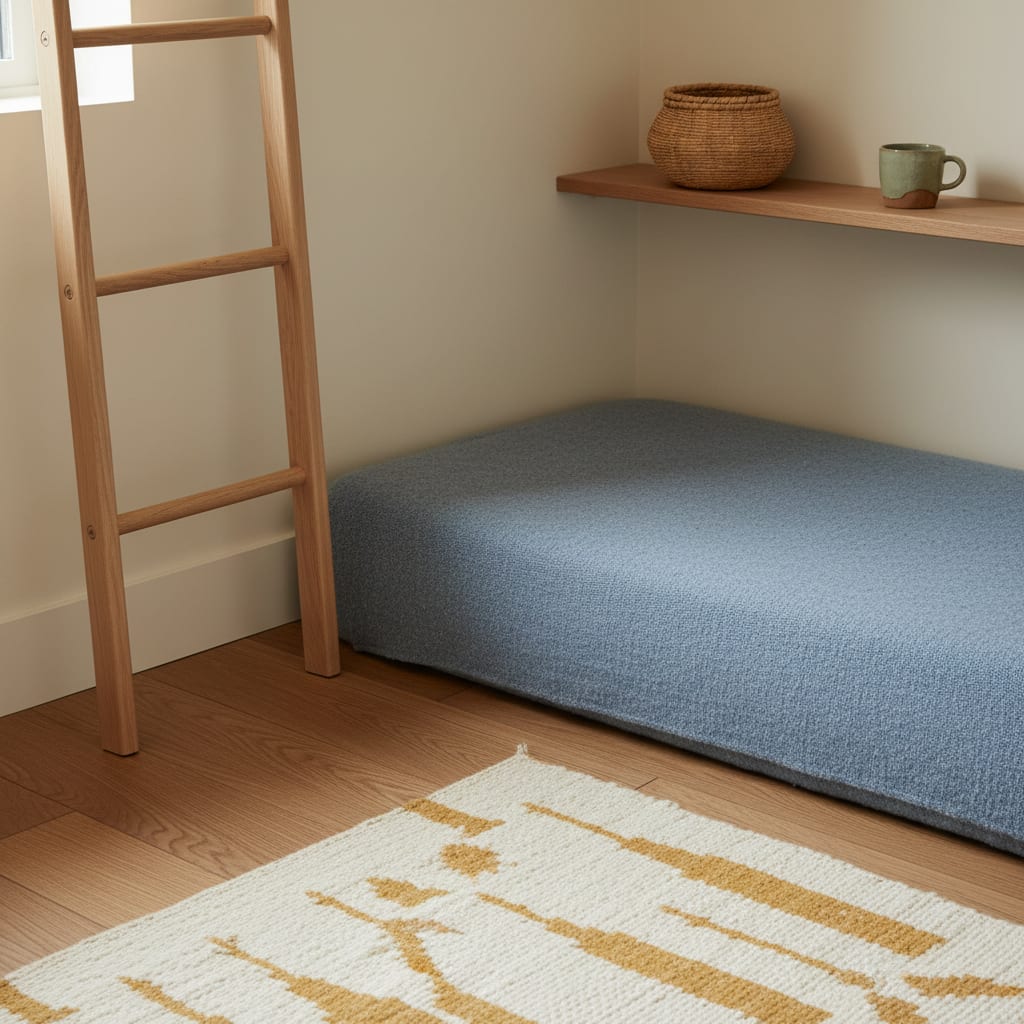
The move most families want is available tonight: the bottom bunk. Many designs — including those sold as Montessori bunks — put the lower mattress on or near the floor, making it a floor bed with a ceiling. Nicole Kavanaugh, writing about her family’s shared Montessori bedroom, notes that “the bunk is very short and that the bottom bunk is a floor bed.” That is the structural idea in a sentence: buy the bunk if the room needs it, and let the younger child use the half that suits them. Families make different calls about the top bunk than the published guidance does, and you will see those calls on Montessori blogs; this site follows the guidance.
The rest is what makes any floor bed work — clear floor, low shelf, nothing climbable at a window, everything needed at night within reach. The floor-bed safety checklist runs that sweep; the crib-to-floor-bed transition covers the first fortnight; and where the bunk exists because two children share a room, room-sharing to an own room handles who settles first.
If your child is already six
Then the question is the bed, and the AAP list is a walk-around:
- Corner it. Walls on two sides brace the frame and remove two of the four edges a child can fall from.
- Guardrails both sides, at the right height. Two minimum, one per side, upper edge no less than 5 inches above the mattress at its maximum specified thickness. The AAP adds a gap check — no more than 3½ inches between guardrail and bunk side — and says to press the mattress down with your own weight, checking a sleeping child cannot roll underneath.
- Check the mattress fits and is supported. Snug in the frame, on wires or slats running directly underneath and fastened at both ends — one held by the frame alone can drop through.
- Light the ladder. It must be attached, and the AAP calls for a night-light “so your child can see the ladder.” A dimmable plug-in unit like the GE Ultrabrite lights the rungs, not the room.
- Two rules, said once and meant. One person up top, and no playing on or under the beds.
The first two weeks in any new bed
A bed change reads like a regression for a fortnight and usually isn’t: more getting up, later settling, one night that undoes your confidence. Change the room once, hold it steady, and walk the child back with the same few words each time. Two things help. A predictable order of operations at bedtime — Betteroo’s toddler bedtime routine guide is a reasonable template if yours has drifted — and a light cue the child can read alone in the early morning. Betteroo’s write-up of what an ok-to-wake clock does and doesn’t fix is honest about the limits, which is why I link it rather than a product page. A clock moves the information into the environment — the same manoeuvre as the floor bed, the limit becoming a fact about the room rather than an adult’s judgement.
 New bed, broken nights?
Betteroo builds a gentle, personalized sleep plan around your child's age — bedtime, nap changes and wake windows — so a bed change isn't landing on an already overtired evening.
Take the 2-minute sleep quiz →
New bed, broken nights?
Betteroo builds a gentle, personalized sleep plan around your child's age — bedtime, nap changes and wake windows — so a bed change isn't landing on an already overtired evening.
Take the 2-minute sleep quiz →
When to ask someone else
Assembling a bunk with the instructions in front of you is a job you can do; judging a second-hand frame is not. If the bed came without instructions, without its permanent label, or with guardrails clearly bought separately, find the manufacturer’s documentation before anyone sleeps in it. If the trouble around the move is distress rather than delight, that is a pediatrician conversation.
FAQ: cribs, bunks and the room in between
My four-year-old is very capable. Is six really a hard line?
The guidance carves out no exceptions, and the reason is the condition it is written for: half asleep, in the dark, on a ladder, hours after the coordination you watched at 4pm. You would be departing from both the AAP and the regulation, on your own judgement, for a bed available in two years anyway.
Does a bunk bed make a room un-Montessori?
No. The interest is whether a child can get in and out of bed unaided, see their own things and manage their own night. A low bottom bunk does all three; a three-foot ladder does not, under six — the same reason we favour floor beds over cribs. When to switch to a floor bed covers the readiness signs.
What about a loft bed with a desk underneath?
Same rule, same reason: the definition is about height — any foundation more than 30 inches off the floor — so a loft bed is a top bunk without the bottom one.