Montessori Bedroom Setup: A Realistic Room Guide
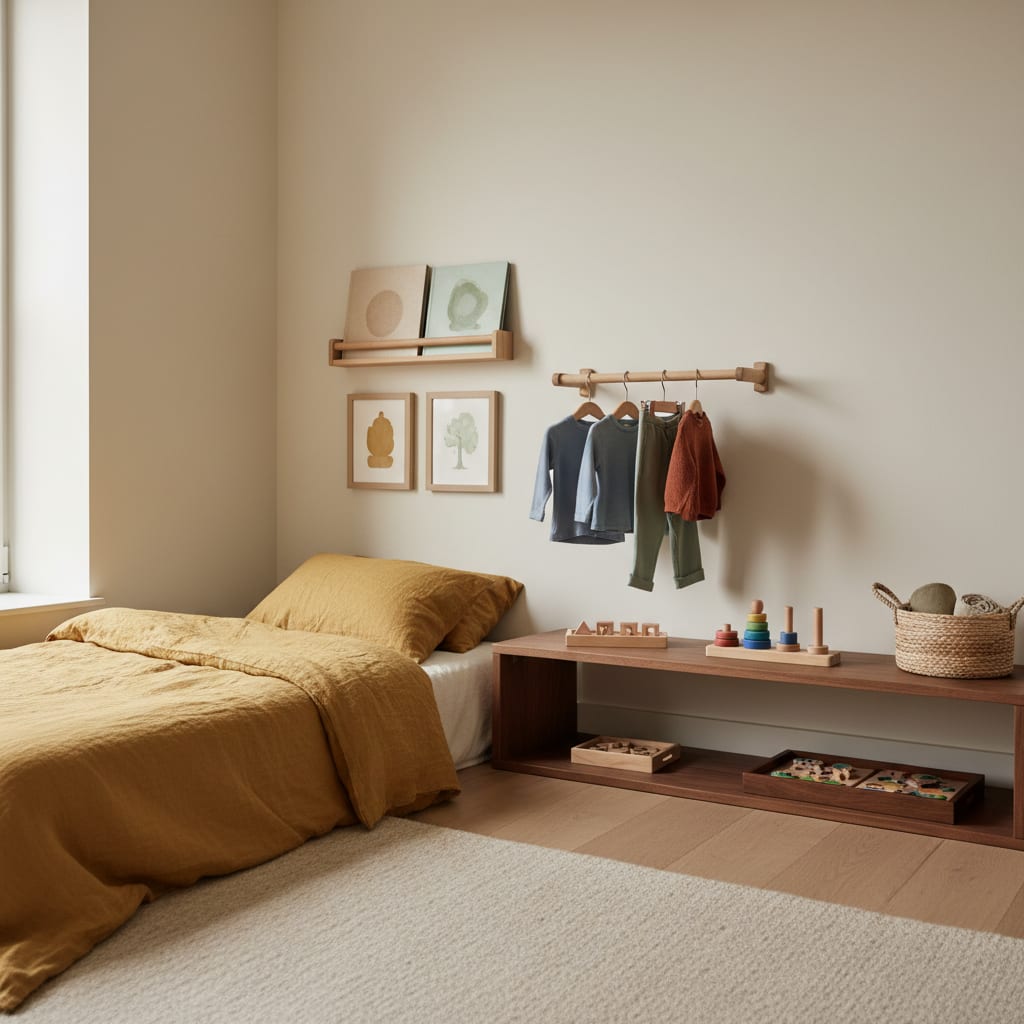
A Montessori bedroom is a room the child can use without you: a bed they can get into and out of alone, clothes they can reach and choose from, books and a few materials at floor level, and nothing in the room they can’t safely touch. That’s the whole formula. You don’t need the beige-and-rattan showroom the algorithm keeps serving you — most of what makes a bedroom “Montessori” is subtraction and lowering, which are free. Here’s the realistic version, zone by zone, from someone who set up rooms in a toddler community for three years and then did it twice at home on a normal budget.
Zone 1: sleep
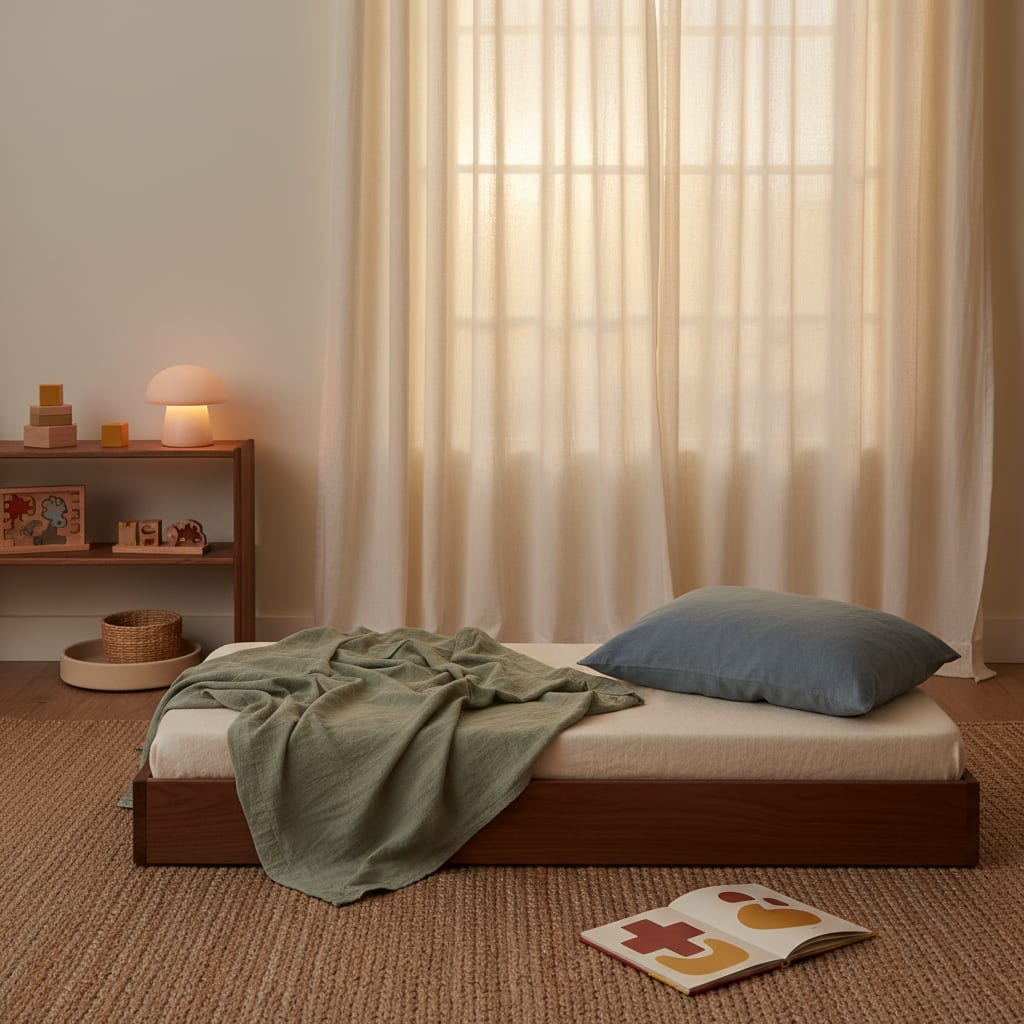
The classic choice is a floor bed — a firm mattress at floor level or on a low frame — because it hands the child their own comings and goings. The complete floor bed guide covers frames, timing, and the first weeks; the short version is that a plain mattress on the floor is the original and entirely legitimate version, and everything above that is aesthetics.
The non-negotiable that comes with it: once the child roams the room at 5 a.m., the room becomes the crib. Anchor every dresser and shelf to the wall (a strap kit like the QuakeHold does it), cover outlets, wrap blind cords, plan the doorway. Run the floor bed safety checklist on your knees, literally at child height, before the first night. If you’re keeping the crib for now — a legitimate call, argued honestly in floor bed vs crib — the rest of this room still applies unchanged.
Zone 2: dressing
This is the most under-built zone and the one that pays the fastest. A toddler who can reach their own clothes will dress themselves years before a toddler whose clothes live five feet up. What works:
- A low rail or low drawers. The bottom two drawers of a normal dresser, handed over entirely, cost nothing. A wall-mounted rail at child height runs cheap at any flat-pack store.
- Limited choice. Two or three weather-appropriate outfits reachable, the rest stored away. The choice is real but bounded — the same trick as the shelf.
- A low hook and a hamper. Pajamas on the hook, dirty clothes in the hamper, both child-height. Care of self starts as furniture placement.
Zone 3: books and work
A small forward-facing book display (a rail, a wall shelf, or honestly a basket) with five to eight books beats a packed bookcase — covers facing out get chosen; spines get ignored. Beside it, one low shelf with a few materials appropriate to the child’s age, spaced generously. Keep the bedroom shelf smaller than any playroom shelf: this room’s job is rest, and a bedroom with four toys gets slept in while a bedroom with forty gets partied in. Rotation logic and storage for everything not currently out is covered in toy storage for a Montessori home.
A floor cushion or small rug defines the reading spot. A child-height mirror (acrylic, firmly mounted) earns its place for dressing and for babies; low-hung art — at the child’s eye line, not yours — costs nothing but a re-hammered nail.
Zone 4: what stays out
Subtraction is half the setup:
- The toy overflow. Everything not on the shelf lives outside the room or in closed storage. The room should read calm at toddler eye level.
- Screens and noisy electronics. The bedroom argument against them is stronger than the general one: they outcompete both books and sleep.
- Adult clutter. If the room doubles as storage, curtain or cabinet it away. The child can’t distinguish “ours, ignore it” from “mine, explore it” — and in a floor-bed room, everything reachable is theirs by definition.
- Anything you’d say “don’t touch” about. That phrase in a child’s own bedroom means the room isn’t finished yet.
Lighting rounds it out: blackout curtains if early light wakes your child, a nightlight or a lamp with a switch the child can operate — one more small independence — and dim light for the last stretch of the bedtime routine.
FAQ: Montessori bedroom setup
What does a Montessori bedroom need?
Four things: a bed the child can enter and leave alone, reachable clothes with limited choice, a small amount of books and materials at floor level, and a fully childproofed room. Everything else — house-bed frames, matching rattan baskets — is decor.
Can you set up a Montessori bedroom without a floor bed?
Yes. Low clothing storage, a forward-facing book display, low art, and a calm uncluttered layout all work with a crib in the room. The floor bed is the classic choice, not an entry requirement — switch when it suits your child.
How many toys should be in a Montessori bedroom?
Fewer than the playroom — a handful of calm choices on one small shelf, rotated when interest fades. The bedroom’s job is rest and unwinding; high-energy and messy materials do their work better elsewhere in the house.
Is a Montessori bedroom expensive to set up?
No — most of it is lowering and removing, which are free. A mattress on the floor, the bottom dresser drawers handed over, a basket of books, art moved down the wall. The spend that matters is safety hardware: anchors, outlet covers, a gate if needed.