3 Montessori Geometric Solids Extensions to Try at Home
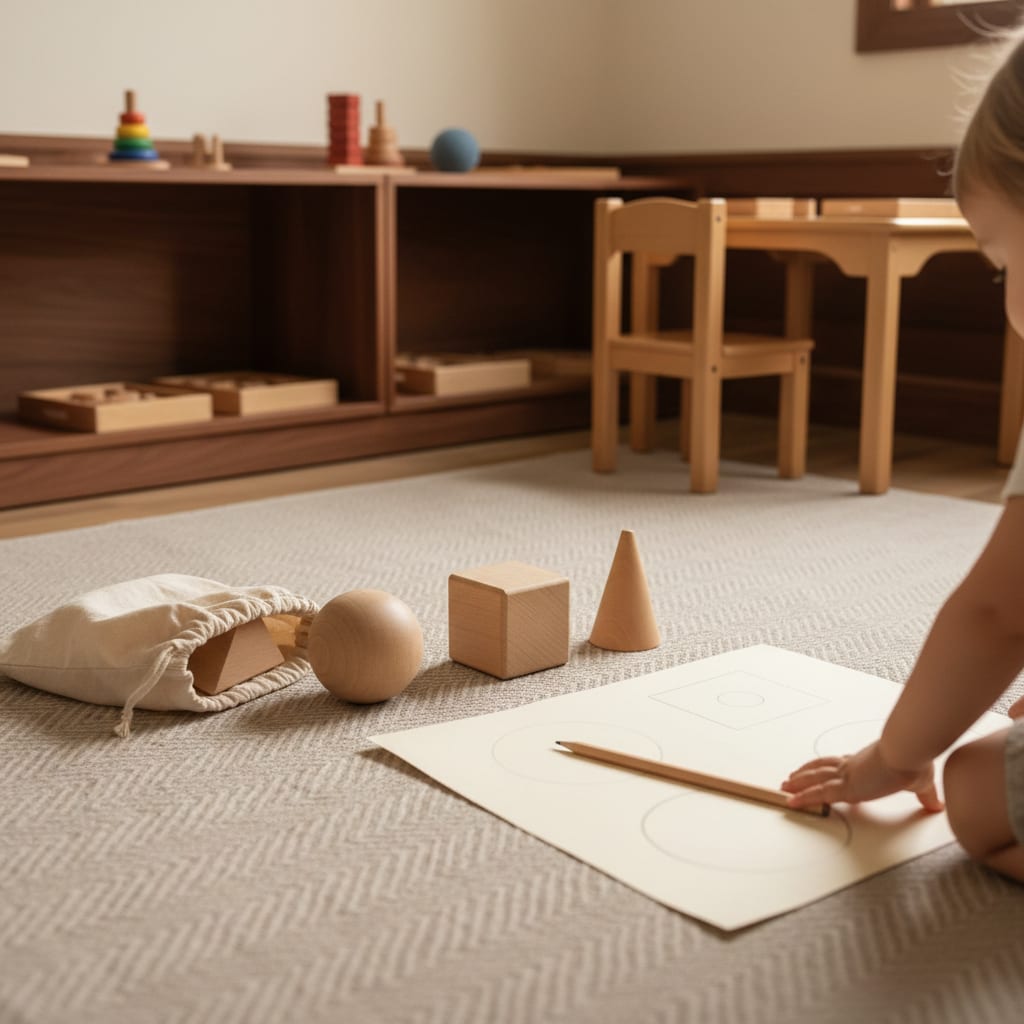
Here are three Montessori geometric solids extensions that work at home once a child knows the basic material: (1) the mystery bag — identifying solids by touch alone, no peeking; (2) the shape hunt — matching solids to real objects around the house, the orange to the sphere, the soup can to the cylinder; and (3) base tracing — drawing around each solid’s flat faces to discover which plane figures hide inside the solid ones. Each extension takes the same ten wooden shapes somewhere new, and none needs anything you don’t already own. This post revives one of the original site’s classroom-corner favorites, translated for a kitchen table.
The material, briefly — and the honest budget version
The classic sensorial material is a set of ten solid geometric forms — sphere, cube, cylinder, cone, ovoid, ellipsoid, and the pyramid/prism family — sized for a small hand. The child’s first work is simply handling and naming them; the deeper work is the sensory impression of curved versus flat, rolling versus stacking. Home sets, such as Adena’s geometric solids with bases, run roughly $20–60 depending on wood and finish.
And the honest part: you may not need to buy one. A wooden ball from the block basket, a block cube, a can-shaped block, a party hat cone — a scavenged set covers the shape hunt and tracing work fine. The mystery bag benefits most from real matched solids, since mismatched sizes give the answer away through the fingers. I’m the shelf-setter, not the certified guide, so for the doctrine on how sensorial materials isolate qualities, Trillium Montessori explains it from actual training; this post is what to do at the table.
Present names in small doses — three solids at a time is the classic rhythm — and let handling come long before vocabulary. The naming game itself is the same three-period pattern used in toddler language work, which is no accident; half of Montessori is one good pattern wearing different costumes.
Extension 1: the mystery bag
The classic. A drawstring bag or pillowcase, three to five solids inside, and hands that have to do the seeing. First game: reach in, feel one solid, name it before drawing it out. The reveal — was the hand right? — has the same self-checking snap as every good Montessori material: the child doesn’t need you to confirm the answer.
Variations that extend the life of it: you name a solid and the child finds it by feel; two bags and two players racing to find the same shape; a younger sibling’s version with just sphere, cube and cylinder — dramatic differences first. It’s also the rare fine-motor-plus-vocabulary work that travels: the bag has saved us more than one waiting room. Stereognosis — knowing by touch — sounds grand, but you’ll recognize it as the skill you use finding keys in a coat pocket, and children find its game version genuinely funny.
Extension 2: the shape hunt
Send the solids out into the house. The child carries the cylinder and hunts its relatives: the soup can, the glue stick, the rolling pin. The sphere finds the orange and the tennis ball; the cube finds the dice and the stock cubes; the cone, eventually, gloriously, finds the ice cream. Collect the finds on a mat next to their wooden originals and you’ve built a temporary museum of the idea “shapes live in things.”
This is the extension that does the most quiet work, because it moves geometry from the shelf into the world — after a good shape hunt, children spot cylinders in lampposts for weeks. It pairs naturally with an outing: a grocery run is a shape-hunt goldmine, and the same look-closely energy powers the museum-trip approach we’ve written about. For seasonal and themed variations of hunts like this from across the community, Living Montessori Now has collected years of them, and Every Star Is Different — a longtime friend of this site’s first life — builds especially good themed extension sets.
Extension 3: tracing the bases
Give the child paper and a pencil and have them draw around each solid’s flat faces. The cube leaves squares; the cylinder leaves circles; the sphere — dramatic discovery — leaves nothing but a wobble, because it has no flat face at all. What emerges on the paper is the bridge between solid and plane geometry: the flat shapes were hiding inside the solids all along.
Extensions of the extension: cut out the traced shapes and match them back to their solids; sort solids into “rolls,” “stacks,” and “both” and notice how the bases predict it; for an older child, trace every face of a cube and discover there are six squares — which is a paper cube waiting to be taped together. Keep it discovery-flavored rather than quiz-flavored. One presentation, then step back; the concentration this kind of repeatable work builds is the actual point, more than the geometry — the same principle as everything in helping your child concentrate.
FAQ: Montessori geometric solids
What age are the geometric solids for?
Classrooms introduce them in the 3–6 range, with sensory handling first and names layered on slowly. At home, toddlers can handle and roll them much earlier; the extensions here land best from around three and up.
Do I need the official ten-solid set at home?
No. Scavenged household solids cover the shape hunt and tracing beautifully; a purchased set (roughly $20–60) mainly improves the mystery bag, where matched sizing keeps touch honest. Buy it if the interest is real and sustained, not preemptively.
What are the names of the Montessori geometric solids?
The standard set: sphere, cube, cylinder, cone, ovoid, ellipsoid, triangular prism, rectangular prism (cuboid), triangular pyramid and square pyramid. Use the real names from the start — children collect “ellipsoid” as happily as “brontosaurus.”
My child just stacks and rolls them. Is that wrong?
That’s the material working. Rolling and stacking is the sensory point — curved surfaces roll, flat faces stack — and the classification games above are just that discovery made conscious. Follow the handling; the vocabulary keeps.