Montessori Gift Ideas for Christmas: What Actually Gets Used
The best Montessori gift ideas for Christmas are fewer than you think: one good thing beats ten. Choose by gift type rather than by catalog. Give one material that will earn a place on the shelf, one real tool sized for a small child, one book that shows the real world, and one experience. Pick each for the child you actually have: their age, what they keep returning to, and what your shelf already holds. Then tell relatives what you have chosen, early, so the house is not refilled with forty things in one morning.
I spent three years as an assistant in a Montessori toddler community and hold no guide’s diploma. What follows is a house test, not a certification. There is no such thing as a “Montessori-certified” toy, whatever a box says.
Why one good gift beats ten
The Montessori bloggers who write the best gift guides all start by apologising for writing one. Simone Davies opens her Montessori gift guide at The Montessori Notebook with “I am all about living with less, but I still find it fun to do a little bit of thoughtful gift giving.” Carine Robin of The Montessori Family begins her non-toy gift list: “We love toys in our family but we know that we don’t need that many.” Nicole Kavanaugh’s ultimate non-toy gift guide names the problem every family has in December: “It feels like every couple months it’s a birthday, holiday or special occasion. And, before we know it, there are just too many toys.”
That is the case for a short list. A Montessori shelf holds a few things the child can choose from and put back. Ten new toys on Christmas morning do not fit on it. Most go into a cupboard, and the child never finds out which one they would have loved.
Kavanaugh’s rule for choosing is the one to keep: “you need to follow your child in making purchasing decisions!” Before you buy, spend a week watching what your child goes back to. A child who empties every drawer wants a material for putting in and taking out. A child who drags a chair to the counter wants to work beside you. The gift follows from that.
Gift 1: one material that earns the shelf
This is the “toy” slot, and it should be the hardest to fill. The test I use at home: will this be chosen weekly, without me selling it? This site’s toys-by-age posts already sort the candidates by stage, so here is only the short pointer.
- Under 6 months. Babies need very little. A grasping toy is plenty; the Montessori toys for 0-6 months post walks through the mobiles and first rattles.
- 6 to 12 months. An object permanence box, like the Adena Montessori object permanence box, is the classic first material: a ball goes in the hole, rolls out of sight and comes back.
- 1 year. A first knobbed puzzle with a few big pieces, such as the Melissa & Doug First Shapes jumbo knob puzzle. Davies suggests starting with “large knobs and fewer pieces” and building up as the grasp refines. More ideas are in Montessori toys for 1 year olds.
- 2 years. Practical work tends to win at two (see the next section), but if you want a toy, choose an open one. Montessori toys for 2 year olds has the full shelf.
- 3 years and up. Blocks in proper proportions, like PlanToys’ 50-piece unit block set, get used differently every year. A small set of realistic animals such as the Schleich Wild Life five-animal set is another. Davies says of Schleich figures: “I would rather have a few of these high quality farm animals and build a collection slowly.” The fuller list is in Montessori toys for 3 year olds.
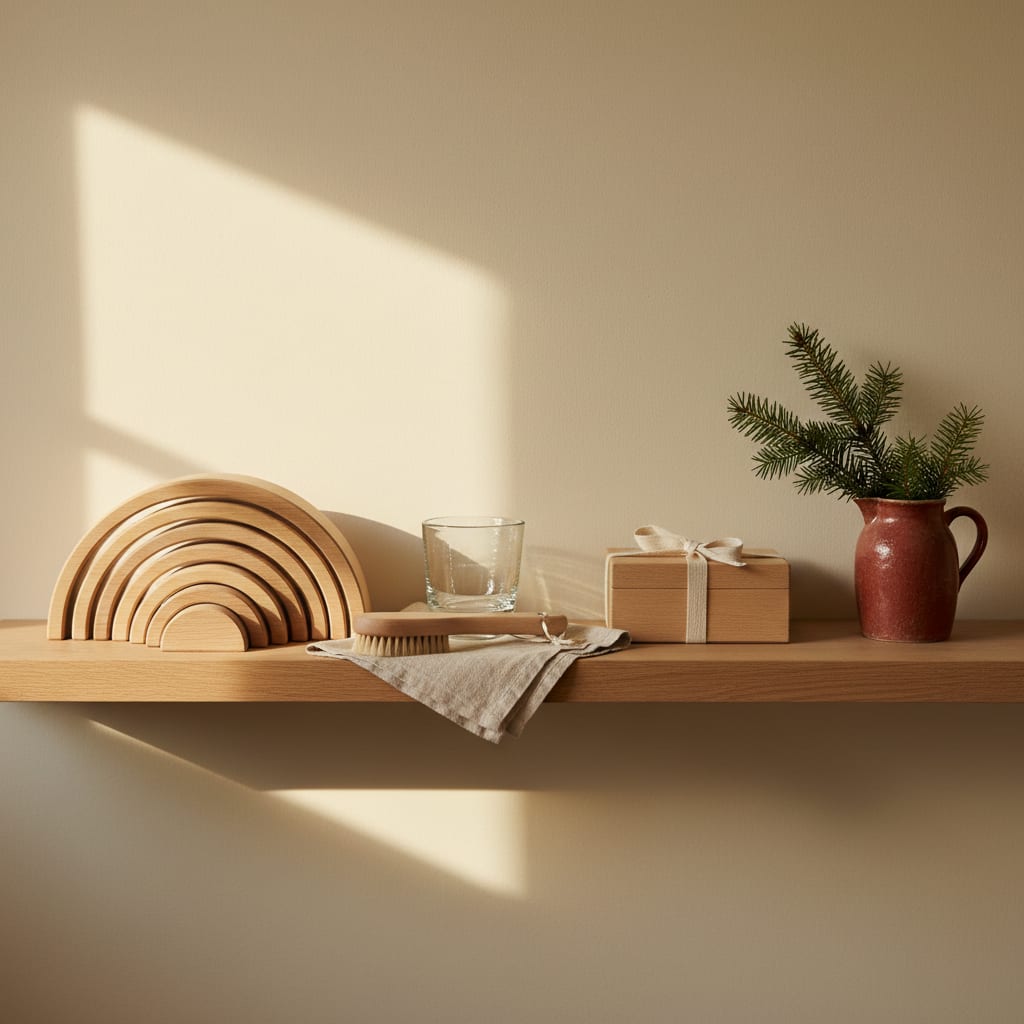
The big-ticket version. If a whole family is pooling for one gift, an open-ended stacker that lasts for years is a better use of the money than several small toys. The Grimm’s large 12-piece rainbow is the archetype: it gets stacked, nested, rocked and built into tunnels and bridges, and children use it differently as they grow.
The safety floor. Check the age on the box before anything else. The AAP’s page on choking prevention says to “follow the age recommendations on toy packages” because “age guidelines reflect the safety of a toy.” It lists toys with small parts, small balls, marbles, coins and button batteries among household choking hazards. It also warns that “many choking incidents happen when older brothers or sisters give dangerous foods, toys or small objects to a younger child.” On Christmas morning, with a baby on the floor and an older sibling unwrapping small figures, that last line matters.
Gift 2: one real tool
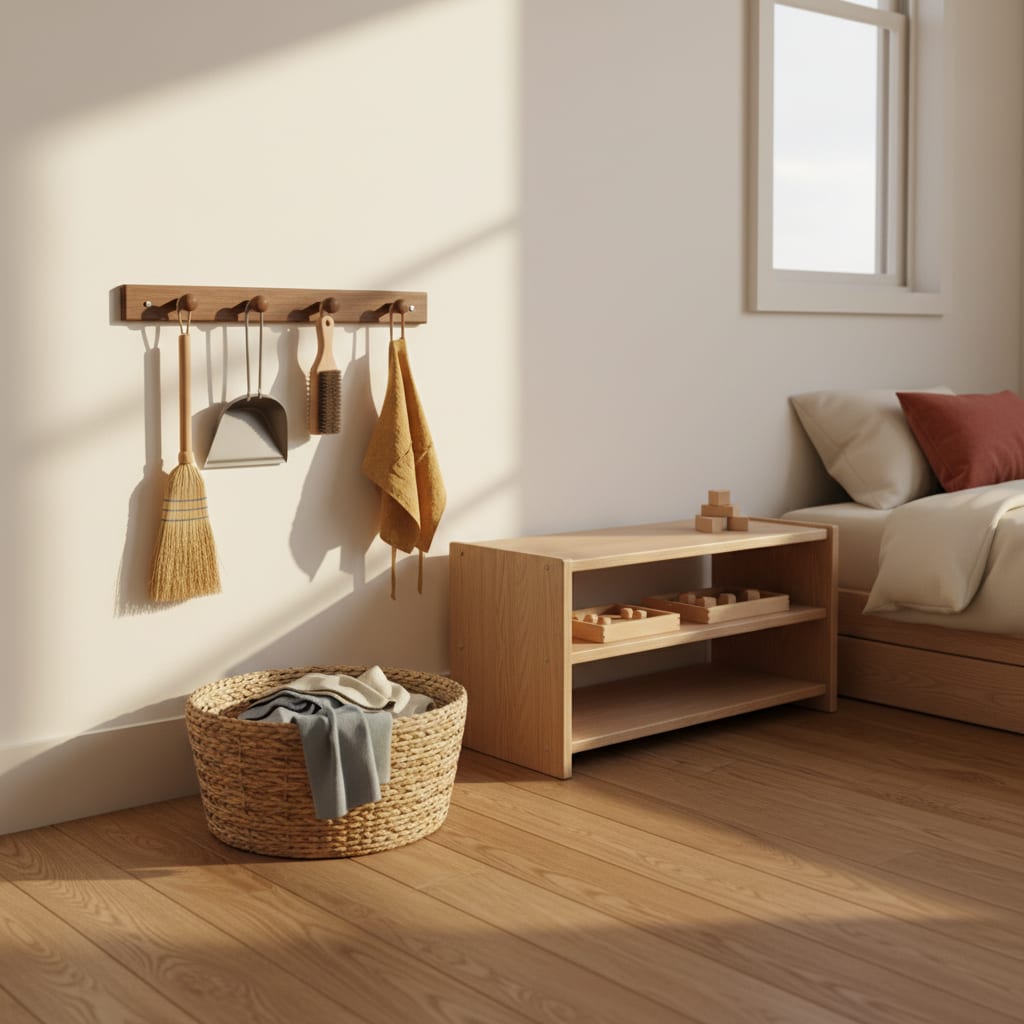
This is the gift that surprises relatives and gets used every day. Montessori calls this area practical life: real tasks, done with real tools sized for small hands. Robin’s list opens with exactly these: “a broom, a dustpan and brush, a spray bottle or a cleaning set, a child’s size apron.” Kavanaugh’s has a whole section of kitchen and cleaning tools.
Good single gifts in this slot:
- A hand brush and dustpan that actually sweeps, such as the Redecker horsehair hand brush and stainless steel dustpan set. Hung on a low hook, it gets used from about eighteen months.
- A small, heavy drinking glass. A child who pours their own water needs a glass that is easy to hold. The Duralex Picardie tumblers come in a small size and a set of four. Glass needs an adult nearby, and the occasional breakage is part of learning to carry it.
- A first real knife for a child who already helps in the kitchen. The kiddi kutter training knife is labelled 3 and up and is made for soft foods like banana. Supervise every time.
- A kitchen helper stool, if the family is pooling. The Guidecraft Kitchen Helper raises a child to counter height so they can work beside you. It is a large object, so measure your kitchen before anyone orders it.
Wrap the tool with a small job attached: “This is for sweeping up after snack.” A tool with no job usually becomes a toy.
Gift 3: one book that shows the real world
Montessori homes tend to favour books about real children doing real things for the under-sixes, with fantasy coming later. One good book is a better gift than a stack.
- For babies and young toddlers, Everywhere Babies shows ordinary babies playing, sleeping and crawling.
- For a winter gift, The Snowy Day is a real child’s real day in the snow.
There is a longer list of true-to-life picture books for toddlers on this site, filed under Network Reader.
Gift 4: one experience
The gift with no box is often the one remembered. Davies includes it in her list: “Outside – a simple reminder that heading outside is free and so much fun.” Other experience gifts that suit young children:
- A membership to a children’s museum, zoo or botanical garden, used on short, repeated visits.
- A standing date: a weekly walk to the library, or Saturday pancakes made together.
- Something to look after: a plant and a small watering can, which appears on both Robin’s and Kavanaugh’s lists.
For a relative who lives far away, a printed photo of themselves for the child’s shelf, plus a promise of a video call on a fixed day, is a real gift to a small child.
Stocking fillers without clutter
If your family does stockings, fill them with useful small things rather than more toys. Robin suggests items under the heading “care of self”: “a hand mirror”, “a combing set”, “some handkerchiefs”, “new pairs of gloves and hats”. A pair of slippers the child can put on without help, or a sponge cut to fit a small hand, work too. Check the age labels: a stocking is where the small parts tend to end up.
What to tell relatives
Most relatives want to give something the child will love. The way to help them is a short list sent early, with a reason attached.
- Send it in November, before the shopping starts. Robin wrote her list partly so “your family will be happy to pick from your list,” and notes “the challenges parents face when trying to persuade their family to select specific gifts.”
- Name one item per person, with a link, so nobody has to guess.
- Explain once, kindly. “We keep only a few toys out at a time, so we’d love one special thing rather than several.”
- Offer the experience slot to grandparents. A standing outing together often means more to both of them than another parcel.
- Plan for the extras anyway. Some gifts will arrive off-list. Thank the giver warmly, then put most of them away and bring them out one at a time over the winter.

FAQ: Montessori Christmas gifts
What is a good Montessori gift?
Something the child will choose again and again: a real tool sized for them, an open material that fits their stage, a true-to-life book, or an experience. Follow what your child is already drawn to.
How many gifts should a Montessori child get for Christmas?
There is no Montessori number. A handful of well-chosen gifts fits a home where only a few things are out at a time; ten new toys mostly end up in a cupboard.
Are “Montessori toys” on Amazon really Montessori?
The word on a box means nothing. No body certifies toys. Judge by whether the toy is simple, does one clear thing or many open things, and suits your child’s age and interests.
What can grandparents give instead of toys?
An outing, a membership, a real tool, a book, or something to look after, like a plant with a small watering can.