A Montessori peace table is a small, set-apart spot where two children in a conflict sit down and take turns saying what happened and how they feel, until they agree on a way forward. At home it works well for the sibling squabble that flares at bedtime: move the argument out of the bedroom to the peace spot, let each child speak while holding a small object like a peace rose, help them find one repair, and then go to bed. Keep it short and practise it on calm days first. The goal is a quieter lights-out, not a perfect verdict.
I was an assistant in a Montessori toddler community, not a trained guide, and I’m not a family therapist. What the peace table is and how schools use it is quoted below from Montessori schools and from Simone Davies of The Montessori Notebook. The home version is my adaptation.
What a peace table is in a Montessori classroom
Greenspring Montessori School describes it in its post on peace education in the Montessori classroom: “Most classrooms have a peace corner or peace table, at which two students can go to resolve a conflict or a single child can go to calm down and feel peaceful.” It goes on: “Children learn to take turns holding the peace rose while speaking about how they feel. They stay at the peace table until they have heard each other and resolved their conflict.”
West Side Montessori in Toledo explains the peace rose the same way: “One child holds the rose and speaks, while the other listens. Once the first child has finished, they pass the rose to the other, who then shares their perspective.” It adds that teachers stay close: “they may provide language prompts or help clarify misunderstandings, but they refrain from taking control of the conversation.”
Two details from Greenspring matter at home. First, the age split: “With very young children, adults model and coach the children with words they can use. Older students can do this independently.” Second, it sits next to grace and courtesy, the lessons in greeting, saying please and thank you and tucking in chairs. Both are about respect for other people, practised in small steps.
Simone Davies adds a useful caution in Cultivating peace at home with Montessori: “Montessori peace education goes far beyond a peace table.” She mentions that there are “many variations on this from a peace rose to a peace stone.” The table is one tool. The skills behind it, listening to both sides, finding solutions and making a repair, are the point.
Why the fight happens at bedtime
Siblings fight at bedtime for ordinary reasons: everyone is tired, two children want the same parent, one wants the light on and the other off. If they share a room, the afternoon’s grievance comes to bed with them.
The trouble is that a fight in the bedroom tends to go on in the dark. A child who goes to sleep still angry is often still awake. Settling it first, somewhere else, gives the room back to sleep.
Setting up a peace spot at home
You don’t need a table. A peace spot at home can be:
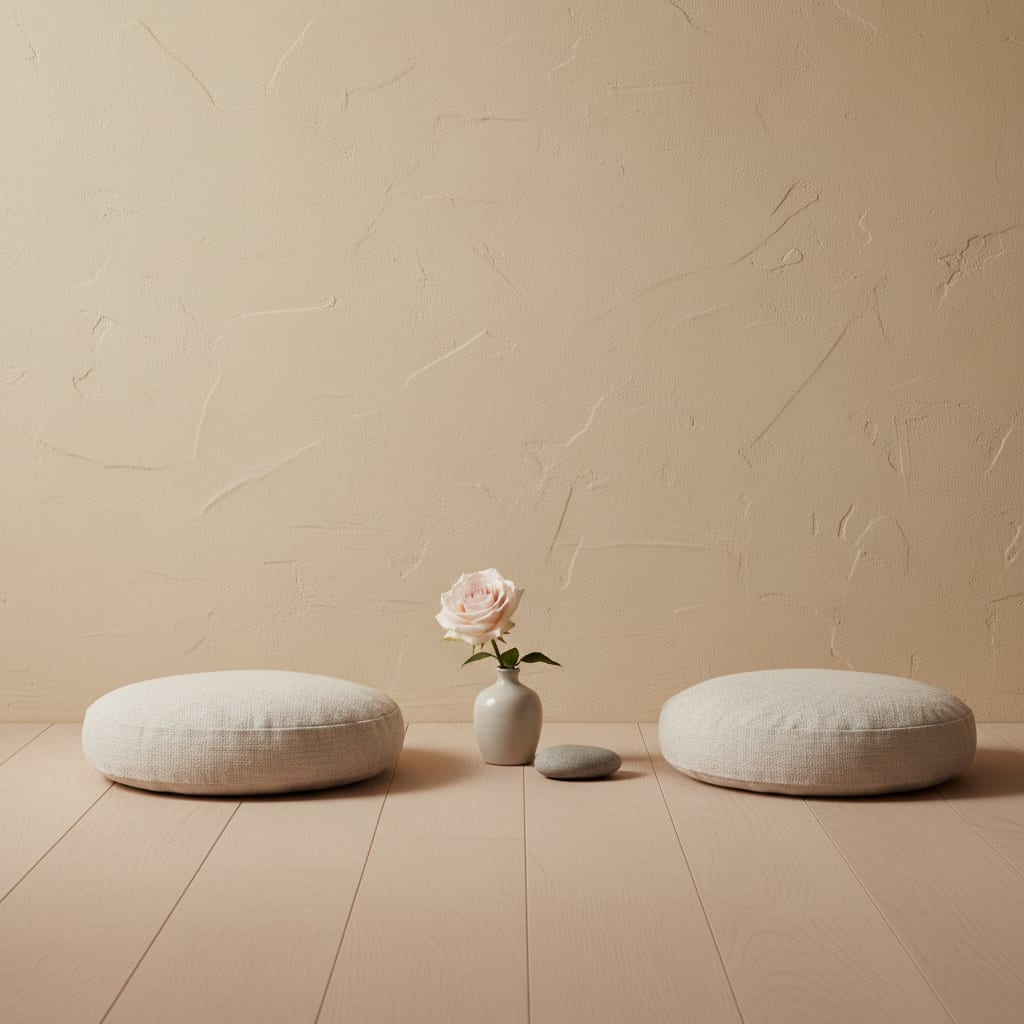
- Two small chairs or cushions facing each other in a quiet corner of the living room, away from the bedroom.
- One object to hold. A silk or wooden rose, a smooth stone, a small wooden egg. Whoever holds it speaks. Davies’ “peace stone” is a perfectly good version.
- Nothing else. No toys and nothing to fiddle with. It’s a spot for talking, not playing.
Keep it in the same place every time, so the children know where to go without discussion. And keep it outside the bedroom. Bedrooms are for sleep, and the walk to the peace spot is part of the cool-down.
Practise when nobody is cross
The Montessori way of teaching anything social is to show it at a calm time, not in the moment. Our post on Montessori grace and courtesy covers that lesson format: a short scene, the exact words, then practice another day.
Try it with the peace spot on a quiet afternoon:
- Sit with both children. Show the rose or stone. “Whoever holds this talks. Everyone else listens.”
- Act out a tiny made-up problem with a stuffed animal or with your partner. “I felt sad when you took my cup.”
- Pass the object across. “I didn’t know you were using it.”
- Show one repair: “Can I give it back?” “Yes.”
- Let each child try both roles.
A two- or three-year-old will mostly listen and copy your words. A five- or six-year-old can do much more of it alone. That matches Greenspring’s description of adults coaching younger children while older ones take over.
The bedtime version, step by step
When the squabble starts at bedtime:
- Stop the routine, calmly. “We’re not going to sleep angry. Let’s go to the peace spot.”
- Give a minute to settle first if anyone is crying or shouting. A child who is too upset can’t take turns. Betteroo’s guide to setting up a quiet place to settle big feelings covers that part, with an adult staying close for younger children.
- First speaker holds the object. Usually the child who feels wronged. “I felt ___ when you ___.”
- Pass it across. The other child answers. You can help with words, but don’t take over.
- Find one repair. Giving back the toy, swapping who chooses the story tomorrow, a hug if both want one. One is enough.
- Back to bed. The routine picks up where it stopped. Don’t restart it from the bath.
The whole thing should take a few minutes. If it drags past ten, it’s late, everyone is too tired, and the honest answer is to say: “We’ll finish this at breakfast.” Then do.
What the adult does and doesn’t do
- Don’t judge the case. The peace spot isn’t a courtroom. West Side Montessori’s line is the one to keep: teachers guide but “refrain from taking control of the conversation.”
- Don’t force an apology. A “sorry” said under pressure is a word, not a repair. Offer a repair and let the child choose it.
- Do name feelings. “You sound angry because you wanted the last story.” Most young children don’t have the words yet.
- Do model it yourself. Davies notes that children absorb “how we handle frustration.” If you snap at your partner at bedtime and then use the peace spot, the children will notice that too.
Some fights aren’t really about the toy. If the same squabble happens every night, look at the routine. Two children who both need you at the same moment may need staggered bedtimes, or one parent per child for the last ten minutes. Our Montessori bedtime routine is a good place to lay that out.
When siblings share a room
Sharing a room makes the peace spot more useful, because the grievance has nowhere else to go. Settle it before anyone gets into bed. Then make the room itself easy to share: each child’s own bed, their own small basket of books, and an agreed rule for the light. If you’re still deciding whether to move a younger child in, the sibling variant of the room-sharing move covers the timing.
 Peace made. Now the night.
Betteroo builds a gentle, personalized sleep plan around your child's age, naps and bedtime, including evenings with more than one child to settle.
Take the free sleep quiz →
FAQ: the Montessori peace table at home
What age can children use a peace table?
Toddlers can join in with an adult giving them the words, as Montessori schools describe for younger children. From about four or five, many children can take turns with less help.
Should I use the peace table in the bedroom?
Better not. Keep the peace spot in another room so the bedroom stays for sleep, and so the short walk gives everyone a moment to cool down.
What if one child refuses to talk?
Let them hold the object and listen. Being heard by a sibling is often enough to soften the next one. If nobody is ready, settle the evening and come back to it in the morning.