Room Sharing to Own Room: The Montessori Move
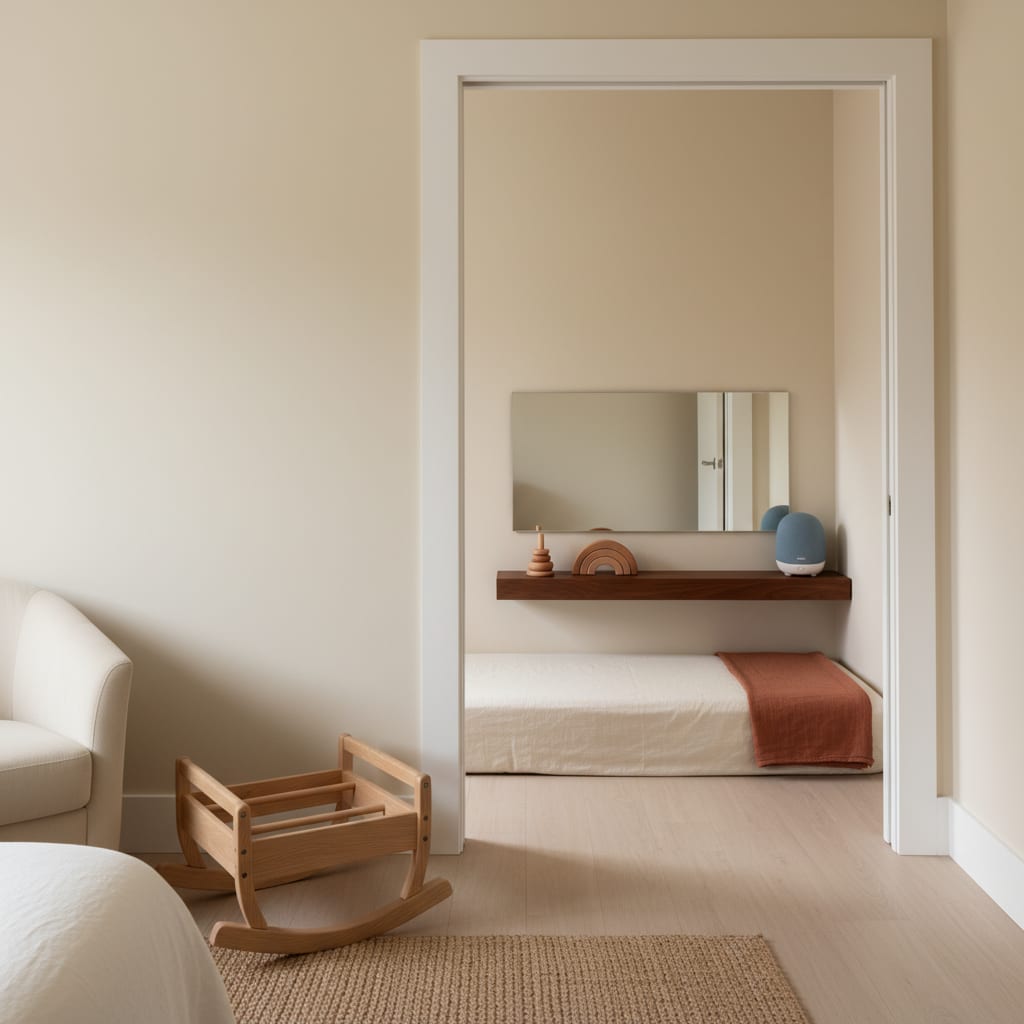
Moving from room sharing to a baby’s own room goes best when the room stops being new before anyone sleeps in it. Current AAP guidance is to room-share — baby on a separate firm, flat sleep surface, never in your bed — for at least the first six months, and ideally the first year; after that, the timing is a family decision, not a developmental deadline. The Montessori part isn’t the calendar, it’s the preparation: the child should already know that room in daylight, from the floor, awake, before it becomes the place they wake up alone. Here’s how that sequence actually runs.
Standard caveat from this shelf: I set up rooms in a Montessori toddler community for three years, and I’m not a clinician. Safe-sleep questions, and anything about your specific baby, belong with your pediatrician.
When the move is genuinely on the table
Three signals, none of them about age alone.
Safe-sleep clearance. Six months is the earliest most families should be considering it, twelve months is the guidance’s preferred mark, and if there’s any medical history in play, your pediatrician’s answer outranks the general rule.
Your sleep is worse together than apart. This is the real trigger in most houses. Parents wake at every grunt and reflexively intervene; babies surface at every mattress creak. Past the safe-sleep window, a wall between you often improves both parties’ nights — Betteroo’s overview of whether babies sleep better in their own room is a fair summary of what’s known and what isn’t.
The room is ready to be lived in. Not decorated — usable. A prepared room the baby has crawled around, nursed in, and played in during the day is a different psychological object from a room they are carried into at 7 p.m. and left in.
Not signals: a birthday, a relative’s opinion, or the fact that you already bought furniture.
Prepare the room first — that’s the Montessori half
Give the room a two-week daylight career before it has a nighttime one.
- Do daily floor time there. The mirror, the movement mat, the low shelf — the whole setup in our Montessori infant room post exists to make the room interesting from floor height. Ten minutes a day, awake and happy, teaches the room faster than any bedtime ritual.
- Move the routine before you move the sleep. For a week or so, do the bath, the feed, the books, and the song in the new room, then carry the baby back to the shared room to sleep. The sequence becomes familiar in place.
- Nap there first. Naps are lower stakes for everyone. A few days of first-nap-in-the-new-room does most of the acclimatization work before you touch nights.
- Keep the sleep surface identical. Same firm mattress, same sheets, same sleep sack, same bare sleep space. Change the room or change the bed — never both in one week.
The three-step move
Step one: the practice week. Routine and naps in the new room, nights still shared, as above.
Step two: the first nights, unglamorously. Move on an ordinary evening in an ordinary week — not the night before a trip, not during teething, not the week a parent starts a new job. Do the routine you’ve been rehearsing, put the baby down awake if that’s how you’ve been working, and go. Plan for two or three nights of extra waking. That is the transition, not a verdict on it.
Step three: hold it for two weeks. Resist the hybrid. Bringing the baby back to your room at the 2 a.m. wake seems merciful and instead teaches a very learnable rule: cry twice and the room changes. Whatever your response plan is — feed, settle, wait — run the same one in the new room that you were running in the old one.
If your child is old enough to be moving into a floor bed at the same time, don’t. Stack those changes at least a month apart; the mechanics of that one are in the crib to floor bed transition.
Sound, light, and the two variables people forget
A shared room is noisy and dim in a very particular way, and a baby who has slept in it for months has calibrated to that. The new room is often quieter and brighter, which parents rarely predict.
- Sound. If your bedroom had a fan, a partner’s breathing, a street-facing window, the new room can feel unnervingly silent. Steady, low white noise at a modest volume across the room — a mechanical unit like the Yogasleep Dohm is the long-running standard because it makes real fan noise rather than a looped track — smooths the difference. Place it away from the bed, not beside it.
- Light. Rooms that face a streetlight or an eastern sky ruin more transitions than separation does. Get the room genuinely dark before you blame the move.
- Temperature. A room that has been empty and closed for months runs warmer or colder than the one you sleep in. Check it at 3 a.m. once, not just at bedtime.
 Move rooms on the right week
Betteroo builds a personalized nap and bedtime plan around your child's age and your approach — so a room move isn't competing with an overtired schedule.
Take the 2-minute sleep quiz →
Move rooms on the right week
Betteroo builds a personalized nap and bedtime plan around your child's age and your approach — so a room move isn't competing with an overtired schedule.
Take the 2-minute sleep quiz →
When it’s separation, not the room
Around eight or nine months, and again in the second year, plenty of babies who moved smoothly suddenly object — that’s developmental rather than architectural, and moving them back rarely fixes it. Keep the room, shorten the distance: sit by the bed for a few nights and retreat gradually across a week or two, which is the same slow-fade logic behind our floor beds and independent sleep approach. If you want the developmental background, separation anxiety and sleep covers the ages it typically shows up.
Daytime helps more than night-time reassurance does. Games where you leave and come back, narrated departures (“I’m going to the kitchen, I’ll be back”), and a consistent goodbye at the bedroom door all teach the same fact: leaving is followed by returning.
The sibling variant
If the destination is a sibling’s room rather than a solo room, the sequence is the same with one addition: give the older child a stake and a boundary. Let them help arrange the shelf in our Montessori bedroom setup sense — choosing where the books live, which side the baby sleeps on — and give them one shelf or basket that is genuinely theirs and off-limits to the baby. Expect a few weeks of mutual waking; most sibling pairs sleep through each other faster than parents believe, though the older child usually adapts first.
FAQ: moving a baby to their own room
When can a baby move to their own room?
Current safe-sleep guidance is room-sharing on a separate sleep surface for at least six months and ideally twelve. After that, timing is a family judgment — sleep quality for everyone, room readiness, and your pediatrician’s read on your particular baby.
How long does it take a baby to adjust to their own room?
Most families see two or three unsettled nights and a fully settled child inside two weeks. Naps in the new room ahead of time, and an identical response plan on both sides of the move, shorten it considerably.
Should I move my baby to their own room and to a floor bed at once?
No. Separate the two changes by at least a month. Stacking them makes it impossible to tell which one is causing a bad week, and it doubles the novelty a child has to absorb at bedtime.
Will moving rooms make my baby sleep through the night?
Sometimes it helps, mostly by reducing the micro-wakes that come from sharing a room with adults. It doesn’t create sleep on its own — schedule, room darkness, and a consistent settling approach still do the heavy work.