Door Open Exactly This Far: A Montessori Sleep Question
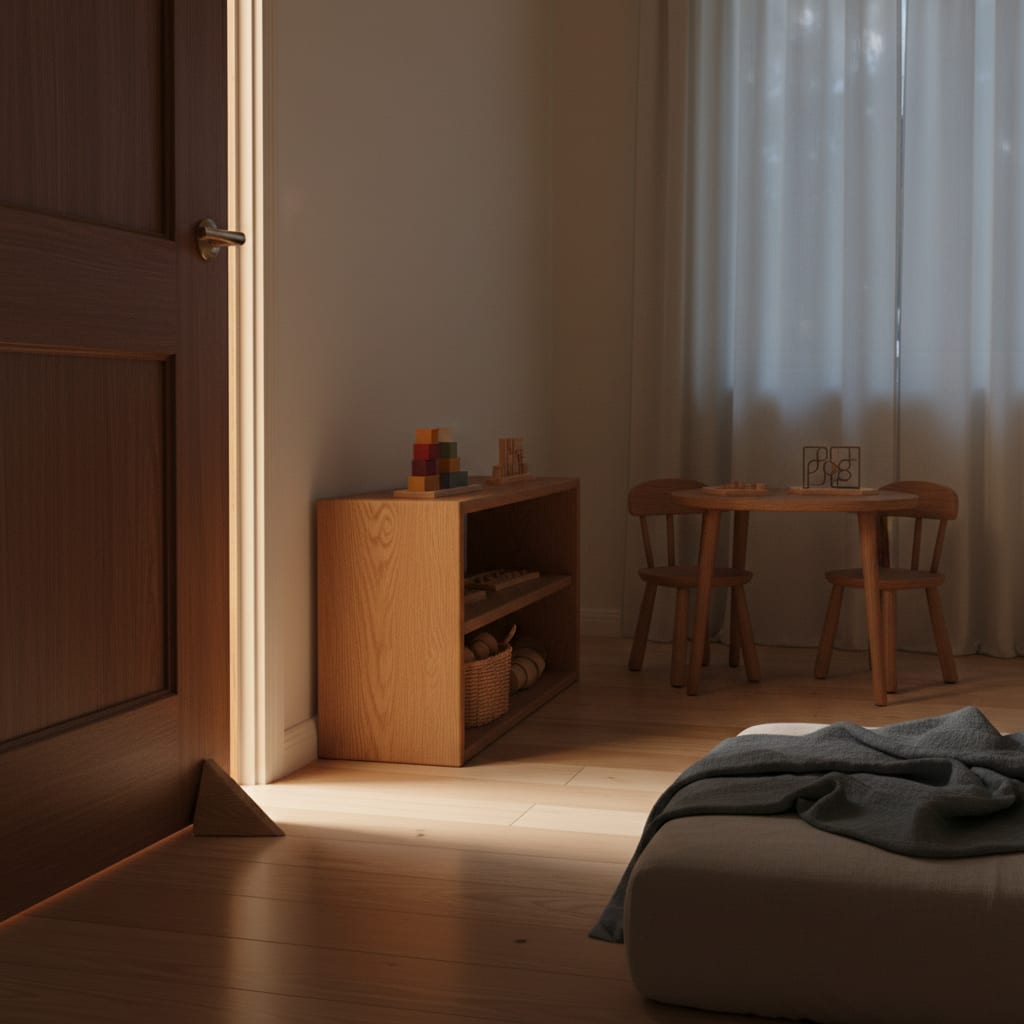
If your child needs the bedroom door open exactly this far — not wider, not narrower, and they will get out of bed to correct you — assume first that they mean it literally. For many children under about four, a specific door gap is an order request: one more thing that has to be where it was last night, in the same category as the same cup and the same three books. Order requests are stable, specific, and satisfied the moment they are met, which is what makes them easy to tell apart from stalling. The practical answer is not to negotiate the gap but to make it reproducible without you.
This is a different problem from the door as a noise-and-light event. If your child sleeps fine until the handle turns, the fixes are physical and they are in why a child wakes when the door opens. Here the child is awake and telling you something. The two overlap — a child woken by the door repeatedly may well develop opinions about it — but which post you want depends on which end of the night the trouble starts.
Why “exactly this far” is a real request
Montessori’s own observation was that young children pass through a stretch — roughly the first three years, most visible around two — in which the placement of things carries unusual weight. The shoes by the door, the coat on the third hook, the same person doing the same step of bedtime. Adults read this as fussiness. From inside it is a child building a reliable model of a world they cannot control, and consistency is the raw material.
A door gap is an unusually good candidate for this. It is visible from the bed, it controls light, sound and the sightline to where the adults are, and unlike the shoes it is set by a person each night, from outside, by hand — which means it varies, which means it becomes worth policing. The child is not being rigid about the door. The door is genuinely the least reliable thing in the room.
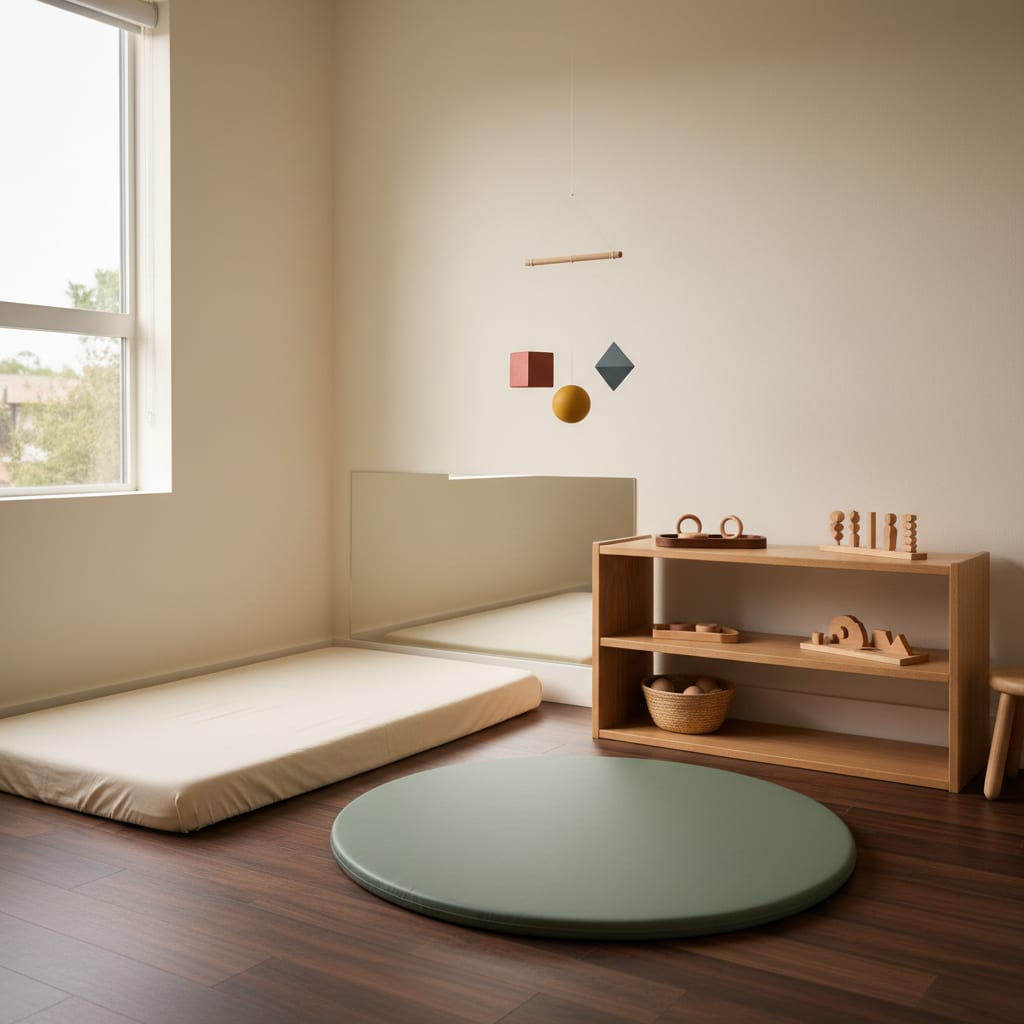
Under that reading, matching the gap is not indulgence. It is the same move as putting the hairbrush back on the same shelf: you are removing a variable so the child can stop tracking it. The Montessori term for the whole idea is the prepared environment, and the doorway is part of it — a point that gets missed because doors are architecture rather than furniture. The rest of the room is covered in the Montessori bedroom setup; the door belongs on that list too.
Telling order apart from stalling and from fear
Three different requests can sound identical at 7:40 p.m. The differences are reliable.
Order. The request is specific and stable — the same gap tonight as last night. Once met, the child settles, usually without further conversation, and does not add a second condition.
Stalling. The request escalates and migrates: the door, then the door and the landing light, then one more song. It is never quite right, and the tell is that satisfying it produces a new condition rather than sleep. Stalling is a normal bid for a few more minutes of you, and the answer is a boundary held kindly, not a wider door.
Fear or separation. The request is really about where you are. The gap has to be wide enough to see or hear an adult; the child asks where you will be; the gap widens when you are further away or when a parent is travelling. This one is not solved by the door at all — see separation anxiety in the toddler years for the shape of it.
One caution about the third: a child who wants light rather than access is telling you the room is too dark, and a hall light through a gap is a poor way to deliver it — a hard-edged wedge across the ceiling, tied to whatever the rest of the house is doing. A small, dim, warm-toned lamp inside the room is the better instrument; something like the VAVA nursery night light, turned to the bottom of its range, does the job.
Make the gap reproducible without an adult
This is the part that is properly Montessori, and it is the difference between granting a request and solving it. Right now the correct gap lives in an adult’s judgement, which is why it is wrong two nights in five and why a babysitter has no chance. Move it into the physical world.
- Set a stop. A wedge doorstop placed at the exact position, or a small block of wood on the floor against the door’s swing, means the door closes to the same point every night by physics rather than by memory.
- Or fix it from above. A hook-and-eye or a simple cabin hook on the frame, set at the right gap, holds the door open at one fixed width and cannot drift.
- Mark it once, together. Let the child set the gap and place the stop. A four-year-old can do this entirely; an eighteen-month-old can later push the door to the stop. Once the child can restore it themselves, it stops being a nightly request.
- Tell everyone. The stop only works if the visiting grandparent uses it — the real argument for an object over an instruction.
Two safety notes, because a fixed-open door changes the room. If the child is in a floor bed and can leave, an open doorway means the landing and stairs are now part of the sleep environment — gate the stairs and childproof the hallway to the same standard as the bedroom, and work the floor bed safety checklist beyond the doorway as well as inside it. And never wedge or hook a door in a way that would stop it opening in an emergency, or that leaves a hard object where a child walking out half-asleep will meet it with a foot.
 Is it the door, or is it the timing?
Betteroo turns your child's age and real sleep data into a personalized day-by-day plan — so you can tell a bedtime that's too early from a room that needs fixing.
Take the 2-minute sleep quiz →
Is it the door, or is it the timing?
Betteroo turns your child's age and real sleep data into a personalized day-by-day plan — so you can tell a bedtime that's too early from a room that needs fixing.
Take the 2-minute sleep quiz →
When the gap is a symptom of the schedule
Sometimes the request appears out of nowhere in a child who never cared before, and the door is carrying something else. A bedtime that has drifted too early leaves a child lying awake with nothing to do but notice the room; an overtired child is more rigid about everything, not just doors; and a new sibling, a house move or a parent away for work all raise the demand for sameness at night. If the gap became urgent the same fortnight something else changed, treat the change and expect the door to relax on its own.
FAQ: the child who needs the door open a certain amount
Should I just give my toddler the door gap they ask for?
If the request is stable and specific and settles them, yes — then remove your judgement from it with a doorstop or a cabin hook, so the gap is identical every night whoever does bedtime. Granting it is cheap; granting it inconsistently is what keeps the request alive.
How do I know if it’s stalling?
Watch what happens after you meet it. An order need is satisfied and the child settles. Stalling adds a new condition — the light, a song, water — and is never finished. Meet the first request once, then hold the boundary calmly.
Is a door gap a Montessori thing?
Not a doctrine, but it sits squarely inside two Montessori ideas: the young child’s strong need for consistent order, and the prepared environment, in which the room does the work rather than the adult. Fixing the gap physically so the child can restore it themselves is the Montessori move; arguing about centimetres is not.
What about the hallway light coming in?
If your child wants the gap for light, give the room its own dim, warm lamp instead — a hall light through a gap makes a hard bright wedge and changes whenever someone downstairs flicks a switch. If they want the gap for sound or sightline, dimming the hall is enough.
My child wants the door fully open. Is that a problem?
Only if the hallway is bright or busy, or if the child is in a floor bed and the landing is not gated. Plenty of families sleep with doors wide open. Make the hall dim and quiet, secure the stairs, and it is a legitimate setup rather than a compromise.