Winter Solstice With Kids: A Montessori Lantern Walk
To mark the winter solstice with young children the Montessori way, keep it real and keep it short. Show what is happening with a globe and a flashlight. Take a fifteen-minute walk at dusk with a battery lantern the child carries. Come home to the usual bedtime routine, started a little earlier. In 2026 the solstice falls on Monday, December 21, and dark comes early enough for the walk to happen before dinner. The child’s light is battery-powered; flames, if any, stay in adult hands.
I was a classroom assistant in a Montessori toddler community, not a certified guide. The safety and sleep points below come from the U.S. Fire Administration, the AAP and the CDC.
What the solstice actually is
Start with the real event, because Montessori asks for reality before story with the under-sixes. The U.S. Naval Observatory’s Earth’s Seasons data puts the 2026 December solstice at 20:50 Universal Time on December 21, which is 3:50 in the afternoon on the East Coast. In the Northern Hemisphere it is the shortest day and the longest night of the year. After it, the days start getting longer again.
A 2009 post on the NAMC Montessori teacher-training blog, Winter Solstice Activities for Your Montessori Classroom, gives the simplest demonstration: show the solstice “with a globe or ball and a flashlight.” Hold the light still as the sun, tilt the globe, and carry it slowly around. A four-year-old can see the top of the globe lean away from the light. A two-year-old will mostly enjoy the flashlight, and that is fine: “This is the shortest day” is enough.
A globe that stays on the shelf afterwards, such as the raised-relief Replogle Student globe, earns its place all year. The same post notes the word means “sun (sol) stoppage”.
For a book, Susan Cooper’s The Shortest Day, illustrated by Carson Ellis, is a short poem about people long ago “singing, dancing,/ To drive the dark away” at midwinter. Publishers Weekly puts it at ages 4 to 8. Read it as something real people did, rather than as a fairy tale.
Whose tradition the lantern walk is
The honest note first: there is no solstice lantern walk in the Montessori albums. Lantern walks and candle spirals sit closer to the seasonal festivals of Waldorf education, which builds its year around them. Our Montessori vs Waldorf comparison covers where the two differ, and families borrow from both all the time.
Trillium Montessori, Seemi Abdullah’s long-running classroom blog, ran a guest post by lead teacher Lisa Anderson, A Celebration of Light – The Winter Solstice, that says so plainly: the class celebration “takes root in Waldorf traditions.” Her four weeks of preparation run through minerals, plants, animals and people. They end with each child walking a spiral of natural objects in a darkened room, “bringing light to the longest night.” The home version below borrows the shape and swaps every flame for a battery light.
What makes the walk Montessori is everything the child does: they know what the solstice is before you go, they carry their own light, and they help get ready and put things away.
Lights first: what the child carries
The child’s lantern is battery-powered. Always. Choose a small handled LED lantern made for children, such as the Coleman Kids Adventure Mini LED Lantern. Let the child test it in the afternoon, so they know how their own light works before the walk.
Flames stay with the adult, if you use one at all. A 2011 U.S. Fire Administration candle safety bulletin puts it in order of preference: “Avoid using lighted candles. Consider using battery-operated flameless candles.” If you must use candles, its advice is to keep them in sturdy holders, “at least 12 inches from anything that can burn,” and “away from children and pets,” and to “never leave burning candles unattended.”
Mind the small batteries. Many flameless tea lights run on a coin-sized battery, so check the one you buy. The AAP’s choking prevention page lists “small button-type batteries or lithium coin batteries” among the household items to keep away from children, because they “can also cause internal burns if swallowed.” If your tea lights have a coin battery, the adult places them and the adult collects them.
The walk itself
Fifteen or twenty minutes around the block is plenty on a cold evening. Go at dusk, so the change from day to night is part of what the child sees.
- Pick a route you know. Familiar pavement, no busy crossings, and a hand to hold for the youngest.
- Dress for the cold before you open the door. Mittens and hats on at home, not halfway down the street.
- Let the light belong to the child. They decide when to switch it on.
- Name what is real. The first star, the moon if it is up, lit windows, frost, your breath in the cold. This is the same kind of noticing as the outdoor work in our animals in winter activities.
- Turn back while it is still fun.
If your town has a neighbourhood lights walk earlier in December, the Montessori advent calendar treats that as one of its outings. The solstice walk is the darker, quieter one at the end of the run.
Home again: a small spiral, then bed
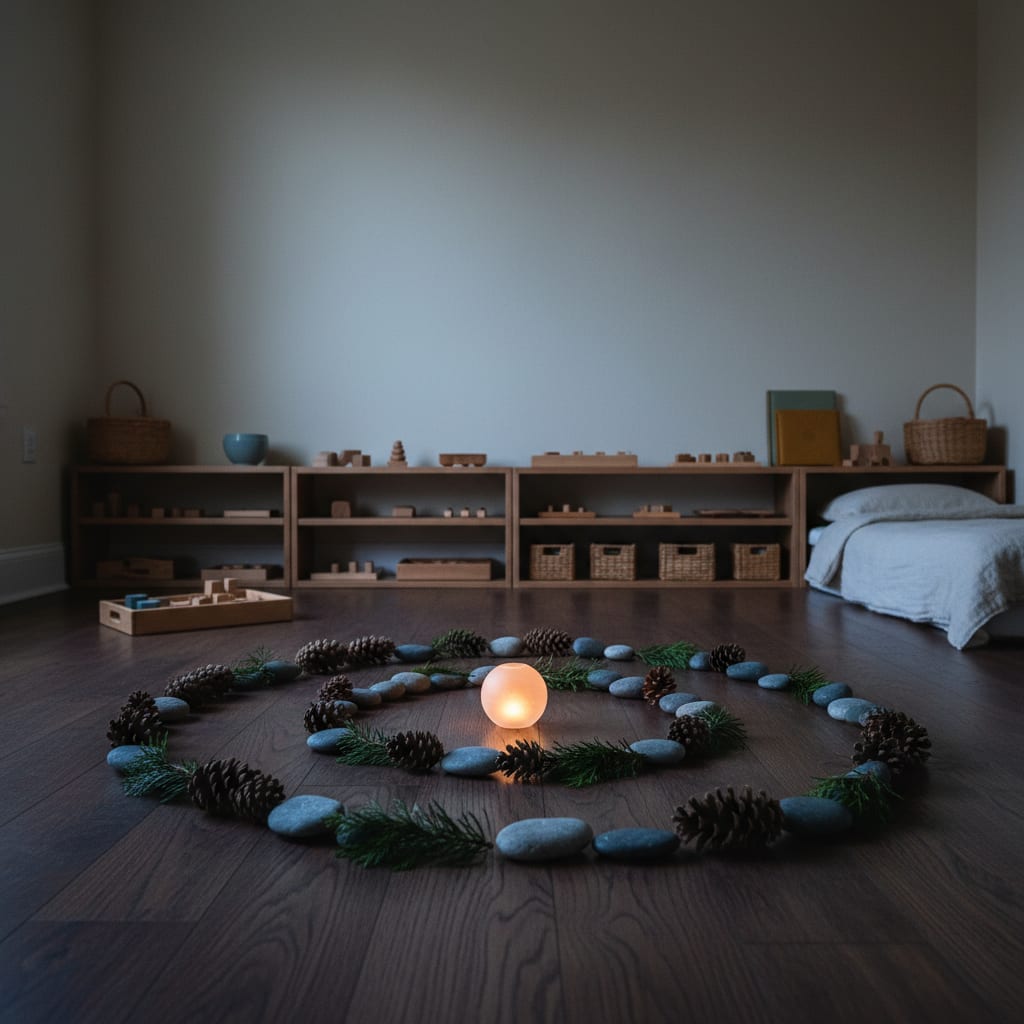
Back inside, the Trillium spiral shrinks nicely onto a tray or a corner of the floor. Lay a spiral of pine cones, stones and evergreen cuttings. Put an unlit battery tea light at the centre. Each person walks in, switches one light on and sets it along the path on the way out. For a toddler, one light is the whole ceremony.
Then go to bed. The longest night is a lovely reason for an early bedtime, and “it’s the longest night, so we’re sleeping early to enjoy it” is an explanation a child can hold onto.
Two things keep “early” from turning into a bad night:
- Keep the wake-up time where it is. The CDC’s sleep recommendations, via its sleep guidance page, are 11 to 14 hours a day for toddlers aged 1 to 2 and 10 to 13 hours for children aged 3 to 5, “including naps.” A child who goes to bed thirty minutes early often just sleeps a little more. A child put down two hours early may lie awake. Betteroo’s sleep chart suggests you count back from the time your child wakes up and then allow a little time to fall asleep. That is a better way to pick tonight’s bedtime than the sunset.
- Run the same routine, just earlier. Same steps, same order, same last word. If the child already runs their own steps, as in our Montessori bedtime routine, the routine holds steady even on a night that feels special.
If the walk leaves your child finding the dark hard at bedtime, Betteroo has a calm plan for nights when the dark feels big, built around a dim night-light, a short routine and brave practice in the daytime.
 The longest night, an easy bedtime?
Betteroo builds a gentle, personalized sleep plan around your child's age, naps and wake-up time, so an early night is one they can actually sleep through.
Take the free sleep quiz →
FAQ: the winter solstice with young children
When is the winter solstice in 2026?
The U.S. Naval Observatory gives Monday, December 21, 2026, at 20:50 Universal Time, which is 3:50 p.m. Eastern.
Is a lantern walk a Montessori activity?
Not originally; it is closer to Waldorf seasonal festivals. You can still run it the Montessori way: explain the real event first, let the child manage their own light, and keep it short.
Can toddlers carry candles on a lantern walk?
Give children battery-powered lanterns only. The U.S. Fire Administration advises avoiding lit candles and considering flameless ones; any real flame stays with an adult, in a sturdy holder, never unattended.
Should my child go to bed early on the solstice?
A slightly earlier bedtime is a nice way to mark the longest night, as long as the morning wake-up time stays the same and the routine is the usual one. If you have concerns about how your child sleeps, ask your pediatrician.