The main difference between Montessori and traditional preschool is who sets the pace. In a Montessori classroom, children of mixed ages choose their own work from prepared materials during a long, uninterrupted work period, with a trained teacher giving short individual lessons. In a traditional preschool, a teacher usually leads a same-age group through a shared schedule of circle time, themed activities and play centres. Neither is right for every child. The more useful questions are whether a particular school actually runs the model it advertises, what it costs you, and how your child handles freedom and structure.
I’m not a trained Montessori guide or an education researcher. I worked as an assistant in a Montessori toddler community, which tells me what a classroom looks like, not which model is better. The descriptions below come from the American Montessori Society and the AAP, the research from its authors’ own summary, and the quality warnings from The Hechinger Report.
How a Montessori preschool day works
The American Montessori Society’s core components page sets out what a Montessori classroom is supposed to include. Four of them define the preschool experience:
- Mixed ages. The early childhood group typically spans “2.5 – 6 years.” Younger children watch older ones; older children reinforce what they know by helping.
- A long work period. AMS recommends at least two hours a day, four days a week, with “3 hours optimal, 5 days a week.” During it, children “select and complete tasks without interruption.”
- Specific materials. “Each carefully crafted material focuses on a single skill or concept and follows a logical sequence.”
- Trained teachers. AMS recognises credentials from AMS, AMI and accredited Montessori teacher education programs.
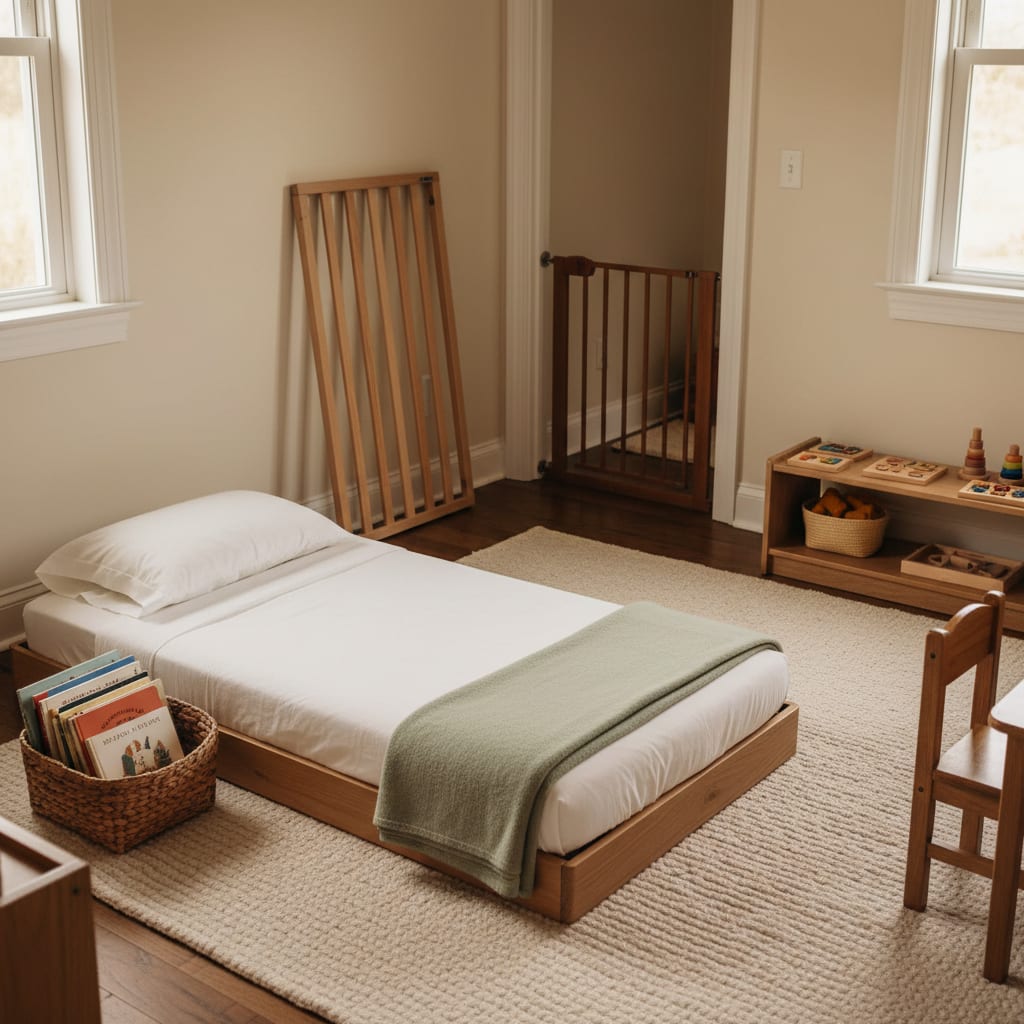
In practice that looks like a calm room of low shelves, children working alone or in pairs on mats and at tables, and a teacher moving between them. There is usually a short group gathering, but the bulk of the morning belongs to the child’s own choices.
How a traditional preschool day works
“Traditional” covers a huge range, from play-based programmes to academic pre-K, so any description is a generalisation. Most share a few features: children grouped by age, a daily schedule the teacher leads, group activities such as circle time and themed crafts, and free play at learning centres such as blocks, art, sand and dress-up. Pretend play usually has a bigger, more open place than in a Montessori room, which tends to emphasise real-world materials. Our comparison of Montessori and Waldorf covers the fantasy question in more depth.
A good traditional preschool is not a lesser thing. The AAP’s guide to choosing a child care center asks the same core questions of any programme: whether it is licensed or accredited, whether you can visit, whether children are “cared for in small groups,” and whether activities are “proper for their age group.” Those questions matter more than the label on the door.
What the research says, and who is saying it
The strongest recent evidence is a national randomised trial of public Montessori preschool published in 2025 in the Proceedings of the National Academy of Sciences. Its authors summarised it for Brookings: 24 public Montessori schools, with children admitted by lottery compared to children who applied and were not admitted.
What they report, in their words:
- At the end of the two preschool years, “there were no differences” between the groups.
- By the end of kindergarten, children who won the lottery “were better readers and had better short-term memory, executive function, and social understanding.”
- Three years of public Montessori cost “$13,127 less per child than traditional public preschool.”
Two honest caveats. First, the summary is written by advocates: its first author, Angeline Lillard, is a University of Virginia psychology professor, and the piece openly argues for the model. That doesn’t make it wrong, but it is not an independent review. Second, it is a study of public Montessori schools that met criteria for being genuine programmes. It says nothing about the private “Montessori” preschool down your road, and the next section explains why that distinction matters.
The name problem
“Montessori” is not a trademark. Anyone can use it. The Hechinger Report’s 2018 investigation, Will the real Montessori please stand up?, found that out of “more than 4,000 so-called Montessori schools” in the US at the time, “only 1,250 are affiliated with the American Montessori Society (and only 204 are AMS-accredited) and about 220 are recognized by AMI.” Those figures are from 2018 and will have changed, but the point has not: a sign saying Montessori tells you very little.
That is the single biggest practical difference between the two options. A traditional preschool is roughly what it says it is. A Montessori preschool might be a high-fidelity programme or might be a daycare with some wooden toys. Our post on whether Montessori is bad puts the generic-name problem at the top of the honest case against it.
Cost
Montessori has a reputation for being expensive, and the Brookings authors acknowledge it: “Many people think of this as an expensive model.” Their argument is that, in public schools, it cost less per child because its “intentionally higher child:teacher ratios” more than offset the training and materials. Public Montessori programmes exist in some districts, and Hechinger’s report describes middle- and upper-class parents competing for spots in private ones. Prices vary so much by area that the only useful figures are your local ones, so ask each school for its full fees, including any extras.
How to tell if a Montessori school is the real thing
Hechinger’s checklist, drawn from Montessori organisations, is a good start:
- Trained teachers in the age group they teach, from a programme accredited by the Montessori Accreditation Council for Teacher Education.
- Membership in or accreditation by AMS, AMI or a similar body.
- Mixed-age classrooms and a long work period, which you can see on a visit.
- Real Montessori materials on open, low shelves, and children using them independently.
Visit during the morning work period, not at pick-up, and ask how long it lasts.
Which fits your child?
There is no outcome-based answer for an individual child. Some practical questions help:
- Does your child settle into long, quiet focus, or thrive on group energy and a changing schedule?
- Is there a genuine Montessori school within reach, or only Montessori-in-name options?
- Does the school fit your family’s hours and budget?
- When you visit, do the children look absorbed and the teachers calm?
If you are new to the method, what Montessori actually means is a good grounding before you tour.
FAQ: Montessori vs traditional preschool
Is Montessori better than traditional preschool?
Research on genuine public Montessori programmes is encouraging, but it cannot tell you which is better for your child or whether a particular school is genuine. Visit, ask about training and accreditation, and watch the children.
What is the biggest difference between Montessori and traditional preschool?
Who sets the pace. Montessori children choose their own work during a long work period in a mixed-age room. Traditional preschools usually follow a teacher-led schedule with same-age groups.
Is Montessori preschool more expensive?
It has that reputation, but fees vary by school and area, and public Montessori programmes exist in some districts. Compare full local fees rather than relying on averages.
Can a child move from Montessori to a traditional school?
Yes. Families switch at kindergarten or later for all kinds of reasons. Ask the new school how it settles children who arrive from a different model, and visit together first.