What Does Montessori Actually Mean?
“Montessori” is a surname. It belongs to Maria Montessori, an Italian physician who opened a classroom for the children of a poor Roman neighbourhood in 1907, watched what they did when the environment was arranged for them rather than for the adult, and spent the following fifty years writing down the method that came out of it. Today the word carries three quite different meanings: a body of educational theory, a type of school, and — most loosely — a marketing label on furniture and toys. Only the first has a fixed definition.
Where the word comes from
Maria Montessori qualified as a doctor in Italy in the 1890s, among the first women in the country to do so, and came to education sideways — through medicine, anthropology and work with children who had been written off as uneducable. The first Casa dei Bambini, the “children’s house”, opened in the San Lorenzo district of Rome in 1907. It was not a school for the affluent; it was childcare in a tenement, and the method emerged from observation of the children in it.
That origin explains a lot about the vocabulary. She kept using clinical, observational language — the prepared environment, sensitive periods, the absorbent mind — because she was describing what she had watched happen, not proposing a curriculum. It also explains why the method is, at heart, cheap: it was invented for children whose families had nothing.
The six ideas underneath it
Strip away the wooden materials and the word means these six things.
1. The absorbent mind. Montessori’s claim that a young child does not learn the way an adult does — they take the whole environment in, indiscriminately and without effort, roughly up to age six. The practical consequence is that what you put in the room teaches more than what you say.
2. Sensitive periods. Windows in which a child is powerfully drawn to a specific kind of learning — order, language, small objects, movement, refinement of the senses. During the window the thing is learned almost effortlessly; outside it, it’s work. Following the child means noticing which window is open now.
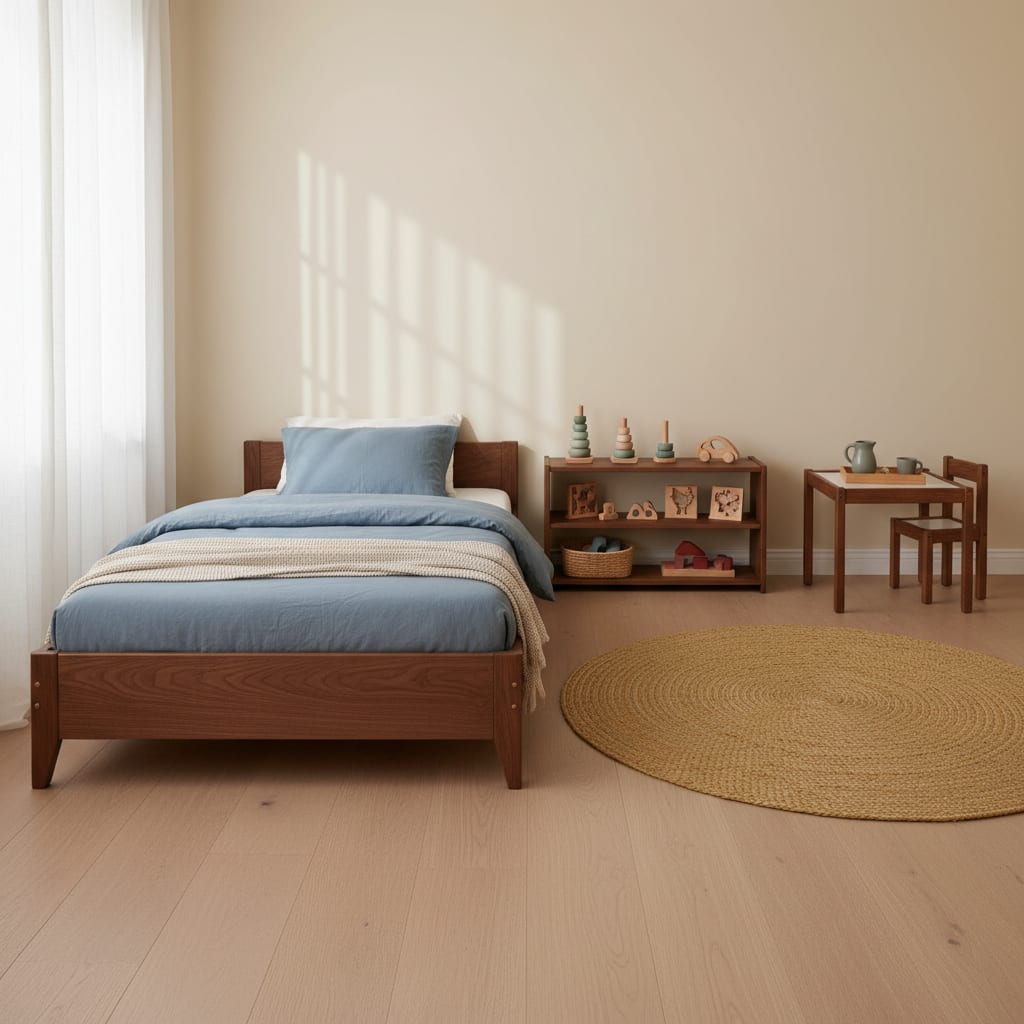
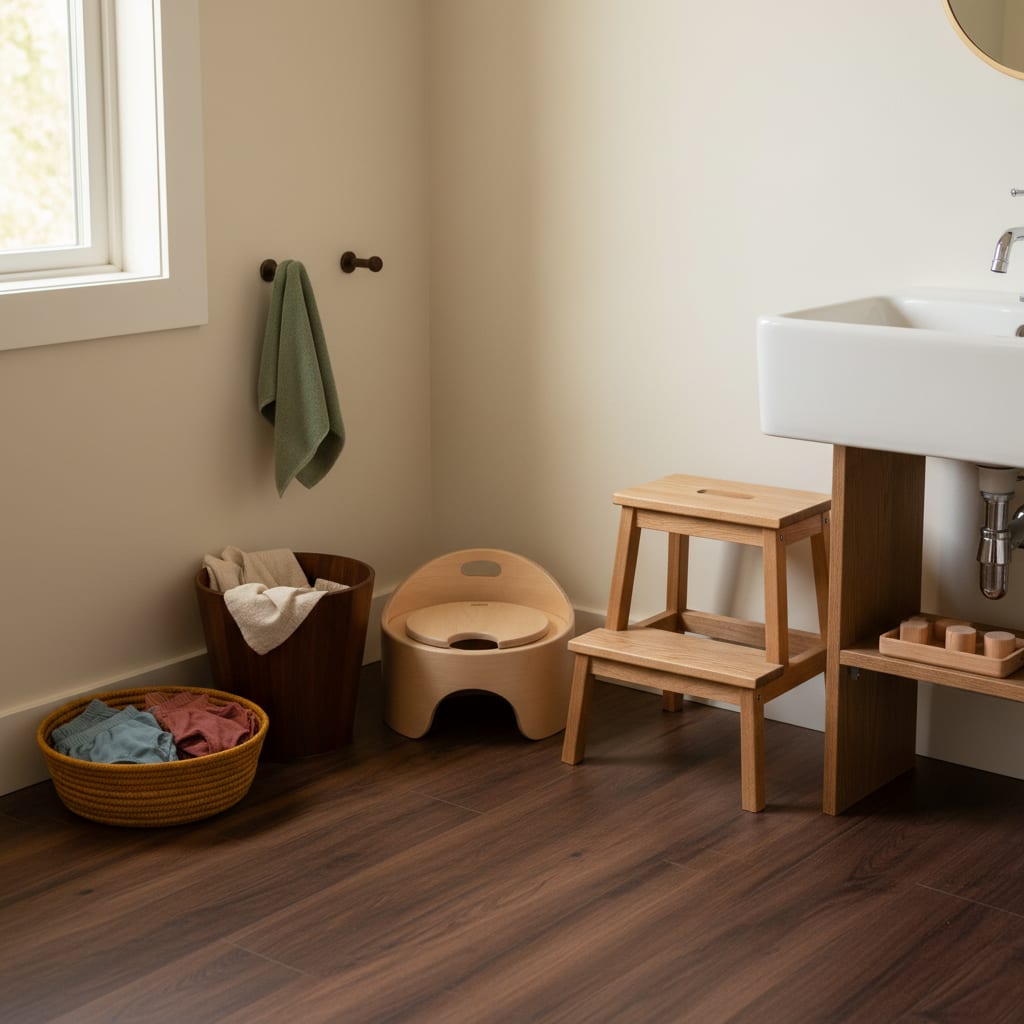
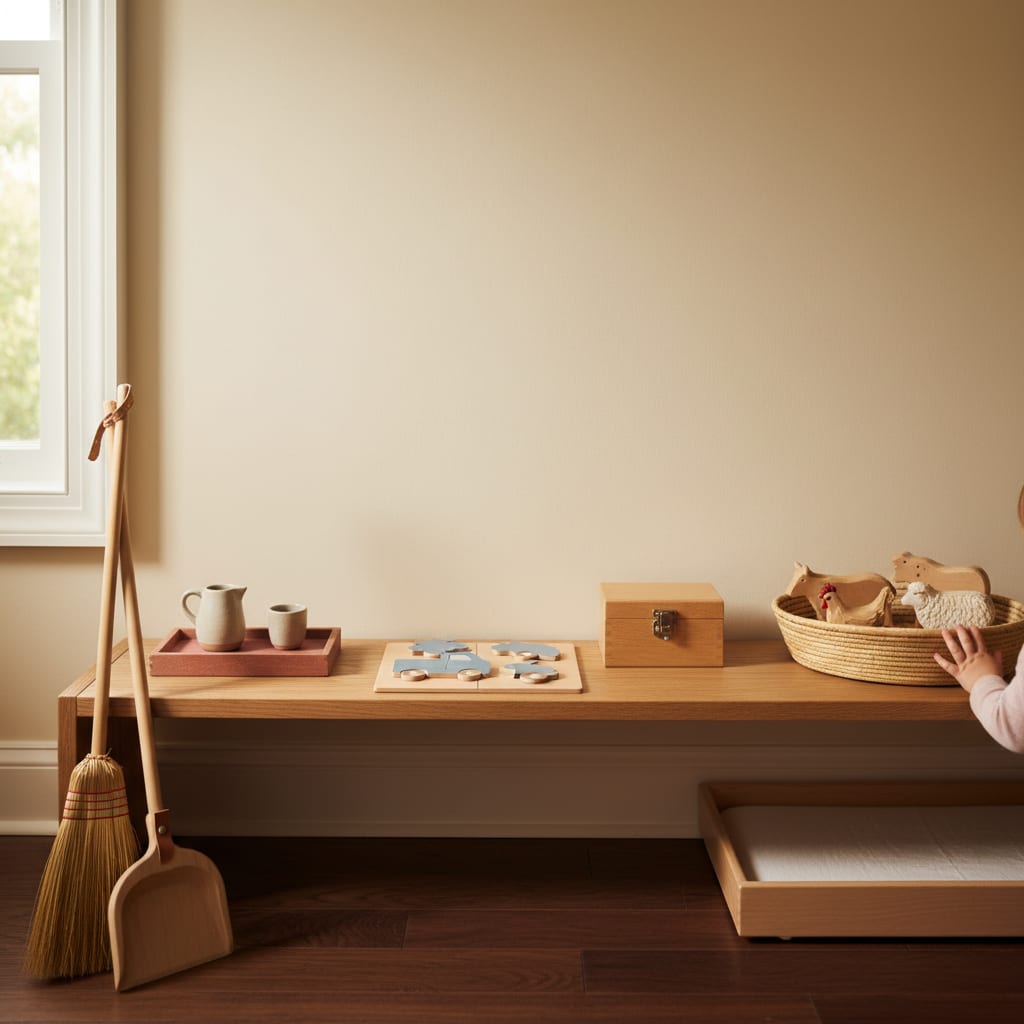
3. The prepared environment. The adult’s main job. Everything sized to the child, everything reachable, everything with a place to return to, and far less of it than instinct suggests. A room arranged so a child can act without asking permission.
4. Freedom within limits. Children choose their own work and how long to stay with it; they may not disturb another child’s work, damage the materials, or leave a thing unrestored. Both halves are load-bearing, and dropping the second is the most common way home Montessori goes wrong.
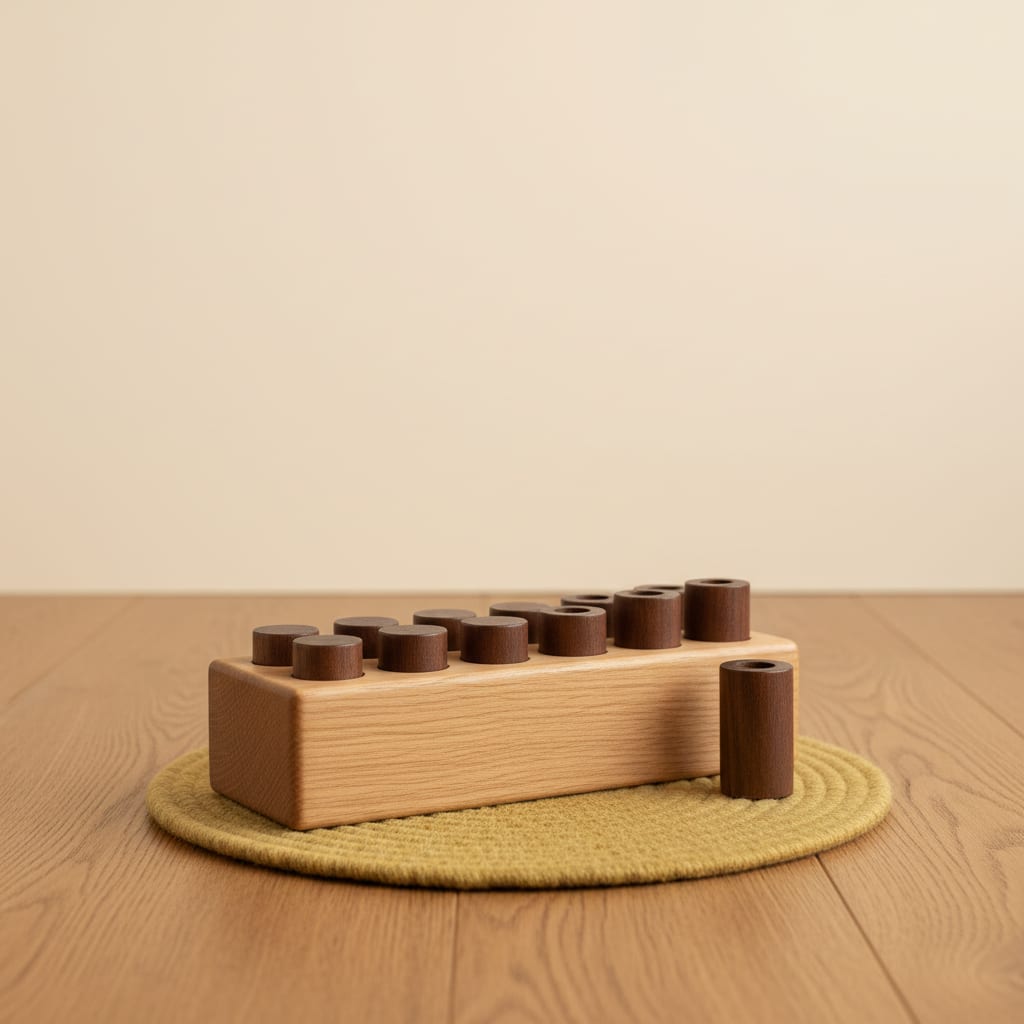
5. Control of error. Montessori materials are built so the material itself shows the mistake — the cylinder that won’t fit, the tower that won’t stack. The child corrects themselves without an adult grading them, which is why they’ll repeat the work forty times without discouragement.
6. Observation, then non-interference. The adult watches, records, prepares — and then does not interrupt a concentrating child. “Never help a child with a task at which he feels he can succeed” is the line that gets quoted, and it is genuinely the hardest part.
Those six, plus the long uninterrupted work period and the mixed-age group, are what the word means when it’s used precisely.
A school sign: what the word guarantees
Nothing, legally. “Montessori” was ruled a generic descriptive term by a US trademark decision in the 1960s, so any school may use it without training, accreditation or oversight. Two schools with identical signs can run completely different rooms.
What to look at instead: whether the guides trained with AMI or AMS (the two main accrediting bodies), whether there is a genuine three-hour uninterrupted work period, whether the classes are mixed-age, and whether the materials are in use rather than on display. Fifteen minutes of watching tells you more than any prospectus.
On a product box, it usually means nothing at all
There is no Montessori certification for toys, beds, wardrobes or shelves, and no body that could issue one. “Montessori” and “Montessori-inspired” on packaging are descriptions of a style — plain wood, muted colours, single purpose — applied by the seller.
Some of those products are genuinely well made and genuinely useful. Plenty are ordinary toys with a 40% markup for the adjective. The test is the object’s behaviour, not its label, which is the whole of what makes a toy Montessori.
The line most people get wrong
Montessori is not a parenting style, a discipline system, or an aesthetic. It is a description of how young children learn plus a set of arrangements that follow from it. Everything else attached to the name — the gentle-parenting scripts, the beige playroom, the capsule wardrobe — is a modern accretion, some of it useful and none of it definitional.
Applied at home, the word means something narrower than the internet suggests and more demanding than it sounds: prepare the room, then get out of the child’s way. The applied-to-family-life half of that is set out in what Montessori parenting means, and what “get out of the way” looks like in a real afternoon is in helping a child concentrate. If you want the shortest possible demonstration of the six ideas at once, watch what happens when you offer a two-year-old real language for real objects — the language activities are the cheapest entry point there is.
FAQ: the meaning of Montessori
What does the word Montessori mean?
It is the surname of Maria Montessori, the Italian doctor who developed the method after opening a children’s house in Rome in 1907. It now also functions as the name of her educational approach and, loosely, as a product label.
What is Montessori in simple terms?
A method built on the idea that children learn best by choosing purposeful work in an environment prepared for their size and stage, with the adult observing rather than directing.
Is Montessori a religion or a philosophy?
Neither. It is an educational method grounded in observation of children. It has no religious content and no doctrinal requirement, though some of its followers treat it more strictly than others.
Does “Montessori” mean anything legally?
No. A US trademark ruling in the 1960s made the term generic, so any school or product can use it. Accreditation by AMI or AMS is the closest thing to a meaningful signal.
Is Montessori-inspired the same as Montessori?
No. “Inspired” is an unregulated marketing phrase, and in practice it usually signals that the item borrows the look — plain wood, few colours — rather than the design principles.