Crib to Floor Bed Transition: A Two-Week Plan

The crib to floor bed transition takes about two weeks in most houses, and almost all of the work happens before night one. Childproof the room to crib standard, keep every other part of bedtime identical, move naps and nights over on the same day, and then spend ten days walking your toddler back to bed with the same four boring words. That’s the whole method. The families I’ve watched struggle weren’t doing it wrong so much as changing three things at once — new bed, new routine, new expectations — and then reading the resulting mess as proof the floor bed had failed.
If you’re still deciding whether to do this, start with when to switch to a floor bed instead. This post assumes the decision is made and the mattress is in the hallway.
Set up the room before you touch the bed
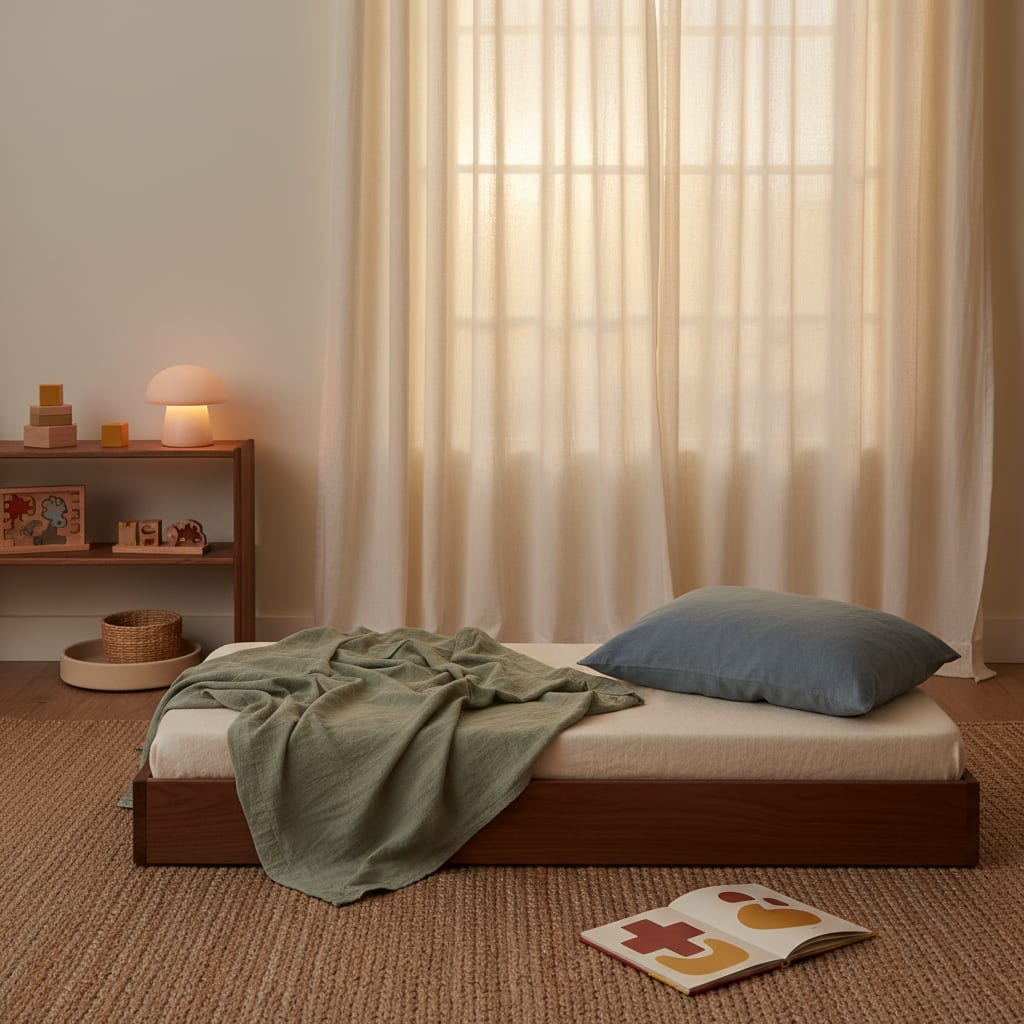
The single biggest predictor of a smooth transition is whether the room can hold an unsupervised toddler at 5 a.m. A crib is a container; a floor bed makes the whole room the container, so the room has to earn it.
Work through the full floor bed safety checklist — anchored furniture, covered outlets, cordless or tied blinds, nothing climbable near a window — and then make two decisions people tend to leave until the first bad night:
- The doorway. Most families use a gate rather than a closed door, so the child can see and hear the house without wandering into the stairs. A standard pressure-mounted walk-through model like the Regalo Easy Step does the job in a normal doorframe; at the top of stairs, use a hardware-mounted gate instead — pressure gates are not rated for that position.
- The floor. Whatever is reachable from the bed is now part of the bed. A book basket and a soft rug are fine. The lamp cord, the humidifier, the box of small parts are not.
Do the room a few days early and let your toddler play in the finished version in daylight. Novelty burned off at 2 p.m. is novelty you don’t pay for at 2 a.m.
Move the bed in with the child, not while they’re out
Montessori’s contribution to this whole business is small and useful: the child should experience the change as something happening with them. Let them carry the pillow, decide which of two pre-approved wall positions the bed faces, put the books in the basket themselves. Ten minutes of participation buys a surprising amount of cooperation, and it costs nothing.
Keep the crib in the room if you must, but dismantled and out of sight — a visible crib is a nightly negotiating position. Most families find it easier to take it out entirely.
Days one to three: expect the party
The first nights are theatre. A child who has never been able to leave the bed will leave the bed, delighted, repeatedly, and will check your face carefully each time to learn what this new power does.
What to do: walk them back. Same route, same words, same flat tone. Pick four words and never improvise on them — “It’s sleeping time now” works — and skip the explanation, the negotiation and the second story. The information your toddler is gathering isn’t verbal; it’s whether leaving the bed produces anything interesting. Make the answer no, fourteen times if needed.
What not to do: a new star chart, a stern talk, or a bribe. Stakes make the exit more interesting, not less. Also don’t hover in the doorway watching — many toddlers will keep getting up purely because you’re visibly available.
Some children sleep on the rug, or half-off the mattress, or wedged under it. This is fine and self-correcting. Put them back on the mattress when you go to bed and let it go.
Days four to ten: the boring middle
This is where the transition is actually won, and it is genuinely dull. The exits get fewer and shorter. Bedtime creeps back toward its old length. You will be tempted to introduce something new — a reward, a different routine order, an earlier bedtime — because progress feels slow. Don’t. The consistency is the intervention.
Two things to watch in this window. First, the schedule: overtiredness looks exactly like defiance at this age, and if bedtime has drifted 45 minutes later during the chaos, fix that before anything else. Betteroo’s guide to when a toddler bed makes sense is a fair outside read on timing if you’re second-guessing yourselves mid-week. Second, early waking: a child who can now get up at 5:40 will. A blackout-dark room and a boring 5:40 response are your two tools; there isn’t a third.

Naps wobble longer than nights
Almost every family reports the same asymmetry: nights settle first, naps take another week or two. Daylight, a less tired child, and a room full of newly reachable books make the nap the harder sell.
Hold the line on the nap period rather than the nap itself. The child stays in the room for the usual window; sleeping is optional, leaving isn’t. For toddlers genuinely at the end of napping, that same structure becomes quiet time — the same hour, different expectation. Don’t switch the two beds around to solve a nap problem; splitting crib naps and floor-bed nights teaches that the arrangement is negotiable, and it stretches the transition out for months.
Judging it at two weeks, and when to pause
At day fourteen, ask one question: is the trend going the right way? Fewer exits, shorter settling, earlier sleep onset than day three — that’s a working transition, even if it isn’t finished. Keep going.
If sleep is genuinely worse than in the crib after two weeks of consistent, boring nights, check the schedule first, then the room’s darkness and temperature, then illness and teeth. If all of that is clean and it’s still a nightly rout, putting the crib back for a season is a legitimate move, not a defeat. The floor bed will still be there at 26 months. The whole point of the Montessori floor bed is that it serves the child in front of you — and “not yet” is a respectful answer.
FAQ: crib to floor bed transition
How long does the crib to floor bed transition take?
Usually one to two weeks of nightly testing before things settle, with naps taking a week or two longer than nights. Consistency shortens it; new rules, rewards and negotiations lengthen it.
Should I do naps and nights on the floor bed at the same time?
Yes. Splitting — crib for naps, floor bed for nights — teaches a toddler the arrangement is up for discussion, and it drags a two-week transition into a two-month one. Move both on day one.
What do I do when my toddler keeps getting out of the floor bed?
Walk them back with the same four words and no extra attention, every single time. Most children stop testing within one to two weeks once leaving reliably produces nothing new — no lecture, no snack, no extra story.
Do I need a gate on the bedroom door?
Most families use one, so the child can hear the house without roaming it. Use a hardware-mounted gate at the top of stairs; pressure-mounted gates belong in doorways and at the bottom of stairs only.
Can we go back to the crib if it isn’t working?
Yes, as long as your child isn’t climbing out — an escaping toddler makes the crib the more dangerous option. Otherwise, pausing for a season and retrying is completely reasonable, and children rarely mind the return.