Montessori Toys for 5 Year Olds: A Realistic Shelf
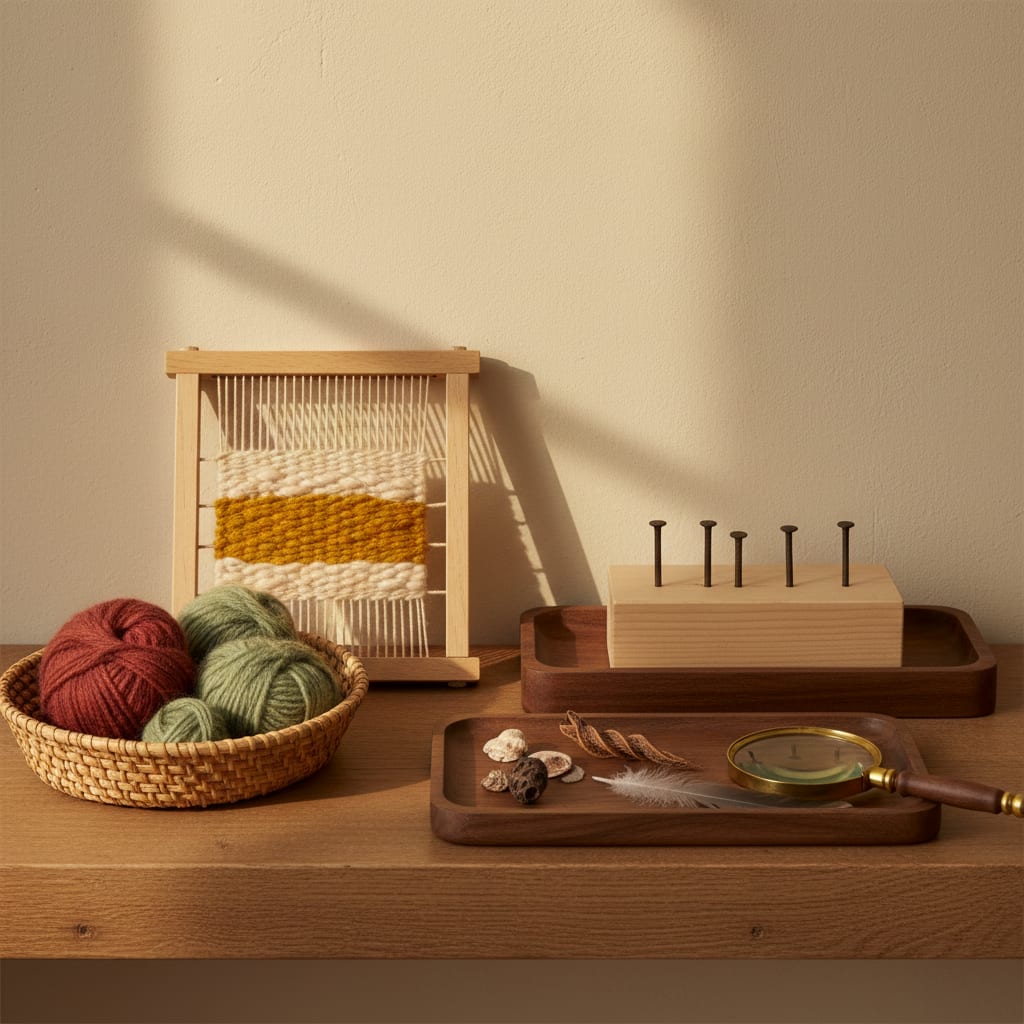
The best Montessori toys for 5 year olds are long projects and real tools rather than toys in the usual sense. Think a small weaving loom, sewing with a blunt needle and real thread, a supervised woodwork tray with child-size tools, first decodable books for a child who is starting to sound out words, one or two games with real rules, and a globe beside a few nature specimens. Keep eight to ten choices out and rotate the rest. Leave the classroom math materials to school, especially if your child attends a Montessori program.
The test is the one this site uses at every age: would this get chosen weekly without me selling it? I was a classroom assistant in a Montessori toddler community, not a trained guide, and five is the top of this site’s age range. So the doctrine below is linked to the American Montessori Society rather than asserted by me.
What five looks like
The AMS’s Family Alliance guide for 5-year-olds opens with a strong claim: “Five is the year of the explosion — into reading, into mathematical operations, into research and cultural curiosity.” It describes children at this age as “at the peak of the 3-6 curriculum with long concentration spans and increasing abstraction.”
That changes the shelf. At four, a work might last ten minutes. At five, a good one can fill a morning, and a child may come back to an unfinished weaving for days.
The CDC’s 5-year milestone checklist is a useful reality check. The CDC defines a milestone as something “most children (75% or more) can do by a certain age,” so these are floors, not goals.
| CDC 5-year milestone (CDC wording) | What on the shelf serves it |
|---|---|
| “Follows rules or takes turns when playing games with other children” | One cooperative game, one simple competitive one |
| “Does simple chores at home, like matching socks or clearing the table after eating” | Real jobs, real tools |
| “Pays attention for 5 to 10 minutes during activities” | Handwork that rewards longer attention |
| “Writes some letters in her name” | A writing tray, not worksheets |
| “Buttons some buttons” | Sewing, lacing, dressing practice |
| “Uses or recognizes simple rhymes (bat-cat, ball-tall)“ | Sound games, then first readers |
Handwork that fills a morning
This is the part of a five-year-old’s shelf I would protect first. Handwork has real steps, a visible result, and room to get better.
- A weaving loom. A small frame loom with thick yarn, such as the National Geographic wooden loom kit, works well as a project. A child can weave a few rows, leave it, and come back the next day to find it waiting. Show the over-under once, slowly, then step back.
- Sewing, step by step. Move from lacing through holes punched in card, to a large blunt needle such as the FILAN plastic sewing needles with yarn through loose-weave fabric, then to sewing on a big button. The CDC’s buttoning milestone and this tray support each other.
- Finger knitting or braiding. Three lengths of yarn taped to the table edge. No equipment and a lot of concentration.
Keep needles on their tray, and keep the tray out of reach of a toddler sibling.
Real tools, with an adult nearby
The AMS’s 5-year guide lists a common mistake: “Stopping practical life because they’re ‘past that’ — practical life continues through elementary.” At five, practical life can include tools that do real work.
- A woodwork tray. A soft wood offcut, a few large-headed nails started by you, and a child-size hammer. The Stanley Jr. 10-piece kids tool set is sold as real construction tools in a child’s size, with a belt pouch. This is a with-an-adult work every time: you sit beside it, safety glasses on, and it goes back on a high shelf afterwards.
- Screwing and unscrewing. Real screws into pre-drilled holes in a board, with a child-size screwdriver.
- Bigger kitchen jobs. Measuring, cracking eggs, washing and peeling with a peeler, always with you there.
Tools are where the home can do something a classroom often cannot: fix a real chair leg together, or build a real bird box.
Reading, when sounding out arrives
The AMS guide calls reading “PEAK” at five, and describes a moment many parents will recognise: “After months of encoding with the Moveable Alphabet, your child may spontaneously discover they can decode — read.” Its suggested material is phonetic reading cards: “Cards with simple CVC words (cat, dog, pen, sun) for the child to decode independently.”
At home, short decodable books do the same job. Bob Books Set 1 are tiny books built from short, sound-it-out words. A child who is ready will read one aloud to you, then read it again to a sibling.
Two warnings, both from the same guide. Do not rush: “Comparing reading timelines between children — the range of normal is enormous.” And do not quiz: “Pushing comprehension questions after reading — let the joy of decoding be enough for now.” The steps before this, from sound games to the movable alphabet, are in learning to read the Montessori way.
Numbers without worksheets
The AMS guide’s 5-year math example is the golden bead material: two children combine and exchange bead quantities until “they have performed addition with 4-digit numbers.” It is a lovely material. It is also built for a trained guide’s sequence, and most families will not need it at home. If your child is in a Montessori school, they will meet it there.
What a home can offer instead is numbers with a purpose:
- Cooking with measures. Two cups of flour, half a teaspoon of salt.
- Counting money for a real purchase, at a market stall or a library sale.
- Dice games. Rolling and adding two dice is arithmetic the child actually wants to do.
The guide’s list of mistakes starts with this one: “Rushing to workbooks and worksheets — the materials ARE the curriculum.”
Games with real rules
Five is when games start to work: following rules, taking turns, sometimes losing without the evening falling apart. One cooperative game and one competitive one is plenty.
- Cooperative: Outfoxed! is a whodunnit for preschoolers in which the players work as a team to find the fox before it escapes. Everyone wins or loses together, and the clue-checking is real logic.
- Competitive: any simple dice or card game your family already plays. Snap, Go Fish and dominoes have taught turn-taking for generations.
Play together at first. Turn-taking is practice, not a test.
A globe and a research corner
Among its environment tips for five, the AMS lists “a research area where questions can be explored” and “cultural materials: globe, maps, nature specimens.” The four-year shelf started with a map puzzle. At five, a real globe earns its place.
- A globe. A raised-relief globe like the Replogle Student classic world globe lets a child feel mountains and trace where a relative lives or where a book is set.
- A nature tray that grows. Shells, seed pods, feathers and a magnifying glass. At five, add simple field guides about local birds or trees, so a question can be answered by looking it up together.
- Books everywhere. The same AMS list puts this first: “Books everywhere — accessible, diverse, inviting.”
How many things, and what to leave to school
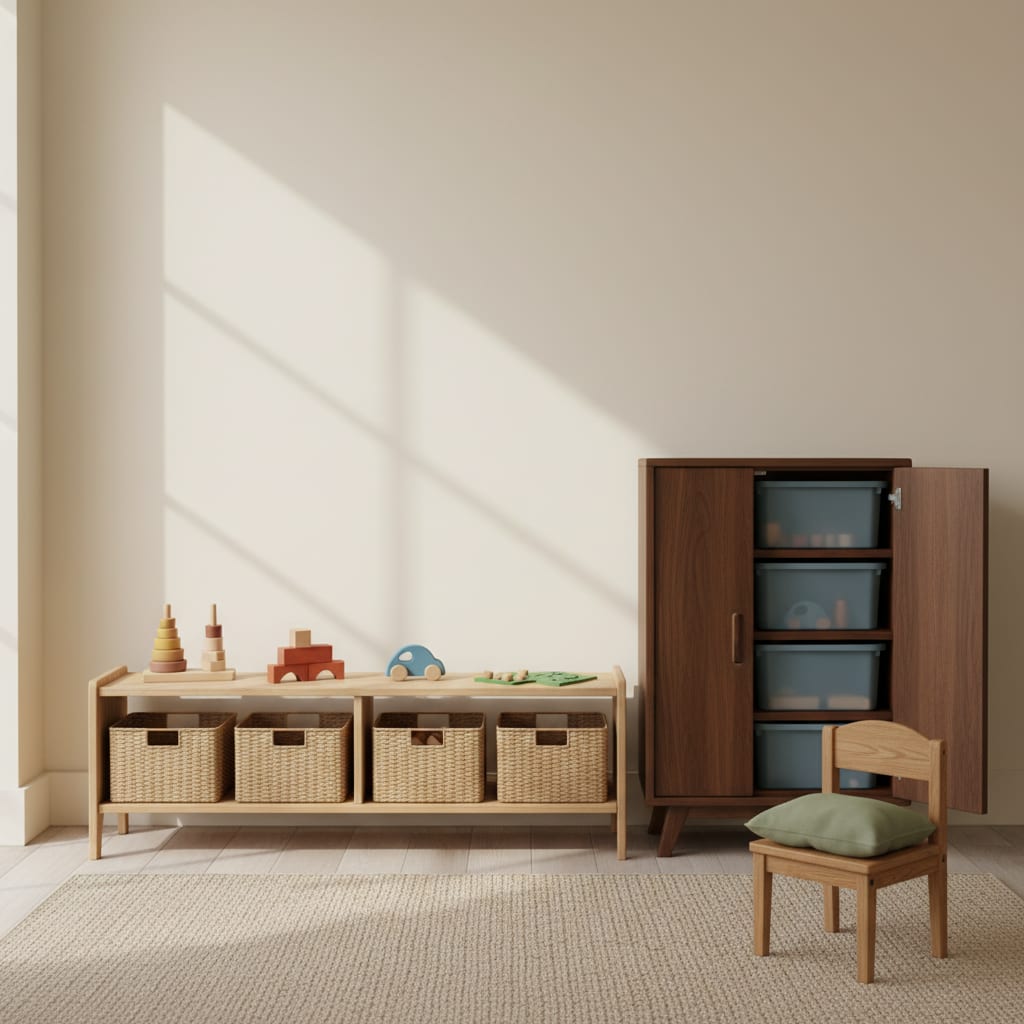
Eight to ten activities out at once, the rest stored. A five-year-old can concentrate for a long time, but only if choosing stays easy, and the toy rotation system works the same way at five as at two.
If your child attends a Montessori school, the home shelf can look less like a classroom. Nicole Kavanaugh’s post on her son’s play shelves at five says it directly: “Gus goes to a Montessori school so his shelves at home do not often include traditional Montessori materials.” She also gives the right instruction for any list like this one: “Always use these types of lists as inspiration but not as a prescribed need for a Montessori home.”
What a home can skip
- Classroom math sets (golden beads, stamp game, bead chains). These are built for a guide’s sequence and are expensive. See above.
- Workbooks and worksheet bundles. The AMS calls rushing to them a mistake.
- Anything sold as “Montessori-certified.” No such certification exists.
- Large toys that do one thing. A five-year-old wants to make things, not press buttons.
Coming up from a younger shelf? Montessori toys for 4 year olds shows what comes before. Much of it, especially scissors, pattern blocks and the map puzzle, stays useful at five. For gift-season choices across every age, Montessori Christmas gifts sorts them by kind of gift rather than by toy.
When the nap is gone
Most five-year-olds have stopped napping. Betteroo’s hub for sleep after the toddler years cites the American Academy of Sleep Medicine’s recommendation of 10 to 13 hours per 24 hours for ages 3 to 5. A quiet afternoon hour with the loom or a book from the shelf helps a long, nap-free day.
 Big days at five, hard evenings?
Without a nap, bedtime does all the work. Betteroo builds a gentle, personalized sleep plan around your child's age and routine.
Take the free sleep quiz →
FAQ: Montessori toys for 5 year olds
What are good Montessori toys for a 5 year old?
Long handwork such as a weaving loom and real sewing, a supervised woodwork tray, decodable first books for a child who is starting to read, one cooperative game, a globe and a nature tray. Practical life continues at five with harder, real jobs.
Should a 5 year old still have Montessori practical life work?
Yes. The American Montessori Society names stopping practical life because a child seems “past that” as a common mistake, and says it continues into the elementary years.
Do I need Montessori math materials at home for a 5 year old?
Usually not. Classroom materials like the golden beads are designed for a trained guide’s sequence. Cooking with measures, counting money and dice games give a five-year-old real reasons to use numbers.
How many toys should a 5 year old have out?
About eight to ten activities on the shelf, with the rest stored and rotated. Fewer choices make longer projects more likely.