Montessori Activities for 1 Year Olds: A Week at Home
Montessori activities for 1 year olds are mostly real life at child size: walking with them instead of carrying them, moving objects from one bowl to another, drinking from a small open cup, naming real things with real words, singing, and time outdoors at their pace. One activity a day, repeated, is plenty. You need almost nothing you do not already own. The week below spreads those across movement, hands, language, music and outdoors, with one rule throughout: the child does the work, and you prepare the place and then mostly watch.
I was an assistant in a Montessori toddler community and have no guide’s diploma, so the doctrine here comes from the American Montessori Society’s parent guide and the pediatric pages linked in each section.
What a one-year-old is working on
The AMS’s Family Alliance guide for 1-year-olds opens with walking: “At twelve months, your child is on the verge of — or has just achieved — independent walking. This changes everything.” It lists order, language, movement and small objects as the “active sensitive periods” at this age, and says “this is the age where practical life truly begins.”
The CDC’s 1-year milestone checklist lines up with that. By their first birthday most children (the CDC’s definition is “75% or more”) “Pulls up to stand”, “Walks, holding on to furniture”, “Puts something in a container, like a block in a cup” and “Looks for things he sees you hide, like a toy under a blanket.” Each day below serves one of those.
One safety rule covers the whole week. One-year-olds still mouth everything. The American Academy of Pediatrics’ choking-prevention page lists “Small balls”, “Toys with small parts” and “Toys that can be squeezed to fit entirely into a child’s mouth” among the household items to keep away from young children. Every object in these activities should be too big for that.
Monday: movement
The activity is a walk, at their speed. The AMS guide lists “Carrying them when they can walk — walk WITH them even when it’s slow” as a common mistake. Pick a short route, the hallway or the path to the mailbox, and let them do all of it, stopping when they stop.
Indoors, give them something to push and something to carry. A sturdy push wagon with a weight in it, a cushion to drag across the room, a basket with one apple in it. One-year-olds love “maximum effort” jobs, like carrying the biggest thing they can lift for no clear reason.
Tuesday: hand work
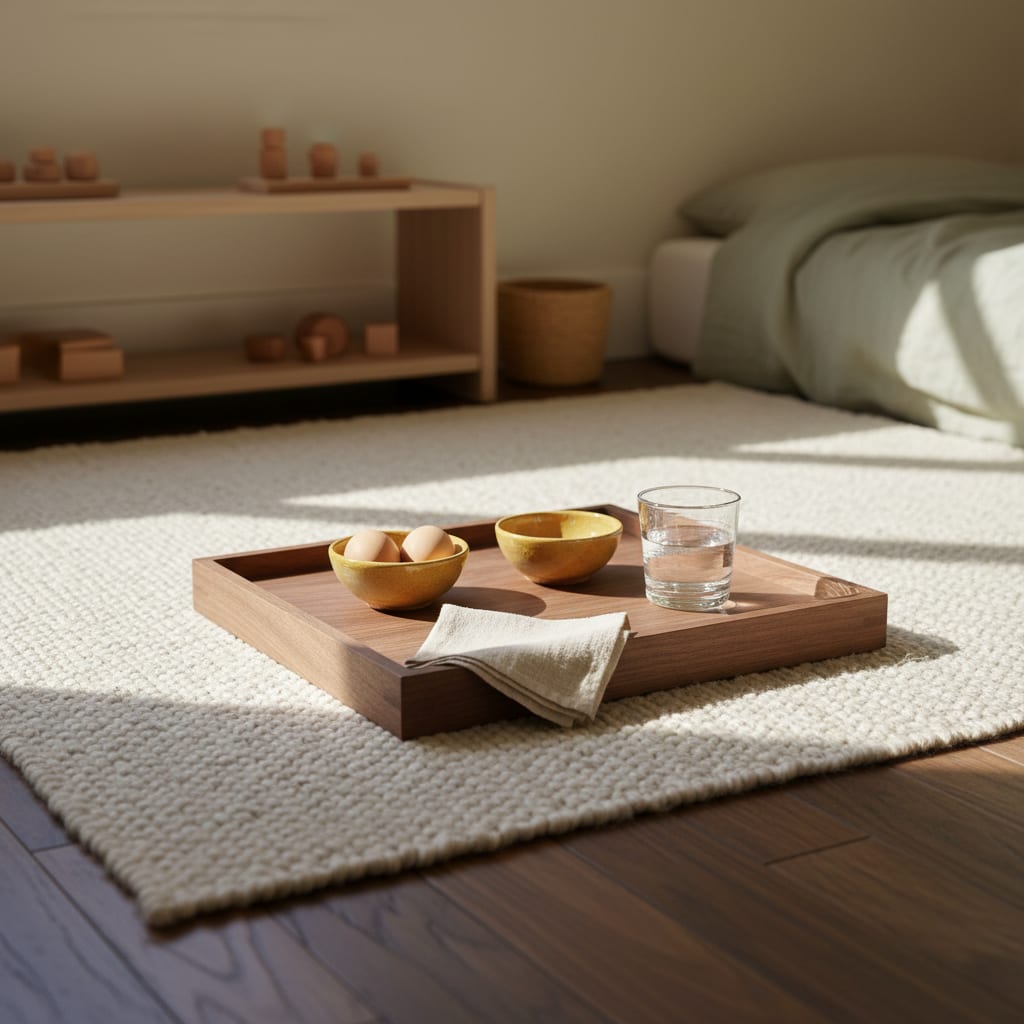
Transferring with hands is, in the AMS guide’s words, “the first practical life activity in the Montessori sequence.” Two small bowls on a tray and a few large objects. Move them one at a time from the left bowl to the right while your child watches, then pause, then offer the tray. The guide’s materials list says “wooden eggs, walnuts, or large pom-poms.” I use only the wooden eggs, or large wooden blocks: pom-poms can be squashed, and that is exactly the kind of object the AAP list warns about.
The ball drop. A box with a hole on top and a ball that drops through and rolls out into a tray. The AMS guide’s DIY version: “Cut a hole in a shoebox lid. Use a tennis ball. Tape the lid on.” It adds: “They may repeat this 20+ times — that repetition is the work.” If you would rather buy one, the object permanence box on my toys for a 1 year old list does the same job.
Wednesday: language
A basket of four to six real objects from one category (three pieces of fruit, a spoon, a cup and a bowl), named plainly. The AMS guide calls this the object naming basket and suggests the “Three Period Lesson”: name it (“This is a horse”), then ask them to find it (“Can you show me the horse?”), and only much later ask “What is this?” It adds: “If they get Period 2 wrong, just name it again cheerfully. Never correct.”
The full set of toddler language activities, sound games included, is in Montessori language activities for toddlers. For this week, one basket and ten minutes is enough.
Thursday: music
Music at this age is not a lesson. It is you singing the same three songs while doing ordinary things, and one real instrument the child can play: a small hand drum such as Remo’s baby drum, a shaker that is too big to mouth, or two wooden spoons on an upturned pot. Clap a rhythm and stop. See if they copy you. The CDC lists “Plays games with you, like pat-a-cake” at one year, which is a music game too.
Turn the background music off for the rest of the day. A child cannot listen to you singing and the radio at the same time.
Friday: outdoors
Go somewhere with grass, leaves or sand and let them lead. At one, the activity is noticing: a leaf in each hand, a stone too big to lift, a puddle. Name what they touch. Bring a small bucket and let them carry their finds home. Then let them put the finds on a low tray inside, which turns Friday into Saturday’s work.
Saturday: real jobs
Practical life at one is short, one-step and mostly imitation: carrying a cloth, putting a shoe in the basket, dropping a sock into the laundry. The full age-by-age list lives in practical life activities by age, so here is just one activity from the AMS guide, because it changes how meals feel:
Drinking from an open cup. The guide suggests a very small glass with “only 1-2 tablespoons of water”, and says “When they spill — and they will — hand them the towel to wipe.” Its reason: “using a real cup says: ‘I trust you with real things.’” The CDC lists “Drinks from a cup without a lid, as you hold it” at one year, so most children are already near this.
Sunday: repeat
Pick whichever activity your child liked most this week, put it out again, and do nothing new. Repetition is how a one-year-old learns. When carrying heavy things and real one-step jobs start to take over, move on to Montessori activities for 18 month olds.
How the week fits around sleep
Most of this works best in the long stretch after the morning nap, when your child is fed and rested. Betteroo’s guide to a sample two-nap day at twelve months says “most twelve month olds still do best on two naps”, and warns that new walkers “often wake to practice.”
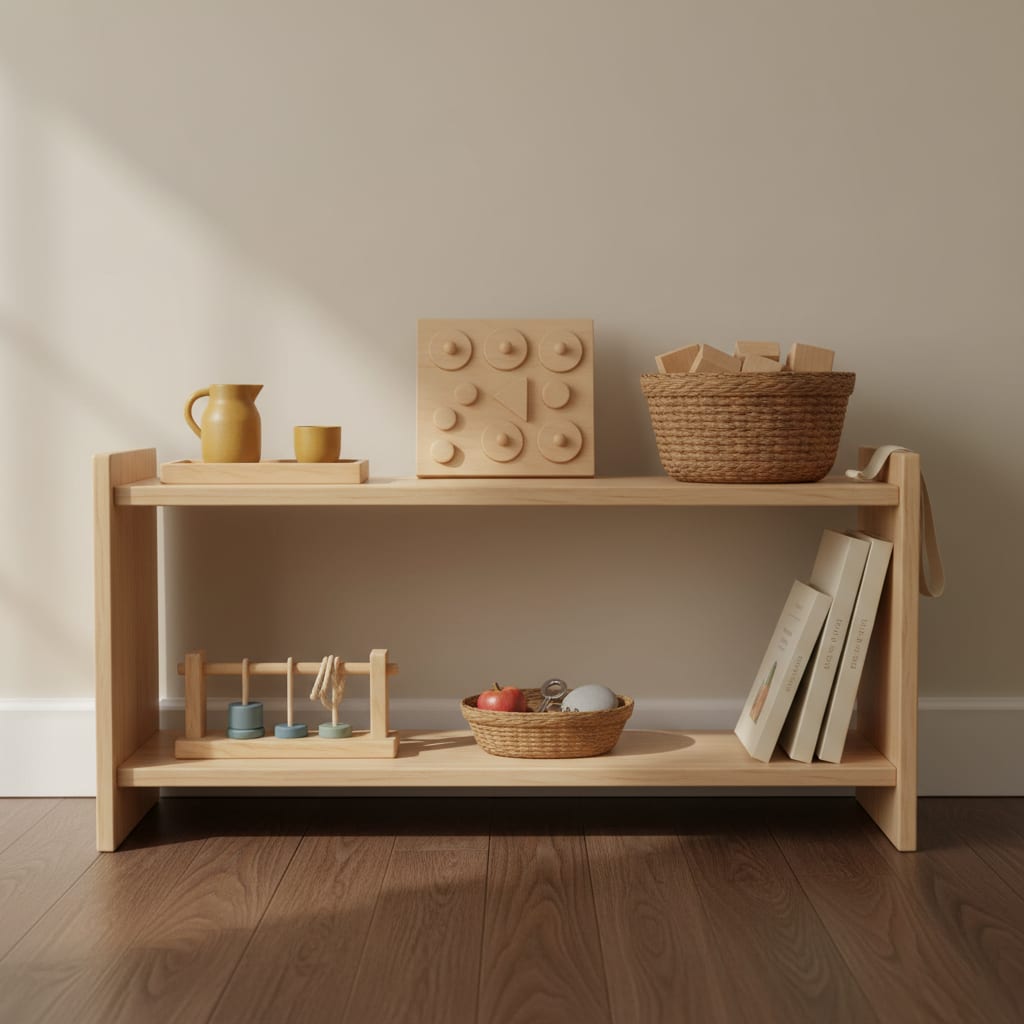
Keep the shelf short as well. The AMS guide’s line is “3-4 activities on a shelf is enough.”
FAQ: Montessori activities for one-year-olds
What Montessori activities can I do with a 1 year old?
Walking together, carrying and pushing heavy things, moving large objects between two bowls, a ball drop box, a basket of real objects to name, drinking from a small open cup, singing, and time outdoors.
How long should a 1 year old do an activity?
As long as they choose to. A one-year-old might repeat the ball drop twenty times and then walk away. Let them start and stop, and avoid interrupting while they are working.
Do I need Montessori materials for a one-year-old?
No. Two bowls, a shoebox, a ball, a small glass and some real objects from your kitchen cover almost everything here.
Is a one-year-old too young for practical life?
No. The AMS guide calls one “the age where practical life truly begins.” Keep each task to one step, and expect watching more than doing at first.