Wooden Toys Worth Buying — and the Ones to Skip
Wooden toys worth buying share four traits: one clear purpose, enough openness to be used differently at two and at four, construction that survives being thrown down stairs, and a place in a real week’s play. That’s a short list — a stacker, a set of proportioned blocks, one pounding work, a few good puzzles and real practical-life tools carry most children from one to five. Almost everything else in the wooden-toy market is decor with a certificate of good taste. Here’s how to tell the difference before you spend.
Wooden is not the same as Montessori
The word “wooden” has become a shopping shortcut for “wholesome,” and it isn’t one. A wooden toy with six flashing functions is a plastic toy in a nicer coat; a beautifully turned object nobody touches is expensive furniture. Montessori’s actual test has nothing to do with material — it’s whether the object gives the child real work, at their current edge of ability, with a result they can see for themselves.
Wood wins anyway, most of the time, for unglamorous reasons: it has weight, so a child’s hands learn something; it’s quiet enough to leave room for concentration; it doesn’t have a battery compartment that dies mid-game. Those are good reasons. “It photographs well on a shelf” is not, and the market knows it.
The four tests a wooden toy has to pass
- One job, clearly stated by the object. A child should be able to see what it does. Materials that need an adult to explain the rules are mostly toys pretending to be work.
- Room to grow. The best pieces get used one way at eighteen months and another at four. A single-outcome puzzle is finished the week it’s solved.
- House durability. Thick stock, tight joints, a finish that doesn’t chip. The honest test is whether you’d let it fall onto tile.
- Weekly use, not monthly. If it hasn’t been chosen in two weeks, it’s decor — the same standard applied in Montessori materials by age 3.
The ones worth the money
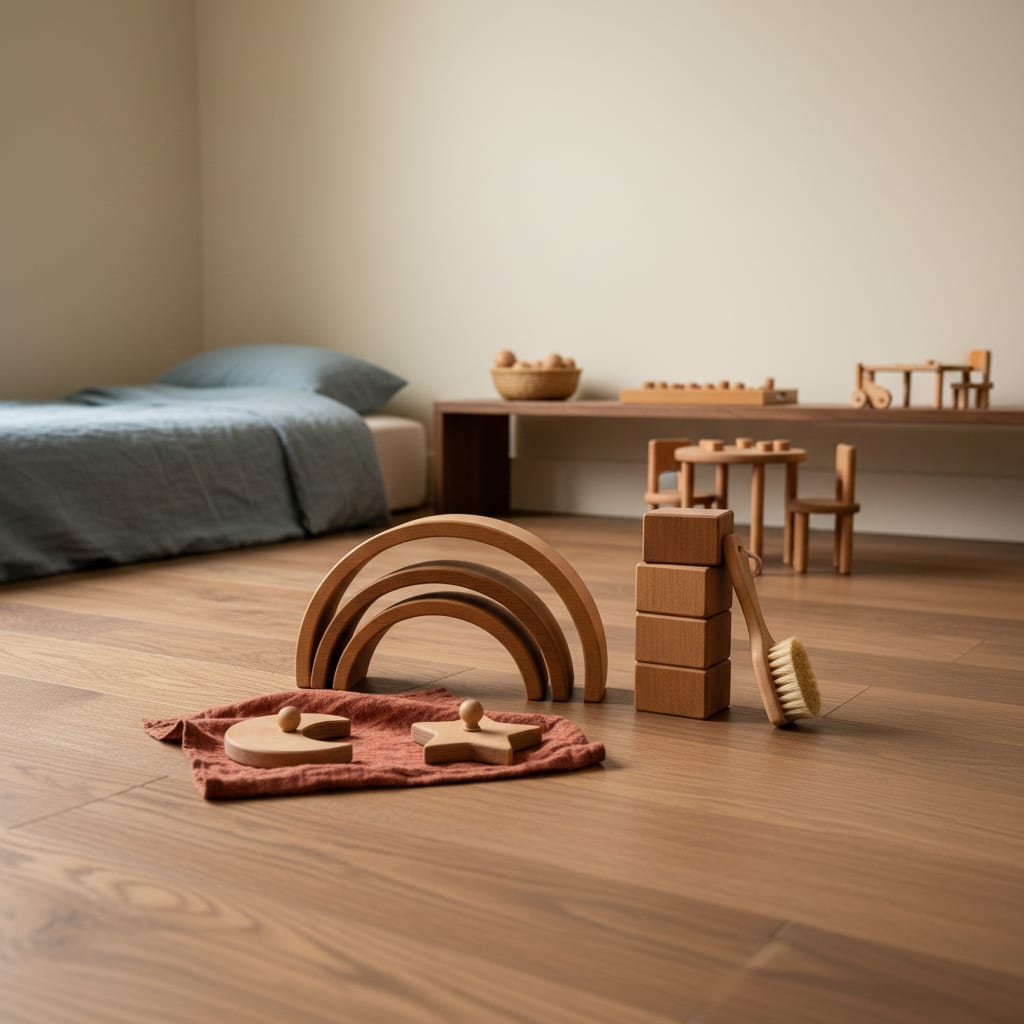
- An arch or rainbow stacker. The most open-ended wooden object there is. The Grimm’s large rainbow gets stacked at one, tunneled at two, built into ramps and fences at three, and turned into a puppet stage at four. Buy once, use for years; the smaller versions cost less and do proportionally less.
- Unit blocks in fixed ratios. PlanToys’ unit blocks in the 50-piece box are the workhorse: because the pieces relate mathematically — two of these make one of those — buildings stand up, and the math goes in through the fingers years before anyone names it. Proportion matters far more than piece count.
- One pounding or hammering work. Toddlers hit things. Give the impulse a job: Hape’s pound-and-tap bench absorbs a whole developmental phase and converts to a xylophone once the pounding fades.
- Knobbed and inset puzzles. Real wooden knobs, chunky inserts, three to six pieces for a toddler. These are self-correcting — the piece fits or it doesn’t — which is the quality that lets a child work without you.
- Realistic animals and objects for language work. A small basket of accurate figures beats a bin of cartoon ones for vocabulary; children are learning what things are.
- Real tools that happen to be wooden. A child-size broom, a wooden-handled scrub brush, a small rolling pin. The highest use-per-dollar in the entire house, and the whole ladder is in practical life activities by age.
What to skip
- Painted no-name sets. Soft wood, thick paint, and edges that raise splinters after a month. If a listing shows only styled photos and no close-up of a joint, assume the joint is why.
- “Montessori” busy boards. Latches, zippers and gears screwed to a board, sold with the M-word attached. Real practical life uses the actual door, the actual zip, the actual pitcher — there is no such thing as a Montessori-certified product, and the busy board is where that fiction gets sold hardest.
- Enormous wooden play-food hauls. Fifty pieces of pretend pizza is fifty pieces to tidy. A small set is genuinely useful for two-and-up pretend play; the bulk bundles are clutter with a wooden alibi.
- Anything with forty small components and no container. The container is part of the material. Sets that arrive loose in a bag never come back together, and a work that can’t be restored isn’t chosen twice.
- Decorative shelf objects. Wooden rainbows so pretty they live above child height, tiny turned figurines that break, matching sets bought for the room rather than the child. If it’s for the room, buy it — just don’t count it as a toy.
Buying secondhand, and buying unfinished
Wooden toys are the best possible secondhand purchase: they’re durable, they wash, and their value is in the shape rather than the newness. Local resale groups, thrift shops and school-supply resales turn up blocks, puzzles and figures constantly at a fraction of retail. Check for splits, missing pieces, and any painted item old enough to raise a paint-safety question — when in doubt on very old painted wood, skip it.
Unfinished or plainly oiled pieces from small woodshops are often better built than mid-priced retail, because the maker isn’t paying for packaging and a licensing deal. Ask for dimensions and a photo of the underside; good makers answer that in an hour.
Care: splinters, oil and the dishwasher mistake
Wooden toys need almost nothing: a wipe with a damp cloth, and a dry-off rather than a soak. Never run them through a dishwasher — the heat and moisture split glued joints and raise the grain, which is exactly how a smooth block becomes a splintery one. Once or twice a year, a light rub of food-safe oil on raw wood restores anything that’s gone chalky. Sand any rough spot the moment you feel it; a splinter is what ends a material’s career, not wear.
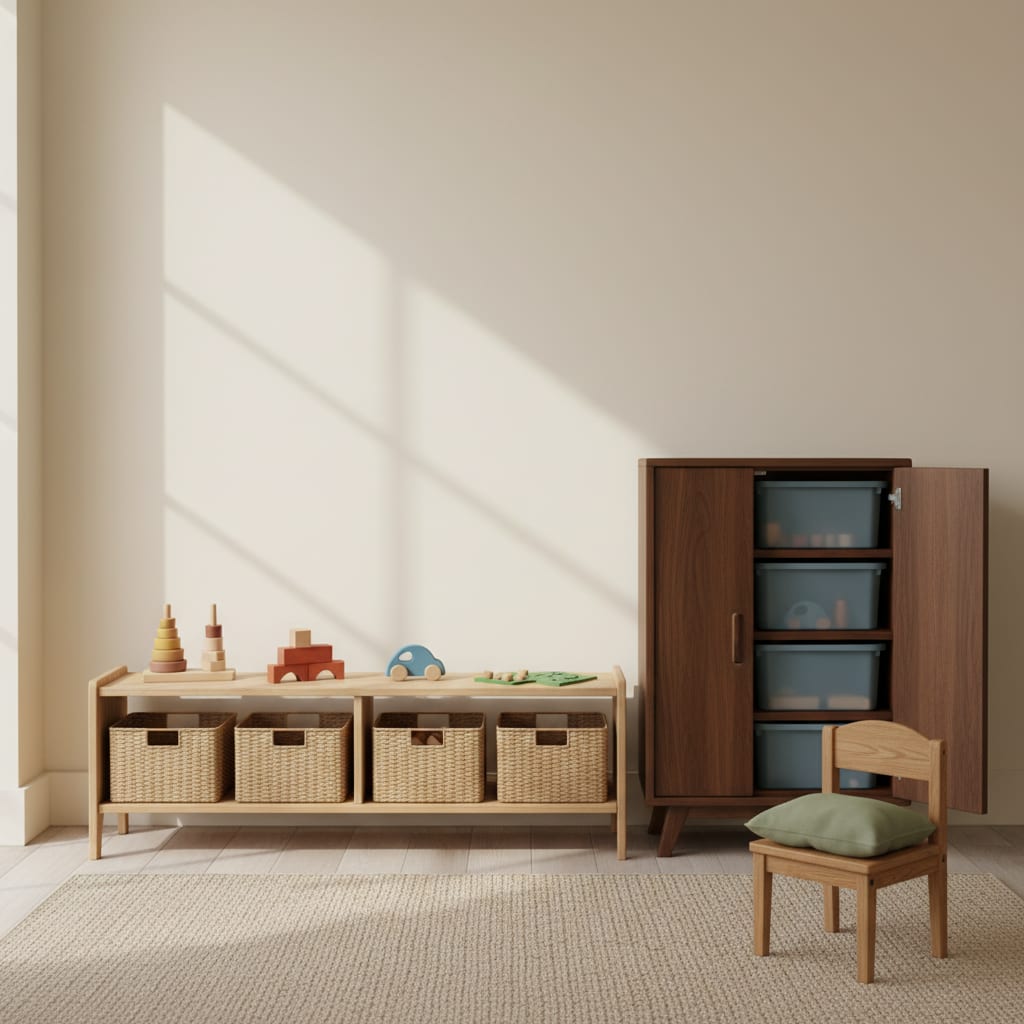
Keep the shelf small and store the rest — everything above works far better in a rotation than in a heap, which is the whole argument of our toy rotation system and the reason a well-arranged low shelf does more for play than another purchase will.
FAQ: wooden toys
Are wooden toys better than plastic ones?
Often, but not automatically. Wood has weight, quiet and durability on its side, which supports concentration. A wooden toy that entertains rather than gives the child work is no better than the plastic version of the same thing.
Which wooden toys last the longest in real use?
Open-ended ones: an arch or rainbow stacker, proportioned unit blocks, and simple figures. They get used differently at every age, so they never quite get outgrown.
How many wooden toys does a child need?
Fewer than you’d think — four to eight things visible at a time, with the rest stored and rotated. Depth of use beats variety, and a crowded shelf reliably produces less play, not more.
Is it safe to buy wooden toys secondhand?
Yes, with checks: no splits or splinters, all pieces present, and caution around very old painted items whose paint history is unknown. Wash cloth parts, wipe wood, and sand any rough edge before it goes on the shelf.