Montessori Shelf Setup: Height, Size, What Goes On
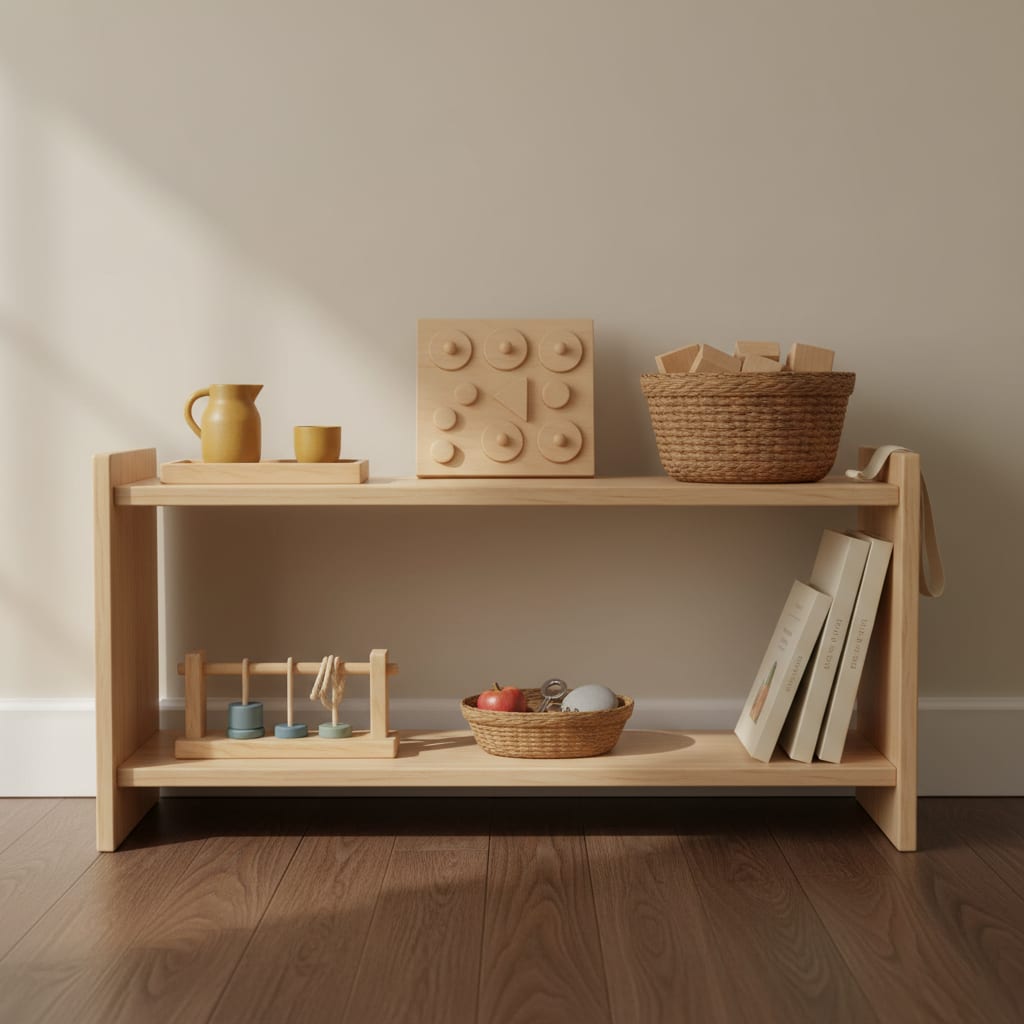
A Montessori shelf is a low, open, shallow unit the child can reach flat-footed, holding a small number of complete works with visible space between them. Practically: roughly 24 to 30 inches tall for a toddler, two shelves, no doors, no bins deep enough to hide anything, anchored to the wall, and six to eight things on it. That’s the whole specification. Everything else — oak versus pine, Instagram versus secondhand — is preference. The shelf is a piece of furniture doing a job: making choice possible for someone three feet tall.
What the shelf is actually for
Two jobs, and they explain every design rule that follows.
The first is survey. A child standing in front of the shelf should be able to see every option at once without moving anything. That’s why it’s low (their eye line), shallow (nothing hides behind anything), and open (no doors, no lids, no opaque bins). A toy stored where it can’t be seen is, for a two-year-old, a toy that does not exist.
The second is return. Every work has one home, and the home is obvious — a tray in that spot, a basket in that spot. This is what turns tidying from a shoveling job into a matching game, and it’s the single biggest practical payoff of the whole system. My four-year-old cannot reliably put shoes away, but she has never once had to ask where the puzzle goes.
If those two jobs are being done, you have a Montessori shelf, even if it started life as a secondhand bookcase.
Dimensions that matter, and the ones that don’t
Height: the only measurement worth being fussy about. The top surface should be reachable with feet flat on the floor and no stretching — roughly 24 to 30 inches for a walking toddler, lower for a baby just pulling to stand, and up to about 36 inches by four or five. If you can only get one thing right, get this right.
Depth: shallower than you think. Around 10 to 14 inches. A deep shelf lets a tray sit behind a tray, and the back row becomes invisible storage.
Shelf spacing: generous. Enough vertical room to lift a tray out straight without tipping it. Repurposed cube units are a mixed bag for exactly this reason, and a spilled tray is a child who stops choosing that work.
Width: whatever fits your wall. Two shelves holding three works each is plenty; bigger units invite more stuff, which is the failure mode.
Material and finish: not important. Solid birch, painted pine, and a sanded thrift-store bookcase all do this equally well. If you’re buying new, a plain birch classroom unit like the ECR4Kids Streamline three-shelf is the workhorse most home setups end up with — sturdy, correctly proportioned, and unlovely enough to survive a real house. A sturdy secondhand bookcase turned on its side does the same job for a fraction, and I’d genuinely rather you spend the difference on nothing at all.
Anchor it before anything goes on it
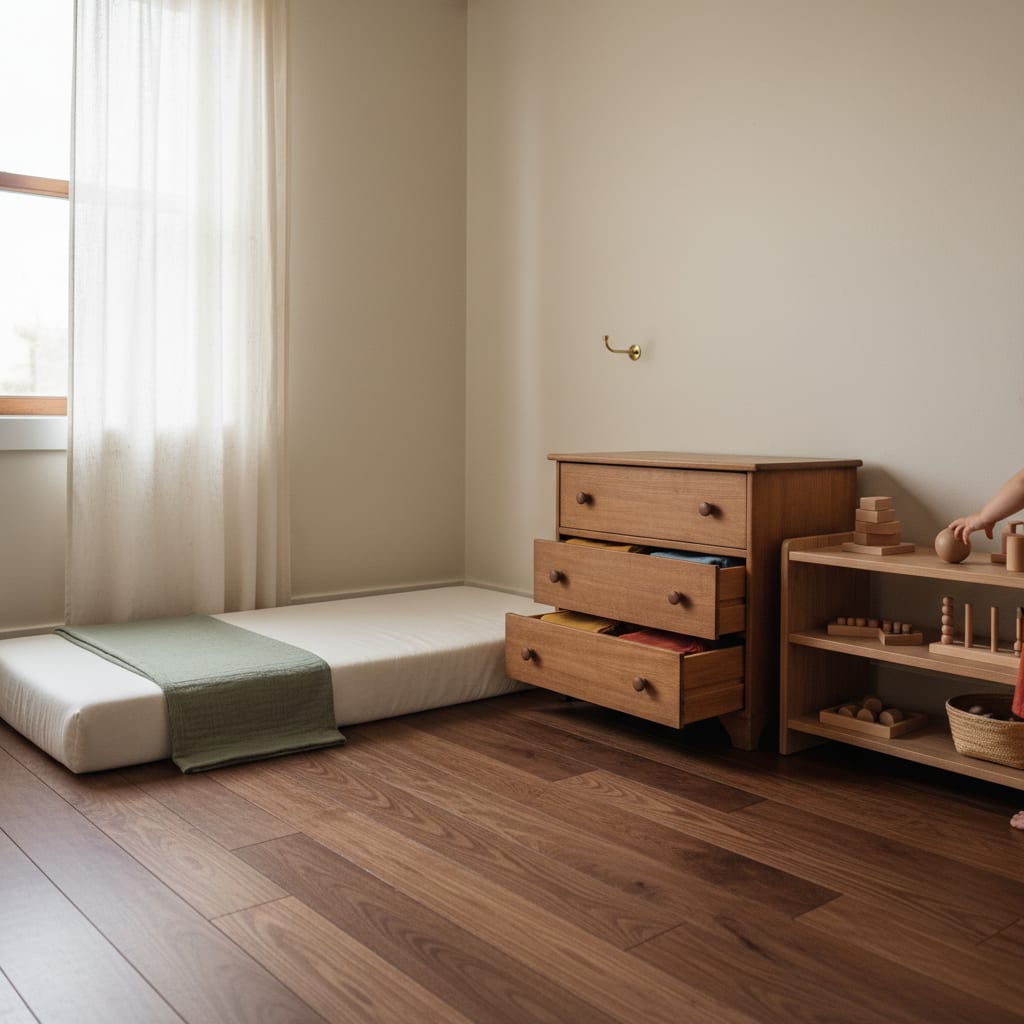
Non-negotiable, and it takes ten minutes. Any low, open unit is a ladder to a climbing toddler, and a shelf carrying trays is heavy at the top. Use the strap kit that came with it, or a hardware-store furniture strap, screwed into a stud rather than drywall alone. If you’re setting up a whole bedroom, do every other freestanding piece in the same pass — the dresser is the more dangerous one.
Two related habits: keep the heaviest works on the bottom shelf, and don’t put anything on top of the unit that you’d mind being pulled down.
How many things, and which ones
Six to eight works for a toddler; up to about ten for a three- or four-year-old who is concentrating well. That number is not aesthetic minimalism — it’s the point at which choosing stays possible. Above roughly a dozen visible options, most young children stop choosing and start grazing.
A shelf that works usually holds one of each of these, rather than four of one:
- Something practical. A pouring tray, a small cleaning task, a dressing frame. Real work outperforms everything else at these ages.
- Something with a right answer. A puzzle, a shape sorter, a nesting set. Self-correcting work builds the long, uninterrupted spans that matter most.
- Something open-ended. Blocks, a basket of cloths, one building material.
- Something language. A set of realistic objects, a small book basket with covers facing out.
- Something fine-motor. Threading, posting, tongs, a latch board.
- Something the child currently loves, even if it fits no category and you’re tired of it.
For age-specific lists, the per-age posts do the detail: Montessori toys for 2 year olds and Montessori materials at 3 both work as shelf-stocking checklists.
Arranging it: there is a grammar
Once you have the right things, the arrangement does real work.
- One work per space. Each tray, basket, or object gets its own footprint with visible gaps. The gap is what says “this is a thing, and it is complete.”
- Left to right, simple to complex. A soft convention, borrowed from the classroom, that also lays down the reading direction. Don’t be religious about it; do use it.
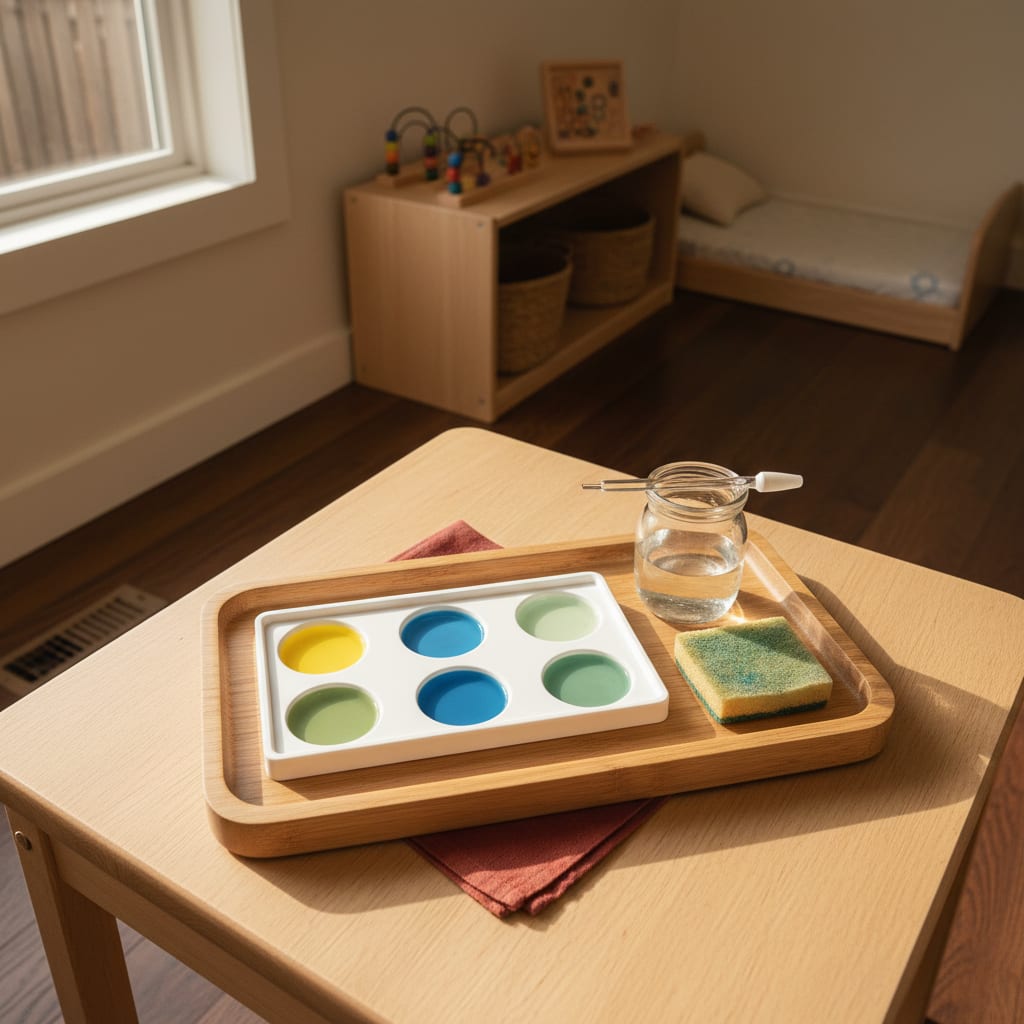
- Complete and ready. Every piece present, the pouring tray filled, the sponge on the tray. A work missing its parts trains a child to expect disappointment from the shelf.
- Trays and baskets carry meaning. A tray says “this is a sequence with a beginning and an end.” A basket says “take some out.” Use them deliberately rather than because they photograph well.
- Bottom shelf for the youngest. In a mixed-age house, the baby’s things live at the bottom, the older child’s on top.
Keeping it good after week three
Every prepared shelf decays, usually around the third week, in one of three ways: it silently fills up, it goes stale, or it becomes a display of things nobody touches.
The fix is a five-minute weekly pass. Take everything off. Put back only what’s been used, complete it, and swap out one or two items for something from the store cupboard. Anything that’s been ignored for two weeks goes back into rotation storage — not into the bin bag, just out of sight. The mechanics of that store, and how to decide what comes out next, are the whole subject of the toy rotation system post, and the wider question of where all the other toys live is covered in toy storage in a Montessori home.
One honest caveat about the aesthetic: a shelf photographed for the internet has three beautiful wooden objects on it and belongs to nobody. A shelf that serves a real child looks slightly worse — a plastic thing the child adores, a puzzle with a chipped knob, a basket that doesn’t match. That’s the correct version.
FAQ: Montessori shelves
How tall should a Montessori shelf be?
Low enough that the child can reach the top surface with feet flat on the floor — roughly 24 to 30 inches for a toddler, lower for a baby pulling to stand, and up to about 36 inches by age four or five.
How many toys go on a Montessori shelf?
Six to eight works for a toddler, up to about ten for a preschooler. The limit isn’t a style rule: above roughly a dozen visible choices, most young children stop choosing deliberately and start grazing.
Do I need to buy a special Montessori shelf?
No. Any low, open, shallow, anchored unit does the job — a secondhand bookcase laid on its side has furnished many excellent rooms. There is no such thing as a certified Montessori product, whatever the listing says.
Where should the shelf go in the room?
Against a wall the child passes often, in good light, away from the sleep space if it’s a bedroom. Toys visible from the bed invite a 6 a.m. work period; a shelf near the door invites use on the way in.
What about bins and baskets with lids?
Skip lids on the display shelf — they hide contents and add a step between the child and the work. Lidded boxes belong in the rotation store, where hiding things is the actual point.