Animals in Winter: Montessori Activities for Home
Animals in winter is one of the easiest seasonal units to run the Montessori way at home, because the whole thing rests on three sortable ideas: some animals sleep through the cold, some leave, and some stay and change. Give a child those three categories, a basket of realistic animal figures, and a window to watch, and you have weeks of work with almost no preparation. What you skip is the craft-cupboard version — cotton-ball snowmen and cartoon bears in nightcaps — in favor of real objects, accurate names, and time outdoors. Here’s the unit as I’d build it at a kitchen table.
First, an honesty note about what this is
There is no “animals in winter” material in the Montessori albums. What exists is a set of habits — reality before fantasy for the under-sixes, classification as a thinking tool, language given precisely, work the child can repeat alone — and a seasonal unit built with those habits behaves like Montessori even though Maria Montessori never sold a hibernation tray. I set up shelves in a toddler community for three years; I’m not a certified guide, and I’d rather say that plainly than dress a nature theme in doctrine it doesn’t have.
The one genuinely Montessori demand this unit makes is accuracy. If you tell a four-year-old that bears sleep all winter, you will be corrected in a year by a five-year-old, and rightly: bears enter a state of deep torpor rather than the true hibernation of a groundhog or a jumping mouse, and they can and do wake. Say “deep winter sleep” for the bear and keep “hibernation” for the animals whose body temperature really drops. Children of this age are collectors of exact things.
The three-basket sorting work
This is the spine of the unit and the work children return to.
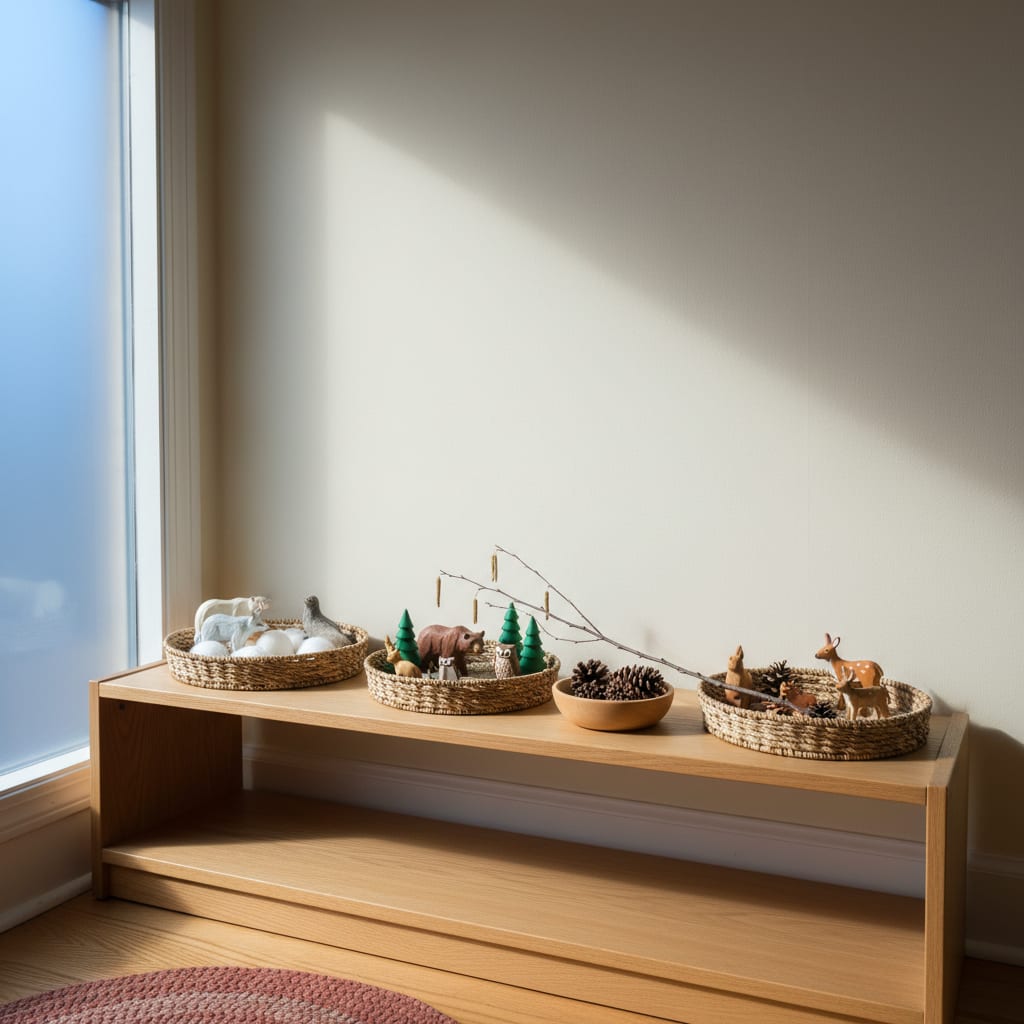
Put out three low baskets or three trays, and one basket of realistic animal figures — twelve or so is plenty. Introduce the categories one at a time over several days rather than all at once:
- Sleep through it. Groundhog, bat, dormouse, some frogs and turtles under the pond ice. The body slows down and the animal waits the season out.
- Leave. Geese, monarch butterflies, hummingbirds, caribou, some whales. The animal follows the food or the warmth and comes back.
- Stay and change. Fox, deer, snowshoe hare, chickadee, squirrel. A thicker coat, a coat that changes color, a food store, a different shelter.
The child sorts, then re-sorts, then starts arguing with the categories — which is the good part. A squirrel stashing acorns and dozing through the worst days is a genuinely hard case. Let it be hard. “Some animals do a little of both” is a truer sentence than any tidy sort.
Realistic figures matter more than the container: a child sorting a plastic cartoon bear learns a cartoon. A set of well-modeled cold-climate figures such as the Safari Ltd Arctic TOOB covers the “stay and change” basket cheaply and stores in its own tube; woodland animals you already own fill the other two. Secondhand figures from a school-supply resale are just as good.
Language work: names, then the three-period lesson
Once sorting is comfortable, the same figures become language work. Name each animal precisely — snowshoe hare, not bunny — and run the classic three periods over two or three sittings: name it (“This is the snowshoe hare”), ask for it (“Show me the snowshoe hare”), then ask what it is (“What is this?”). The rhythm is the same one in our Montessori language activities for toddlers post, just with a seasonal vocabulary.
For a child working toward reading, add matching labels you write yourself in plain print, and let the figure sit on its word. For a pre-reader, skip labels entirely — the objects and your voice are the material.
Take it outside, which is the actual lesson
Everything above is preparation for the part that sticks: going out and looking. In real winter, the yard is a text.
- Track hunting. Fresh snow after a still night is the best reading surface a child will ever get. Look for the direction of travel, the size, the spacing. You don’t need to identify anything correctly to do this well.
- A window feeder. Feeding birds turns “stay and change” from a category into a daily appointment. Chickadees are reliable, close-up, and unbothered by small loud people.
- The nibble survey. Bark stripped at deer height, cone scales piled under a tree, a hole in the snow with a bit of fluff at the edge. Evidence of animals is easier to find than animals.
- The cold experiment. The classic blubber test: one hand in a bag of shortening, both hands into a bowl of ice water. It is messy, it takes four minutes, and it explains marine mammals better than any book.
If your winter has no snow, the unit still runs — migration is more visible in a warm climate than a cold one, and “stay and change” becomes a study of which birds arrive rather than which stay.
Books and materials worth owning
Two or three excellent books beat a stack. The one I’d buy first is Over and Under the Snow by Kate Messner — it takes the subnivean world, the actual life going on under the snowpack, and makes it visible to a four-year-old without inventing a single talking animal. Pair it with any accurate field guide with photographs; for this age, photographs beat illustrations.
Skip: hibernation “sensory bins” of dyed rice, anything with a cartoon bear in pajamas, and printable worksheet packs. The work here is objects and outdoors.
This post revives a piece from this site’s first life, when the network ran seasonal units like this one every year. For the deep version of the same idea — winter animal studies built out over weeks, with an eye to children who need more structure — Every Star Is Different has been publishing hands-on seasonal units for years and is worth your subscription, not just a click.
Where it leads next
A winter animal study opens naturally onto other work already on the shelf. Sorting is classification, which is the same muscle used in the geometric solids extensions when a child hunts real-world objects to match each shape. Color change in a snowshoe hare’s coat sits comfortably beside our color mixing activities. And the concentration this unit builds — a child sorting the same twelve animals for the fourth day running — is the thing worth protecting above all.
FAQ: Montessori animals in winter
What are the three categories for animals in winter?
Hibernate, migrate, and adapt — or, in child language, sleep through it, leave, or stay and change. Three baskets and a set of realistic figures turn those categories into repeatable sorting work a preschooler can do alone.
What age is an animals in winter unit for?
Roughly 2.5 to 6. Younger toddlers do the naming and handling only; three- and four-year-olds sort and argue with the categories; five- and six-year-olds add reading labels, tracks, and the beginnings of research.
Is a hibernation sensory bin Montessori?
Not really. Montessori work for young children favors reality and a clear purpose, so real figures, real books, and a real window beat dyed rice with plastic bears in it. A sensory bin isn’t harmful — it’s just not the lesson.
Do bears actually hibernate?
Bears enter a deep winter torpor rather than true hibernation: their body temperature drops far less than a groundhog’s, and they can rouse. Telling children the accurate version early costs nothing and saves a correction later.