Montessori Bathroom Setup: A Self-Care Station That Works
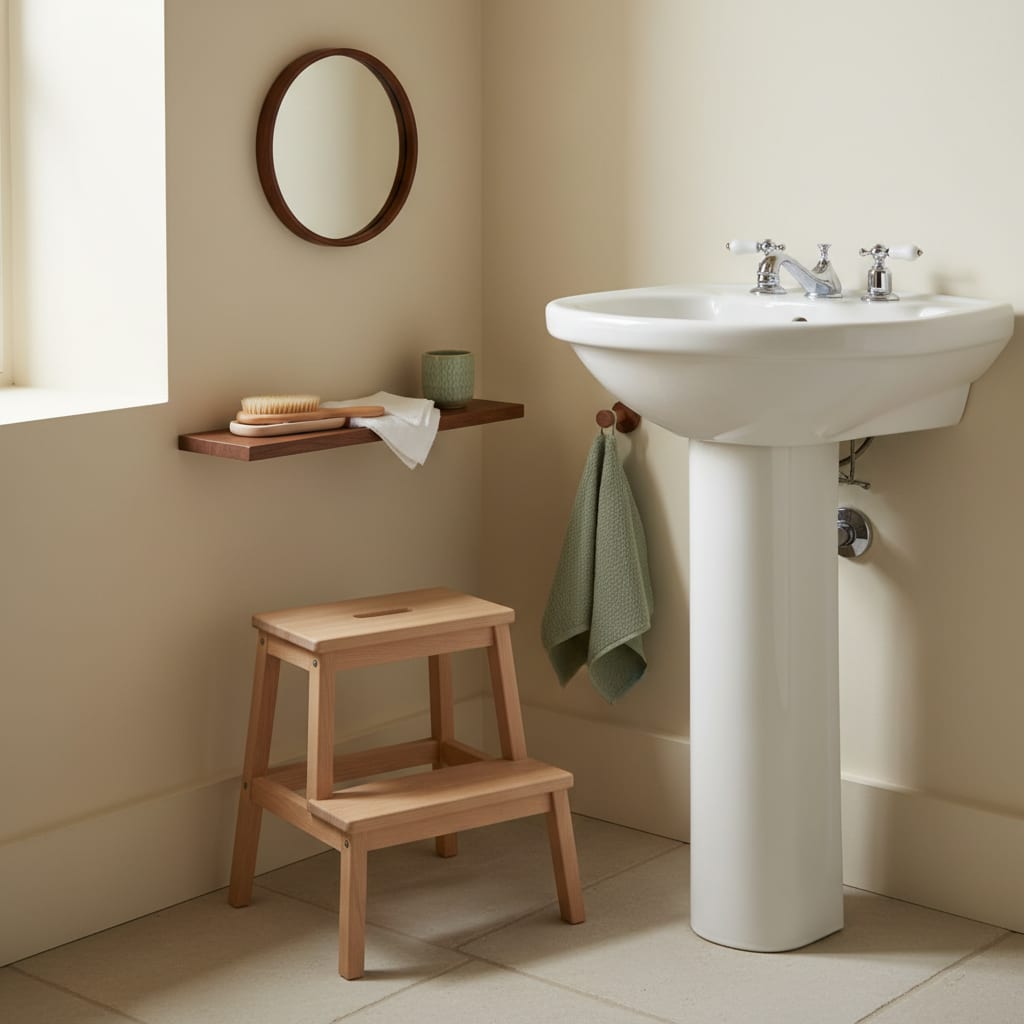
A Montessori bathroom setup is a small self-care station the child can use without being lifted: a stable step at the sink, a mirror at their eye level, a towel on a low hook, and one tray holding their own brush, comb and cloth. That is the whole thing. Everything the child is meant to handle is reachable, and everything that could hurt them (medicines, cosmetics, razors, toothpaste) stays high and locked. The bathroom is still a room a young child uses with an adult nearby, so this setup is about doing, not about being left alone.
I was a classroom assistant in a Montessori toddler community, not a trained guide, so this is the shelf-setter’s view. The safety lines come from the American Academy of Pediatrics, and they win wherever they and a pretty Instagram bathroom disagree.
This post is about hands, teeth, hair and noses. Potties, seat reducers and accidents are a separate job, covered in Montessori toilet learning, so I’ve left toileting out here on purpose.
Why the bathroom belongs to practical life
The American Montessori Society’s core components page defines practical life as domestic work, “self-care and personal hygiene”, and grace and courtesy. Its own example list of practical-life activities starts with “hand washing”. In a classroom, that work happens at a child-sized sink. At home, the sink is built for adults, so the setup has one job: close the gap between the child and the basin without handing over anything dangerous.
The four things that make it work
1. A step that does not tip. Everything else depends on this. A wide, stable two-step stool, such as the Melissa & Doug wooden two-step stool, lets a toddler reach the basin with both feet planted. It lives at the sink, so it never has to be fetched. Wobbly plastic stools and upturned buckets are not a budget version of this; a fall at a hard sink edge is the main injury risk in the whole setup.
2. A mirror at their eye level. Hand washing, face wiping and hair brushing all go better when the child can see what they are doing. If your bathroom mirror is too high, a small mirror fixed low on the wall beside the sink does the job. Choose an unbreakable acrylic one if glass worries you.
3. A towel they can reach and hang back. One small hand towel on a low hook. Self-adhesive hooks such as Command’s small wire hooks go up at child height without drilling and come down when the child grows. The hanging back is part of the job: it is the “returning the materials to the proper place” step the AMS lists in its work cycle.
4. One tray, not a shelf of stuff. On a low surface, a single tray holds the child’s own things and nothing else:
- their toothbrush in a small cup
- a child’s hairbrush or comb
- a folded washcloth for faces
- a small box of tissues with a little lidded bin beside it for nose-blowing
Four items, each with a clear place, so a toddler can see at a glance whether everything is home.
What stays high and locked
This is where a Montessori bathroom and a toddler’s bathroom have to meet the safety guidance, and the guidance is clear. The AAP’s HealthyChildren bathroom safety page says to “store all medicines and cosmetics high and out of reach in a locked cabinet”, and to keep “toothpaste, soaps, shampoos, and other frequently used items” in a separate hard-to-reach cabinet with a safety latch. It also says to unplug and lock away electrical appliances like hair dryers and razors.
So the child-height tray never holds the toothpaste, even the children’s kind. The AAP’s toothbrushing tips say an adult should put toothpaste on the brush “and then keep it out of reach”. This fits the method. Montessori preparation means making reachable whatever the child is meant to handle, and dosing toothpaste is not the child’s job yet.
Three more points from the same AAP page belong in any bathroom a toddler uses:
- Hot water. The AAP says to adjust the water heater so the hottest water at the faucet is “no more than 120 degrees Fahrenheit (48.9 degrees Celsius)”, and to teach a child who can turn the taps “to start the cold water before the hot.”
- Water in general. The AAP warns that children “can drown in only a few inches of water”, so never leave a young child alone in the bath, and keep the toilet lid closed.
- The door. The page suggests a latch at adult height, so the bathroom is “inaccessible unless your child is accompanied by an adult”. The station is for use with you nearby, not for solo trips.
Hands: the first and best work
Hand washing is usually the job toddlers take to fastest, and it is the one worth teaching carefully. The AAP’s hand-washing page lists the steps from the CDC: wet the hands, apply soap, “Rub hands vigorously together”, keep scrubbing “for 20 seconds”, then rinse and dry. It suggests picking a song that lasts 20 seconds, and recommends ordinary soap rather than antibacterial products.
Show the steps slowly, without talking, then let the child try. A bar of soap on a draining dish is easier for small hands than a pump they can empty in a minute. Expect water on the floor at first; a second cloth on a low hook makes wiping it up part of the work. For when hand washing and the other self-care skills tend to arrive, see practical life activities by age.
Teeth: a spot, not the whole job
The toothbrush lives on the tray so the child can start brushing without asking. But brushing is one self-care job a toddler cannot finish alone, and the AAP advises adults to help for years. The sequence (child brushes first, you finish, toothpaste dosed by you) has its own post: Montessori toothbrushing at bedtime covers the setup, the routine card and why brushing goes better earlier in the evening.
Hair and noses: small jobs that build independence
Hair. A child-sized brush and the low mirror are enough. The child brushes, and you tidy the back if it matters that day.
Noses. Nose-blowing is a real skill and it is taught, not demanded. Show it once, slowly: one tissue, wipe, fold, into the bin. Put the tissues and the bin where the child can reach them, so a runny nose becomes something they handle themselves rather than something chased with a tissue. This is the same idea as the evening steps in a Montessori bedtime routine: the child does the parts they can, and the room is set up so every step has a finish.
A small-bathroom version
Most bathrooms are small and shared, and you do not need a child’s vanity. What fits almost anywhere:
- the stool, pushed under the basin edge when not in use
- one low hook for the towel
- the tray on a windowsill, the back of the toilet tank lid, or a narrow wall shelf at the child’s height
- a mirror stuck low on the side of the cabinet
If there truly is no space, put the tray in the kitchen and use the kitchen sink with the same stool.

FAQ: Montessori bathroom setup
What do you need for a Montessori bathroom?
A stable step at the sink, a mirror at the child’s eye level, a towel on a low hook, and one tray with their toothbrush, comb, washcloth and tissues. Medicines, cosmetics, toothpaste and appliances stay high and locked, as the AAP advises.
At what age can a toddler use a step stool at the sink?
There is no single age; it depends on when your child can climb and stand steadily. Choose a wide, stable stool and stay close at first.
Should toothpaste be within a toddler’s reach?
No. The AAP says an adult should put toothpaste on the brush and keep it out of reach, and recommends storing toothpaste in a hard-to-reach latched cabinet.
Is a Montessori bathroom safe for a toddler to use alone?
No. It is set up so the child can do the work themselves, but the AAP advises keeping the bathroom off-limits unless an adult is with them, mainly because of water and hot taps.