Baby Wakes When the Door Opens: A Montessori Guide
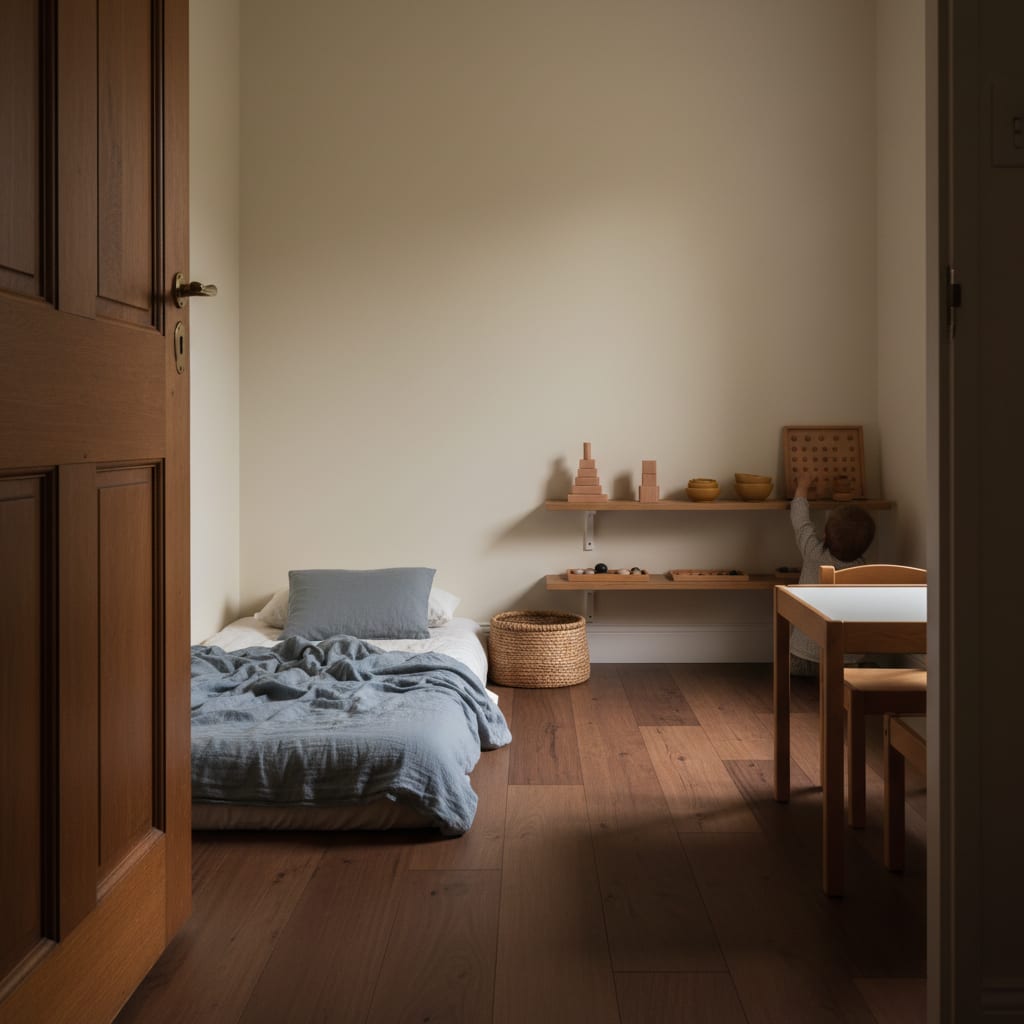
If your child wakes the moment the door opens, the door is almost never the real problem. It is a light wedge, a hinge, and a change in room sound arriving at exactly the moment the child was already in light sleep — and you are usually opening it because something in the setup requires you to. Fix the physical door, then ask the more useful question: what am I going in there for? Most of the reasons — a kicked-off blanket, a dropped comfort object, a check that everything is fine — can be designed out of the room instead of tiptoed around.
The door is a trigger, not the cause
Sleep runs in cycles, and between them everybody surfaces briefly — adults included, resettling without knowing it happened. A child at the end of a cycle is already near the surface, and the door supplies three signals at once: a wedge of hallway light across the ceiling, a change in the room’s acoustics as the seal breaks, and often a creak.
This reframes the fix. You are not trying to make the door silent enough to defeat deep sleep — deep sleep does not need defending. You are making the room’s edges boring enough that a child who happens to be surfacing has nothing to surface toward. The second, larger lever is going in less often at all.
Fix the physics before you fix anything else
These are cheap, and they take an afternoon:
- The light wedge. Usually the strongest signal and the easiest to kill: a draught excluder along the bottom of the door, a heavier curtain inside, and a dimmer hallway bulb between the child’s bedtime and yours.
- The hinge. A creak is a dry pin. Lift the pin, wipe it, add a little oil, drop it back. Free.
- The latch. The loud part of most doors is the bolt snapping into the strike plate on the way out. Turn the handle fully, ease the door to, release slowly — or, since nobody remembers that at 2 a.m., put a strip of felt on the plate.
- The floorboard. A single creaking board two feet inside the room does more damage than the door. Learn where it is, or lay a rug over the approach.
- The sound floor. White noise does not sedate anyone; it raises the room’s background level so a hinge is no longer the loudest thing in it.
The Montessori question: why are you opening it at all?
This is the part that belongs on a Montessori site rather than a general sleep one, and it is the one that ends the problem. The prepared-environment idea is that the room does the work an adult would otherwise do. List your real reasons for going in, then remove them one at a time:
- Re-covering a child who kicks off blankets. A wearable blanket ends this permanently, and it is safer than loose bedding for babies besides. A plain cotton sleep sack in the right size — something like the HALO SleepSack — is the whole fix. You never go in to re-cover anyone again.
- Retrieving a dropped comfort object. Give it a home the child can reach — a small basket beside the mattress rather than a crib corner.
- Checking that everything is fine. Some of this is worth keeping. Much of it is a room you don’t yet trust — work the floor bed safety checklist on your knees at child height, and the urge to look drops off once “what could they get into” honestly answers nothing.
- Putting a child back down. This is the big one, and it is the reason the sleep surface matters more than the door hardware.
What a bed the child can leave changes
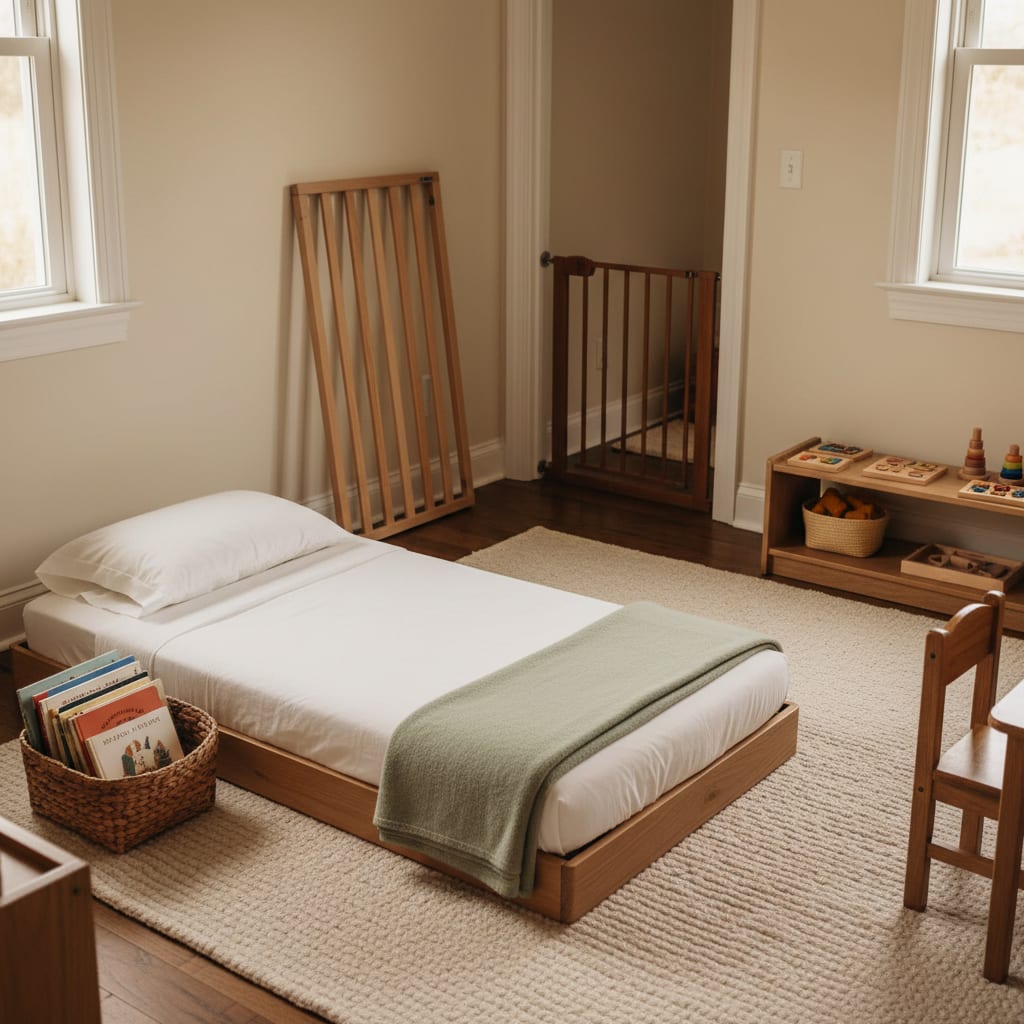
A floor bed alters the calculus. With a crib, every transition needs you: they wake, they call, you open the door, you lift, you lower, you leave, the door opens again — each opening another chance to wake a child who was nearly back down. With a bed at floor level, the child who surfaces at 5 a.m. wanting water, or their bear, or the rug by the window, goes and gets it, and often puts themselves back. That is what the complete floor bed guide is really about, and why the independence argument and the sleep argument are the same argument. Betteroo’s walk-through of how a floor bed works in a real bedroom is a useful second view on the same setup.
It is not free. You trade door-opening for walk-backs: for a couple of weeks a newly free child will come out, and someone has to walk them back calmly, repeatedly, without conversation — a trade discussed honestly in floor beds and independent sleep. The walk-backs end; the resettling is a skill the child keeps.
Two limits, plainly. Safe-sleep guidance for babies under a year points to a crib, bassinet, portable crib or play yard meeting federal safety standards — a floor mattress is not one of those, so for an infant this is a plan for later, not tonight. And a floor bed only works in a room prepared to the standard a crib is held to: everything anchored, cords out of reach, outlets covered, and a considered decision about the doorway.
 Still going in five times a night?
Betteroo turns your child's age and real sleep data into a personalized day-by-day plan — including how many check-ins a night actually needs, and when to stop.
Take the 2-minute sleep quiz →
Still going in five times a night?
Betteroo turns your child's age and real sleep data into a personalized day-by-day plan — including how many check-ins a night actually needs, and when to stop.
Take the 2-minute sleep quiz →
The checks worth keeping
None of this argues for never going in. A child who is unwell, unusually hot or cold, breathing oddly, or crying differently from their normal call gets checked every time, and the noise of the door is irrelevant. The goal is to delete the routine openings so the ones that remain mean something. Snoring, long pauses in breathing, a child who seems exhausted on a full night’s sleep, or total sleep well outside the usual range for the age are pediatrician questions, not door questions.
When the door is innocent
Sometimes you fix the hinge, kill the light, stop going in — and the waking continues on schedule. Then the door was never the variable. The usual suspects are a regression window, an under-cooked wake window, early-hours hunger during a growth phase, teething, or a room that is simply too warm. Ask too whether the child ever falls asleep without you at bedtime: a child who only ever goes down with an adult in the room will look for that adult at every surfacing, and the door is just the messenger. Betteroo’s guide to a toddler who still isn’t sleeping through covers that territory in more detail than a room-setup post should.
FAQ: waking when the door opens
Why does my baby wake up the second I open the door?
Because the door delivers light, a sound change and often a creak at the moment the child was already surfacing between sleep cycles. Close the light gap under the door, oil the hinge, ease the latch, and raise the room’s background sound floor — then reduce how often you need to open it at all.
Does white noise stop a child waking when the door opens?
It helps, because it reduces the contrast between silence and a hinge rather than sedating anyone. It will not cover a wedge of hallway light, which is usually the bigger signal. Treat it as one of four fixes, not the fix.
Should I leave the door open instead?
Many families do, and it removes the opening event entirely — but hall light and household noise then reach the room all night, so it needs a dim, quiet landing. In a floor-bed room it is also a safety decision: an open door needs a gated hallway or a genuinely childproofed floor beyond it.
Is a floor bed the answer to night wakings?
Not on its own. It changes who does the transition — a child who can leave and re-enter their own bed resettles without an adult crossing the room. That removes many door openings, but not the underlying reason a child wakes, and it takes a couple of weeks of calm walk-backs to establish.