Floor Bed vs Crib: An Honest Montessori Comparison
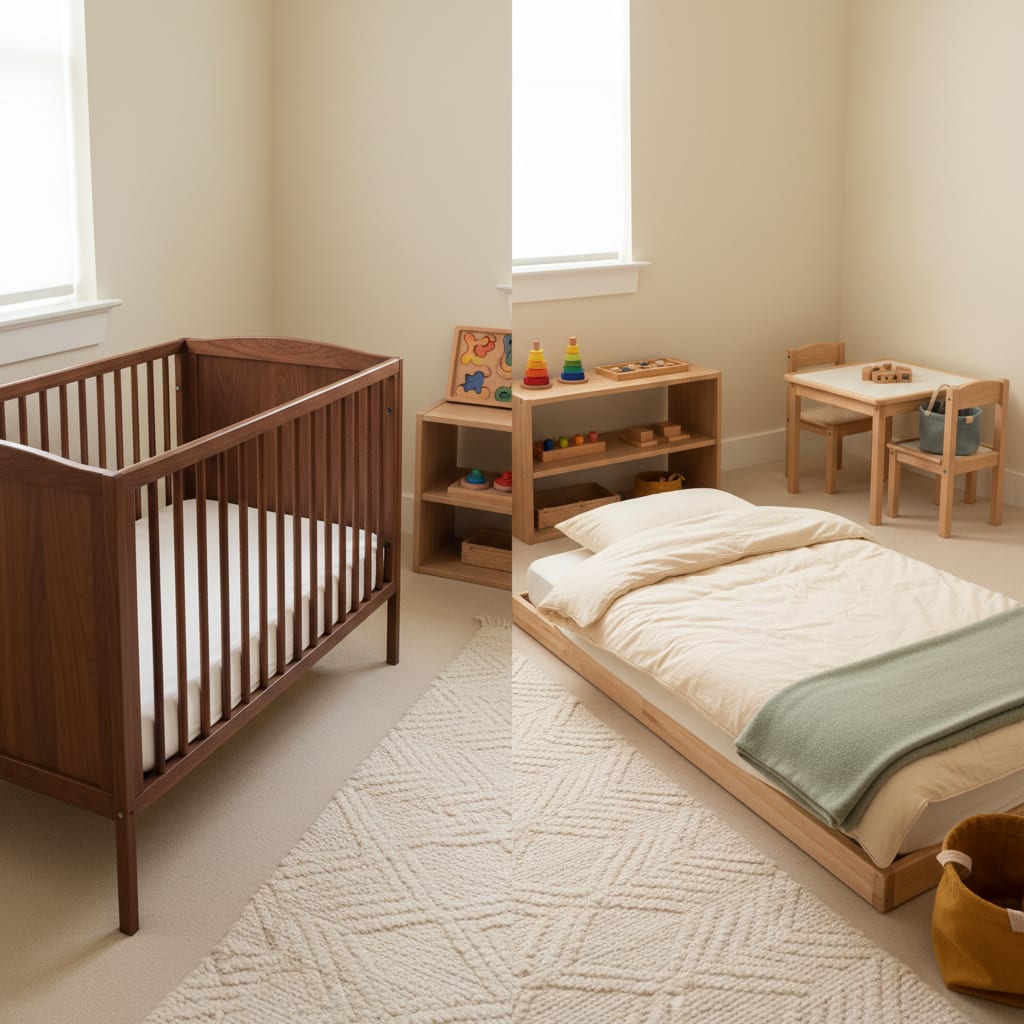
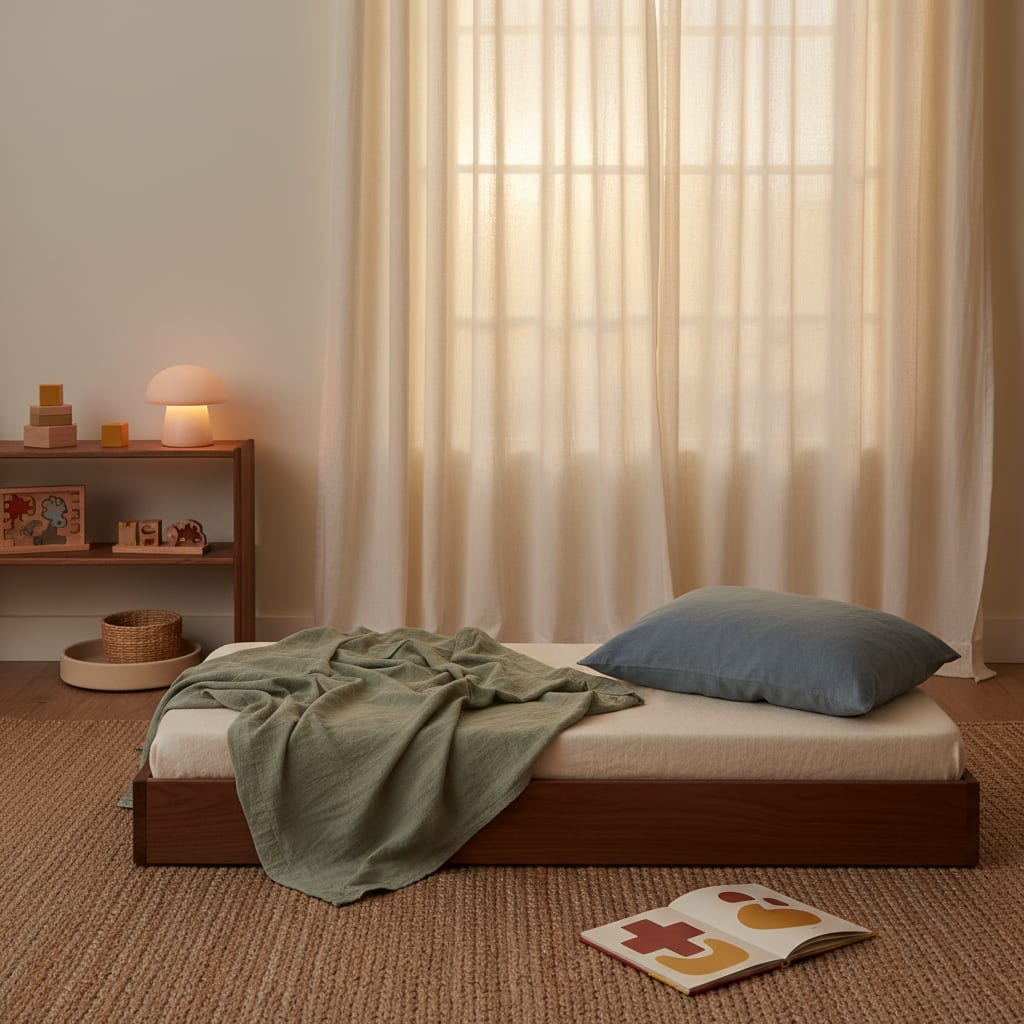
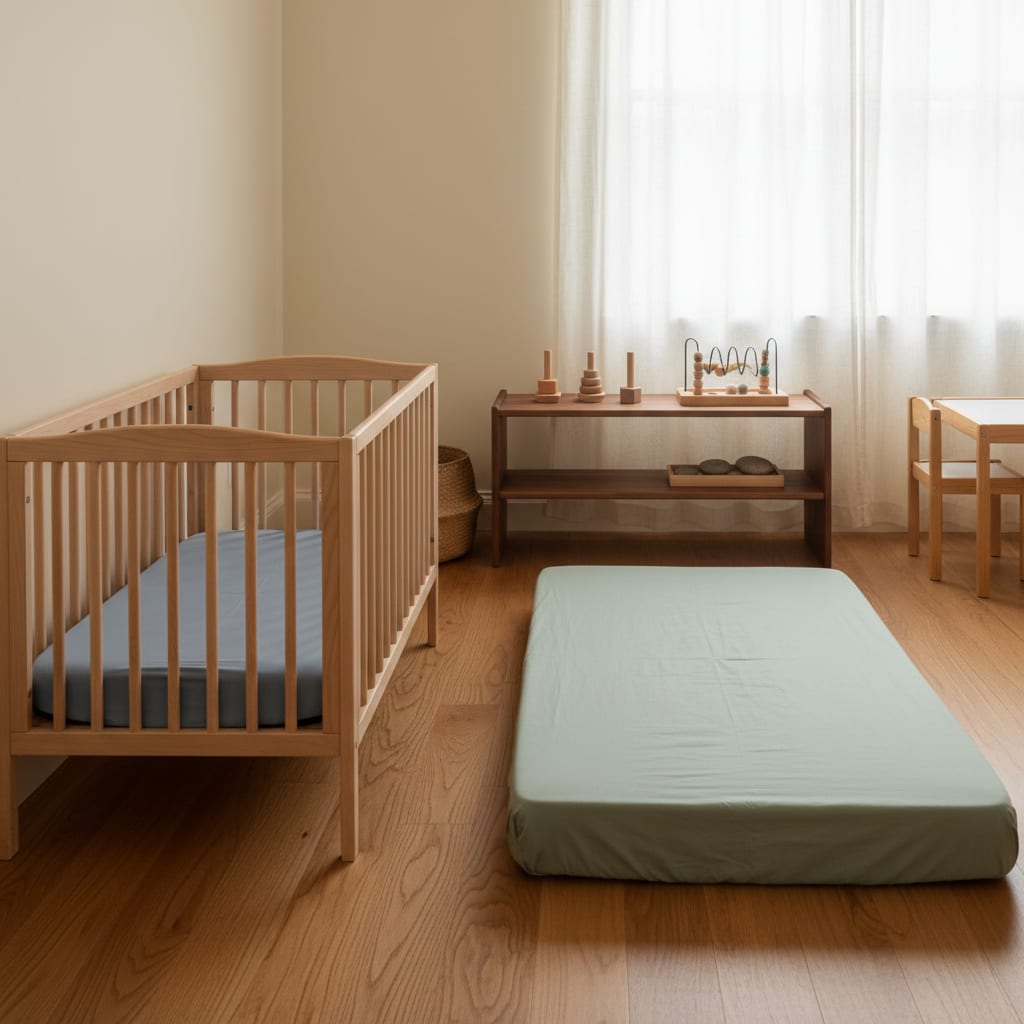
Floor bed vs crib is the wrong fight, and I say that as someone who runs floor beds in her own house. Both can be set up to meet the same safe-sleep standards; both can produce a well-rested child; neither makes a family more or less Montessori in any way that matters. The real difference is what each optimizes for: a crib optimizes for containment and simplicity, a floor bed optimizes for movement and independence — and which of those your family needs more depends on your child, your room, and your season of life. Here’s the honest comparison, safety first.
Safety first, for both
Before any philosophy: the safe-sleep basics are the same on every surface, and they’re the floor under this whole comparison. For babies, current AAP guidance means a firm, flat mattress with a fitted sheet and nothing else in the sleep space — no pillows, blankets, bumpers, or soft toys — and back sleeping, every sleep. A crib delivers that in a well-tested box. A floor bed can deliver it too, but the responsibility widens from the mattress to the entire room: anchored furniture, covered outlets, managed cords and blinds, a secured doorway. The bed is the easy part; the room is the safety project, and the full floor bed safety checklist is the audit to run.
Two honest asymmetries. For young babies, a crib is simpler to keep compliant — there’s less room to get wrong. For crib-climbing toddlers, the asymmetry reverses: a fall from the top rail of a crib is a worse event than anything a mattress at floor level offers. Whatever you choose, talk your specific setup through with your pediatrician — especially for a baby under one.
What the crib does well
- Containment when you need it. There is no negotiating with a crib. During newborn survival months, sleep regressions, or seasons when the adults are at capacity, “the child stays where I put them” has real value, and no judgment attaches to needing it.
- Simplicity. One safe box to maintain instead of one safe room. Small bedrooms, rooms that can’t be fully childproofed, and room-sharing setups all argue for the crib.
- Familiarity. Grandparents, babysitters, and travel setups all understand a crib. The floor bed occasionally requires a briefing.
What the floor bed does well
- Wake-ups without a summons. A crib wake-up has one move: call for rescue. A floor-bed child who surfaces early can reach the book basket, and some mornings that buys you twenty minutes. Some mornings.
- Independence practice. Getting into bed tired and out of bed rested is self-regulation at its most basic, which is why the floor bed is the classic Montessori choice — the same prepared-environment logic as the low shelf, applied to sleep. The complete floor bed guide covers the setup end to end.
- No second transition. Crib kids eventually face the crib-to-bed move; floor-bed kids just keep sleeping. If you’re within sight of that transition anyway, the comparison mostly answers itself — see when to switch a toddler to a floor bed.
What neither does
Neither bed builds sleep. Schedule and routine do — age-appropriate wake windows, a bedtime sequence the child can predict to the minute, adults who respond the same way every time. Most “floor bed failures” I’ve watched up close were schedule failures wearing a furniture costume, and the same is true of crib battles. The floor beds and independent sleep post is the long version of that argument.
How to actually choose
Choose the crib if: your baby is young and you want the simplest safe-sleep setup; your room can’t be fully childproofed; you’re room-sharing; or your family’s current season runs on containment. Choose the floor bed if: your toddler is climbing the crib; you value the independence practice and will do the room work; or you’re facing the toddler-bed transition anyway. And switch when circumstances change — in either direction, without ceremony. A crib household that respects the child’s rhythm is more Montessori than a floor-bed household in chaos; the furniture was always the smallest part of the method.
FAQ: floor bed vs crib
Is a floor bed as safe as a crib?
It can be, if the whole room meets the standard a crib meets by design: firm flat mattress, bare sleep space for babies, anchored furniture, covered outlets, secured doorway. For young babies a crib is simpler to keep compliant; ask your pediatrician about your specific setup.
Do Montessori families ever use cribs?
Yes, routinely. Montessori writing favors the floor bed for the independence it allows, but a crib doesn’t disqualify anyone from anything. The method is the respect for the child’s rhythm, not the mattress height.
Is a floor bed better for sleep than a crib?
Neither bed produces better sleep by itself. A floor bed enables self-serve wake-ups and independent resettling once a child is mobile; a crib offers simplicity and containment. Schedule and routine determine sleep quality in both.
When does a crib become unsafe for a toddler?
When climbing starts. A toddler attempting the top rail faces a worse fall than anything a floor-level mattress presents, which is why crib-climbing — often between 15 and 24 months — is the most common trigger for switching.