Lovevery Play Kits Review: Worth It in a Real House?
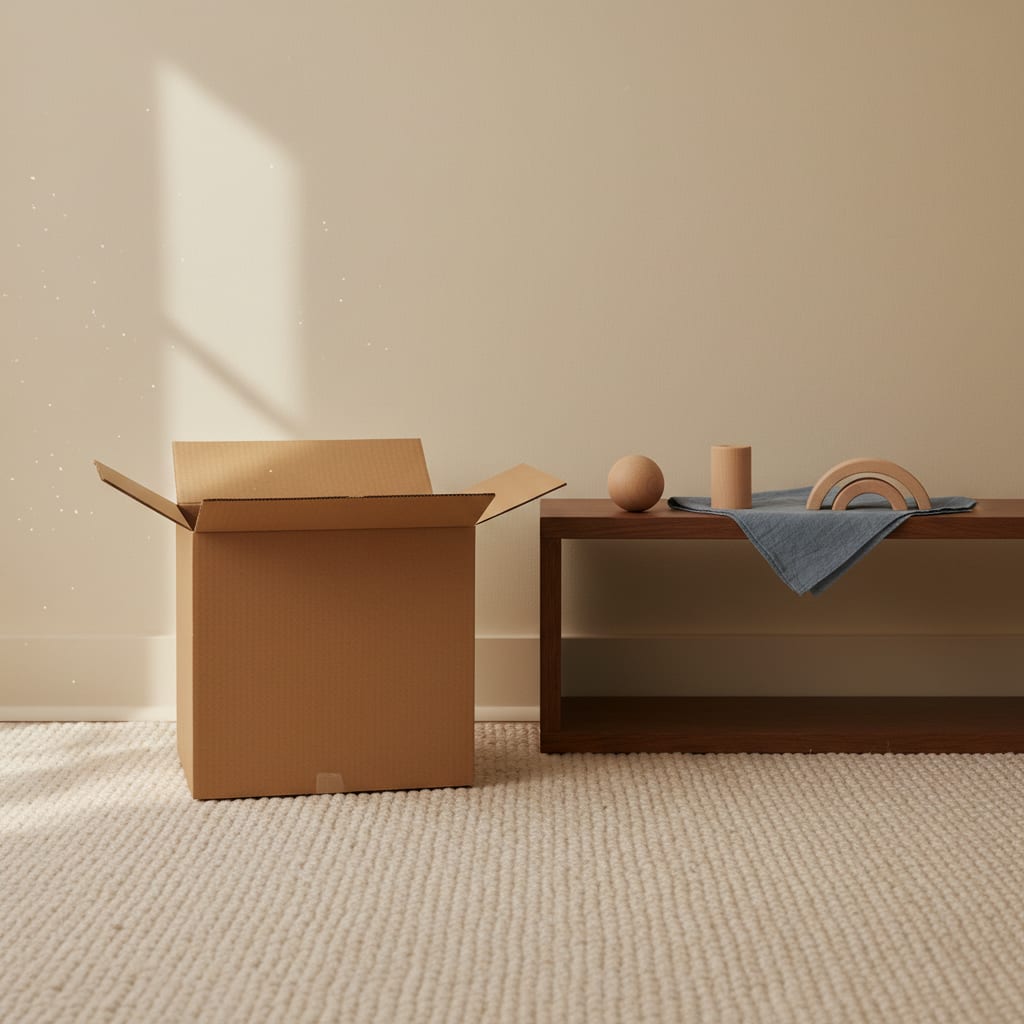
Lovevery Play Kits are a stage-based toy subscription: a box of wooden and cloth materials plus a play guide, timed to your child’s age, from birth to five. Are they worth it? For families who want good materials chosen for them and don’t want to research anything, yes — the build quality is real and the developmental timing is usually right. For families already running a small rotating shelf, they’re an expensive way to acquire toys you could pick yourself, and the volume works against the very thing a prepared environment is trying to do. Here’s the honest ledger.
What you actually get, and what it costs
Each kit arrives with roughly five to nine items — wood, cloth, card, some plastic — plus a printed guide explaining what each piece is for and what skill it targets. The cadence and price change as the child gets older:
| Stage | Ships | Price per kit |
|---|---|---|
| 0–12 months (The Looker through The Thinker) | every 2 months | around $80 |
| 1–4 years (The Babbler onward) | every 3 months | around $120 |
Prepaying several kits at once drops the effective monthly cost — the site advertises figures in the mid-$30s per month when you buy a year up front. Prices move, so check before you commit; the shape of the deal is what matters. At list price the whole birth-to-four run works out at roughly $1,900 — six kits at around $80, then twelve at around $120 — which is not a subscription to drift into unexamined.
What Lovevery does genuinely well
The materials are not toy-aisle materials. Solid wood, tight tolerances, cloth that survives a wash, finishes that don’t chip into a child’s palm. Nothing in a kit has that hollow-plastic tone. Two years in, ours still look like objects rather than debris.
The timing is usually right. The kits arrive roughly when the skill does — the drop-and-retrieve work when object permanence is landing, the sorting materials when sorting starts to click. Parents who don’t want to track developmental windows get that work done for them, and getting the timing right is most of what makes a material get used.
The play guide is the underrated part. Knowing what a material is for, and what to do when the child uses it “wrong,” is the difference between a toy that lasts a month and one that lasts a year. Lovevery’s booklets do that job better than most of what’s free online.
Resale is strong. Kits hold value on the secondhand market to an unusual degree, which changes the real cost calculation considerably.
Where it collides with Montessori
Lovevery describes itself as Montessori-informed, not Montessori, and that’s the fair description. Three honest points of friction:
Volume. Five to nine new objects arriving at once is the opposite of a shelf with four things on it. If everything comes out of the box on day one, you get a week of frantic sampling and then a pile. The fix is yours to apply — see below — but the subscription’s default rhythm pushes against the anti-clutter principle this whole site is built on.
Some items aren’t Montessori at all. There’s plastic, there are a few fantasy-ish and cause-and-effect pieces, and there are things a purist would call toys rather than materials. That isn’t a scandal; it’s just not orthodoxy, and if orthodoxy is what you’re paying for you’ll be irritated.
Kits arrive on the calendar, not on the child. A stage box assumes an average child in an average month. Real children spend six weeks obsessed with one thing and ignore the rest. A subscription can’t observe your child; you can, which is the actual Montessori skill.
The duds, and what happens to them
Every kit has at least one item that never lands. In our house it was a couple of the card-based pieces and one music item that got three minutes total. That’s not a defect — it’s the arithmetic of any curated box — but it’s worth knowing you’re paying for a hit rate, not a guarantee. Judge a kit by whether two or three items go into heavy weekly rotation. If they do, the box did its job.
Who should subscribe, and who should skip
Subscribe if: you have no time or appetite for research, you want quality decided for you, you’re a first-time parent who’d rather spend the decision budget elsewhere, or the kit is a gift someone else is funding — grandparents love a subscription with a name on it.
Skip if: you already enjoy choosing materials, you’re on a tight budget, you have a second child and a cupboard of good things already, or you know yourself well enough to know the boxes will pile up unopened. There are cheaper routes that get you most of the way — I’ve laid them out in Lovevery alternatives.
How to run a kit the Montessori way
If you do subscribe, the kit becomes an input to your shelf, not a replacement for it:
- Open it away from the child. Everything goes into the rotation cupboard first.
- Put out two or three items. Not the box. Two or three, spaced on the shelf, in the grammar a shelf already uses.
- Hold the rest back for the eight or twelve weeks until the next kit. The kit stops being an event and becomes a supply.
- Retire the duds without guilt. Store, gift or resell them. A material nobody touches is furniture.
- Let the guide inform the presentation, not dictate it. Show the work slowly, once, then get out of the way.
That’s the same discipline described in our toy rotation system, applied to a box that arrives whether you asked for it this month or not.
The resale market nobody mentions
Used Lovevery kits circulate constantly through local parent resale groups and the big secondhand marketplaces, generally at a substantial discount to retail, and because the materials are durable, “used” usually means “wiped clean.” Buying one kit secondhand is also the cheapest way to test whether the format suits your family before committing to two years of shipping. It’s the option I’d hand a friend who asks whether to subscribe: try one, at a third of the price, from someone whose toddler outgrew it.
FAQ: Lovevery Play Kits
How much do Lovevery Play Kits cost?
Around $80 per kit shipping every two months in the first year, and around $120 per kit every three months from age one to four, with lower effective monthly pricing if you prepay a year. Check the current figures before subscribing — they change.
Are Lovevery Play Kits actually Montessori?
They’re Montessori-informed. Much of the material is beautifully aligned — real objects, one clear purpose, natural finishes — but the kits also include plastic, cause-and-effect toys and more items at once than a Montessori shelf would hold. Treat them as a good supply, not a curriculum.
Is Lovevery worth it for a second child?
Usually less so. The materials are durable enough to reuse, and most families who already have a full stage set do better rotating what they own and buying one or two gap items rather than resubscribing.
What can I do instead of subscribing?
Buy the three or four anchor materials per stage yourself, use a cheaper subscription, or buy Lovevery kits secondhand. All three routes are covered in our companion post on alternatives.