Montessori Playroom: A Realistic Setup for Normal Houses
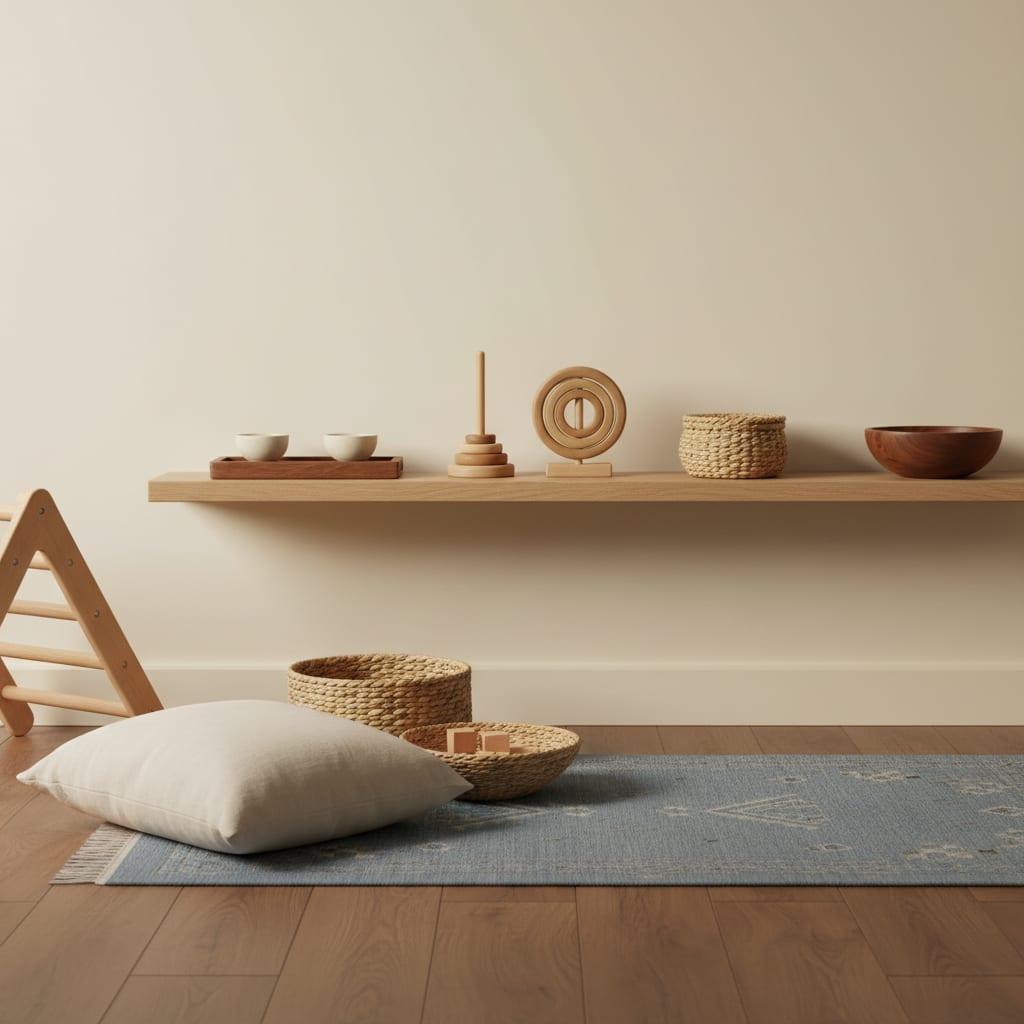
A Montessori playroom is a room, or a corner of one, that a young child can use without asking you for anything. It needs four things: one low, anchored shelf with a few complete activities on it, a rug or mat where work gets done, a movement corner for climbing and hauling, and a reading corner with a few books facing out. Just as important is what stays out: the toy box, the screen and the adult clutter. None of this needs a spare room. A living-room corner with the same four parts works.
I was an assistant in a Montessori toddler community, the person who set the shelves up each morning, and I have no guide’s diploma. So this is the home version of a classroom idea, not doctrine.
The idea: a room that works without you
The American Montessori Society’s core-components page describes the classroom version as a “prepared environment”: “carefully selected, aesthetically arranged materials” with “appropriately sized furniture” and “enough space to allow children to work in peace, alone, or in small or large groups.” It pairs that with “freedom within limits”: children “move about freely and choose their own work, within reasonable limits.”
A home playroom keeps the spirit and drops the catalogue. The test I use is simple. Can your child, alone, choose something, use it, and put it back? If any of those three steps needs an adult (a lid they cannot open, a shelf they cannot reach, a basket so full nothing goes back in), that is the thing to fix. It matters more than any purchase.
Decor pages will tell you how a playroom should look. This page is about how it works, which is a different question.
The four areas
1. The shelf
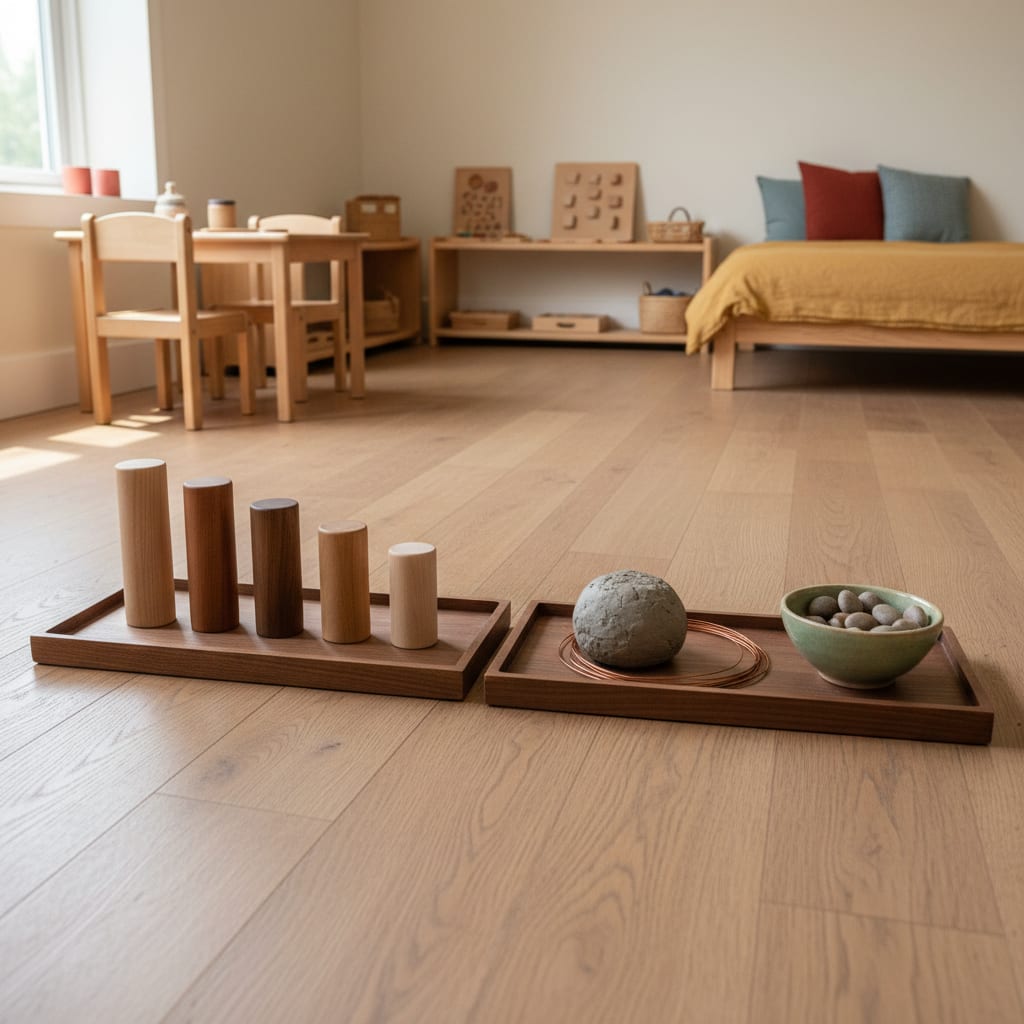
One low, open shelf is the heart of the room, holding a handful of complete activities with space around each. Height, depth, what to put on it and in what order already have their own page: the Montessori shelf guide. The one playroom-specific rule is placement. Put the shelf where the child walks past it, in good light, with the rug in front of it, so the shelf and the work space form one unit.
If you are buying rather than repurposing, a plain classroom unit like the ECR4Kids Streamline 3-shelf is the example this site keeps coming back to. A thrift-store bookcase laid on its side does the same job.
2. The work rug
A small rug or mat, roughly the size of a bath mat, marks where an activity happens. In a Montessori classroom a child unrolls a rug, carries a tray to it, works, then rolls it back up. At home it does two quieter jobs: it keeps the puzzle pieces in one place, and it gives a younger sibling a visible boundary (“that’s her work, this is your rug”). A low table and chair can stand in for the rug once a child prefers to sit up.
3. The movement corner
Toddlers need to climb, carry and push something heavy every day, and a playroom without a place for it will have its sofa climbed instead. A Pikler triangle is the classic piece. A couple of firm floor cushions, a sturdy step or a small wagon to load and haul covers the same need for less money. Give it the floor space it needs to fall safely, away from the shelf and from any window.
4. The reading corner
A few books with their covers facing out, at the child’s height, next to something soft to sit on. Five or six books beat fifty spines, for the same reason a short shelf beats a full one: a child can see the choice. Swap them with the toys. If there is an adult chair here too, all the better, because a lot of reading at this age happens on a lap.
What stays out
- The toy box. It is a pile with a lid: nothing can be seen, so nothing gets chosen. Everything that isn’t on the shelf goes into a rotation store out of sight. The system for that is in toy storage for a Montessori home.
- The television. Not for moral reasons. A screen in the room competes with everything else in it, and it wins.
- Adult storage at child height. The cupboard of paperwork and the box of cables either go up high or behind a door the child knows is not theirs.
- Decor that asks for attention. Busy wall art, a dozen colours, garlands. The Family Alliance guide for 1-year-olds, from the AMS, lists “Overstimulating the environment” as a common mistake and says “3-4 activities on a shelf is enough” at that age.
Safety before the first toy goes on
Any low unit is a ladder to a child who has just learned to climb, and a shelf carrying trays is heavy at the top. The US government’s Anchor It! campaign states it plainly: “Anchoring all furniture with drawers, doors, and shelves to the wall prevents tip-over injuries and deaths.” That means every freestanding piece in the playroom, not just the shelf, and the television too if there is one in the house.
Then do a sweep from the child’s height:
- Heavy things on the bottom shelf, nothing on top of the unit you would mind being pulled down.
- Cords for lamps and blinds out of reach.
- Every small part of an older child’s materials out of the younger child’s reach.
- A clear fall zone around the climbing corner.
No spare room? The living-room corner
Most of the Montessori homes I have known did not have a playroom. They had a corner. It works because the four areas are functions, not rooms:
- The shelf goes against the living-room wall, anchored.
- The rug in front of it marks the play area. Rolled up at night, the room is a living room again.
- Movement happens on the floor nearby, or outside, or on a foldable climber put away in the evening.
- Books sit in a low basket beside your own reading chair.
The hard part of the small version is the rotation store, because there is nowhere to hide the off-duty toys. A lidded box on top of a wardrobe or under a bed is enough. Out of sight is what matters, not where.
Keeping it working
Every playroom silts up, usually in about three weeks. The fix is a short weekly reset: put back only what was used, make each activity complete again, and swap one or two things from the store. The full routine, including what never rotates, is in my toy rotation system.
A real playroom looks slightly worse than the ones in photos: a plastic truck the child loves, a puzzle with a chipped knob. That is the correct version.

FAQ: Montessori playrooms
What is a Montessori playroom?
A room or corner set up so a young child can choose an activity, use it and put it back without adult help: a low anchored shelf, a work rug, a movement area and a few books facing out.
How many toys should be in a Montessori playroom?
Only what fits on the shelf with space around each item, and the rest in rotation out of sight. For a toddler that is usually six to eight activities.
Can you do Montessori without a playroom?
Yes. A corner of the living room with a shelf, a rug and a basket of books does the same job. Most Montessori homes work this way.
Do I need Montessori furniture?
No. Any low, open, anchored shelf, a rug and a child-height seat will do. There is no official certification for Montessori furniture, whatever a listing says.