Spider in the Bedroom: A Montessori Way to Settle a Toddler
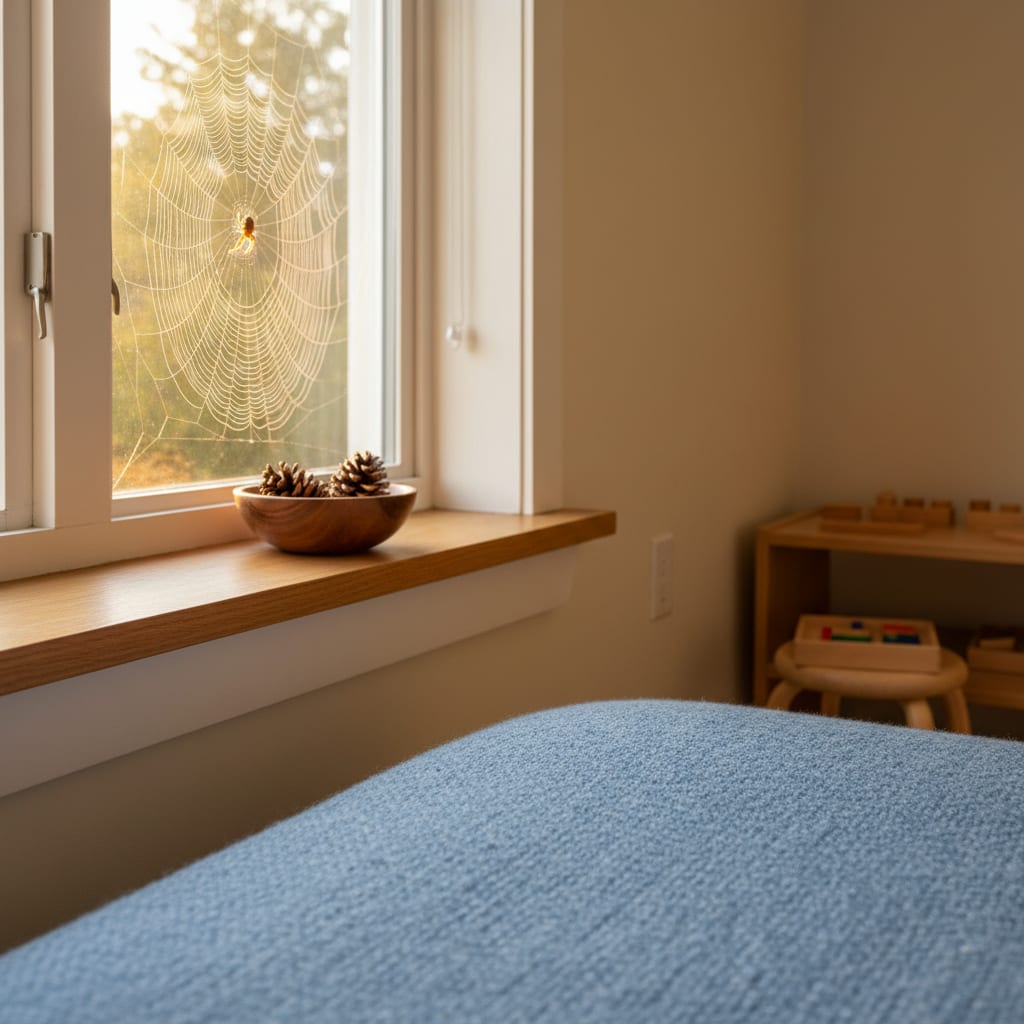
When a toddler spots a spider in the bedroom and will not settle, treat it as a real problem with a real answer, because it is one. Calmly catch the spider and put it outside, or vacuum it up, while your child watches only if they want to. Say one short true thing (“It was a house spider. It eats flies. It’s outside now.”). Then go back to the normal routine. Do not promise there are no spiders anywhere, and do not turn bedtime into a lesson. The curiosity keeps until morning, when a child-led look at a web or a spider in a clear viewer turns the fright into knowledge. That second half is the Montessori part.
I was an assistant in a Montessori toddler community and have no guide’s diploma or medical training. The spider facts below come from a university pest-management page, and the fear advice from two children’s health services.
A spider is not a monster
Most bedtime-fear advice is written about imaginary things. Nemours KidsHealth’s page on childhood fears and worries explains that children of four to six “can’t always tell what’s real and what’s not,” so “the scary monsters they imagine seem real.” For those fears, the Victorian government’s Better Health Channel says in its guide to fear and anxiety in children: “Don’t try to reassure your child by checking in the cupboard or under the bed as this may suggest to the child that you believe monsters could be there.”
A spider is the opposite case. Your child saw something real. Telling them “there’s nothing there” teaches them that their own eyes are wrong. Montessori homes lean hard on reality for young children: real objects, real words, the world as it is. So the respectful answer is a real check, done once, together, followed by true information sized for a small person.
Tonight: five steps
1. Stay calm, because your face is the information. A toddler reads your reaction before your words. KidsHealth’s advice: “Stay calm when your child is fearful. Then, provide support and gentle care.” If you are frightened of spiders yourself, slow down and use the plainest voice you have.
2. Deal with the spider. The University of California’s Integrated Pest Management program, in its page on spiders in and around the home, gives the household options plainly: “Vacuum up the spider and its web,” or “capture them in a jar and release them outside.” Catch-and-release suits the reality-first approach, because the child sees where it went. A long-handled catcher like the Carson BugView lets an adult trap a spider under a clear magnifying cup without touching it.
Let your child choose how close to be. Better Health is clear on this point for toddlers: “Don’t force the child to confront their object of fear, because this may make things worse. Help them to get used to it slowly.” Watching from the doorway, or from your lap, or not at all, are all fine.
3. Say one true thing. UC IPM says “The jaws of most spiders are too small to bite humans,” and that the common house spiders found indoors are “only marginally capable of biting humans because their fangs are too short to pierce people’s skin in most cases.” For a two-year-old that becomes: “Spiders are small. Most can’t bite people. This one lives outside now.”
4. Do one look around, together, then stop. Walk the edge of the room once with a lamp: the corner, behind the curtain, under the bed. Let your child hold the lamp if they want. Then the check is done. KidsHealth warns against catering to a fear: avoiding the thing entirely “will just reinforce” that it should be feared. A second and third search teaches that one was not enough.
5. Back to the routine, exactly as usual. Same book, same song, same goodnight, same place to sleep. If your child usually turns their own lamp on and off, let them keep that job. Better Health notes that a child’s fear “tends to lessen if they feel they have some control over a situation,” and suggests a bedside lamp they can switch themselves with a low-wattage bulb. If the bedtime routine on this site is already child-run, as in letting your toddler run the bedtime steps, keep it child-run tonight too.
If they still cannot settle, sit nearby for a few minutes, quietly, then leave as you usually would. If your child is asking where you will be rather than where the spider went, it may be separation rather than spiders. The door-gap post covers how to tell fear, order and stalling apart.
If they wake later in the night
A child who saw a spider at bedtime may wake later and call for you. Betteroo’s guide to telling a bad dream from a night terror is useful here, because the two need opposite responses. For a verbal toddler who has woken from a nightmare, its advice fits this whole post: “Comfort first, keep the conversation short at night, and talk it through in daylight.”
Tomorrow: the daylight look
This is where Montessori parents have an advantage. A young child’s fear of a creature usually shrinks once the creature has a name, a size and a job. So in the morning, offer (do not insist on) a closer look:
- A web outside. Find one on a fence or a bush and look at it together. Do not touch it.
- A spider in the viewer. If you catch one again, look at it through the clear magnifying cup for a minute, then let it go outside. UC IPM’s description is perfect for a three-year-old: “Spiders have 8 legs and 2 body parts.” Count the legs together.
- Its real name. “House spider.” “Garden spider.” Older preschoolers often enjoy the word “arachnid”. The way of naming that works at this age is in Montessori language activities for toddlers.
- Its job. UC IPM: spiders “are mostly beneficial because they feed on pest insects.” A spider that eats flies is a helper, and toddlers like helpers.
- A realistic picture book about spiders, with photographs or accurate drawings rather than cartoon faces.
Follow your child: one look may be the whole lesson, or it may be a week of morning spider hunts.
The grown-up facts
Some spiders do matter, and which ones depends on where you live. UC IPM describes the adult female black widow, “shiny black with a red hourglass marking on the underside,” as the main spider in California that can cause serious injury, and notes it is “commonly found outdoors, in sheltered, dry, undisturbed areas such as wood piles and garages.” It also states: “if the bite of any spider causes an unusual or severe reaction, contact a physician.” Your state’s university extension service can tell you which spiders live near you. None of this is bedtime conversation for a toddler.
To make the bedroom less inviting, UC IPM suggests keeping “clutter off the floor indoors” and checking “window and door screens for good seals.” Screens keep insects out, but they do not keep a child in: see what to do when a toddler opens the bedroom window before relying on one.
When to ask for help
Most children get over a fright like this within a few nights. KidsHealth suggests talking to your doctor if a child’s fears “seem extreme or last past the normal age,” or “keep your child from doing things — like going to school, sleeping alone, or being apart from you.”
 One bad night is normal. A run of them needs a plan.
Betteroo builds a gentle, personalized sleep plan around your child's age, routine and temperament, starting with a free quiz.
Take the free sleep quiz →
FAQ: spiders and bedtime
Should I tell my toddler there are no spiders in their room?
No. You cannot promise that, and your child saw one. Say something true instead: the spider is outside now, most spiders are too small to bite people, and you checked the room together.
How do I get rid of a spider without scaring my child?
Calmly. Catch it in a jar or a clear bug catcher and release it outside, or vacuum it up. Let your child watch from wherever they feel safe, or not at all.
Is it Montessori to teach a scared child about spiders?
Montessori favours real information about the real world, but led by the child. Offer a look at a web or a spider in a viewer the next day, and stop when your child stops.