Montessori Weaning Table: What It Is and When to Use
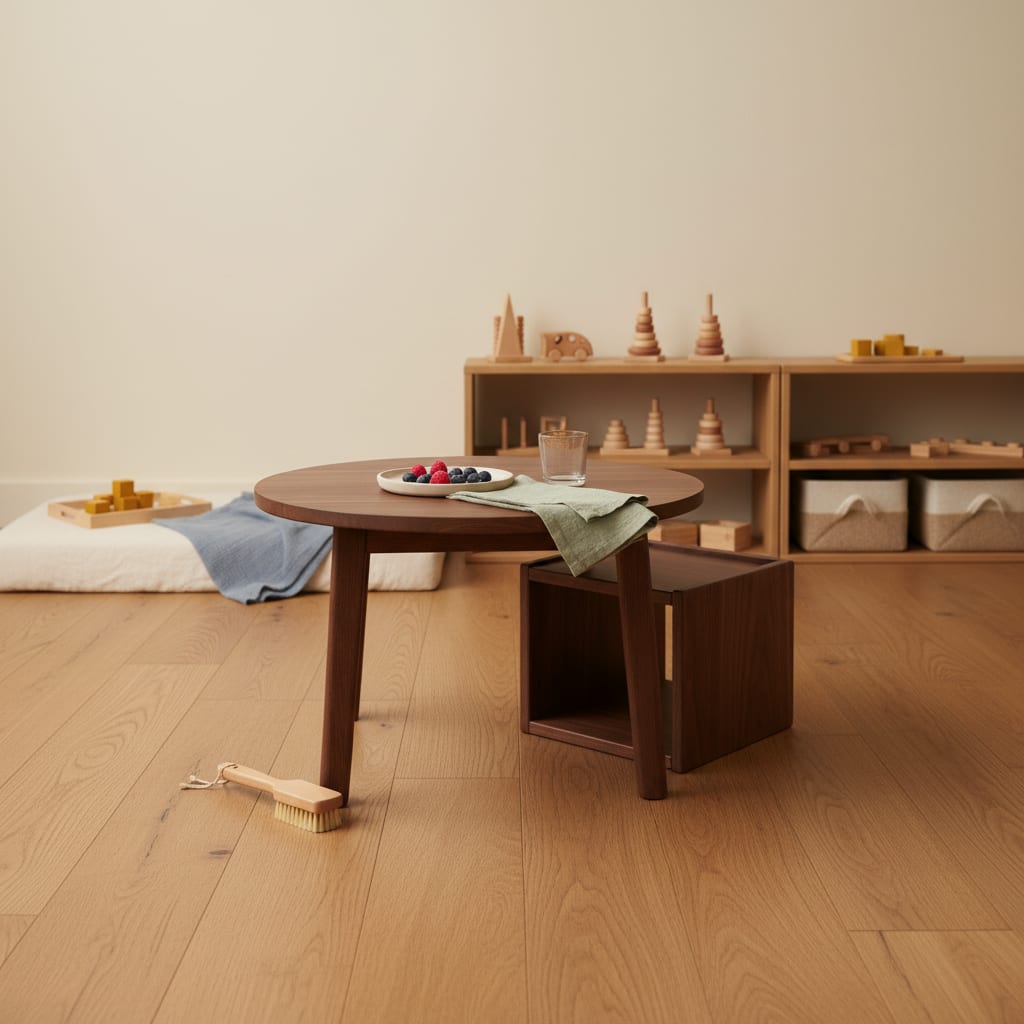
A Montessori weaning table is a very low table and chair — roughly knee height to an adult — where a baby who can sit unsupported eats their meals with their feet flat on the floor. It is not a piece of feeding equipment; it’s a piece of independence equipment. The child arrives at it, sits down, eats, stands up and leaves, which a high chair by definition does not allow. Most families use one from around eight or nine months to about two and a half, alongside — not instead of — the family table.
What the table is actually for
Three things a high chair can’t do, and they’re the whole argument.
Feet on the floor. Stable seating is easier eating. A child whose feet are supported has a base to work from, which matters for the fine motor job of getting food to a mouth.
Getting up and leaving. The child signals “done” by standing, rather than by arching, throwing or shouting until an adult unbuckles them. Mealtimes get shorter and less confrontational, and the child learns their own fullness cues without a strap in the way.
Arriving under their own power. Once crawling or cruising, the child comes to the meal. That single change converts eating from something done to them into something they do.
The trade-off is honest and worth stating: a child who can leave will leave, often at bite three. That’s the same transition cost a floor bed carries, and it resolves the same way — with a boringly consistent adult response, not a new plan.
Age, sizing and the seat
Age. The realistic start is when the child sits steadily without support, usually somewhere around six to nine months, and it comes into its own once they’re mobile. Introducing solids itself is a conversation for your pediatrician, not a furniture decision.
Height. The rule is the same as every Montessori seat: hips, knees and ankles all roughly at right angles, feet flat on the floor. Work backwards from the child, not from a catalogue. For a typical one-year-old that lands the seat somewhere around five to seven inches high and the tabletop around ten to twelve, but measure your own child from the back of the knee to the floor with shoes off and use that number.
The chair. A cube chair — a hollow wooden cube that can be flipped to give two or three different seat heights — is the classic, because it grows with the child and gives arms to push up against. A small weighted stool works too. What matters is that the child can get on and off it without help.
A tray or the bare table? Bare. Food goes on a small plate on the table; a cloth goes underneath; a hand brush lives nearby. The mess is part of the work.
Buying one, or not
The honest answer is that plenty of families never buy the table and lose nothing. A sturdy toddler stool at the right height, an upturned crate sanded down, or a low coffee table pushed against a wall will do the same job. If you’re already committed to a child-height table for art and work, that table will feed a one-year-old perfectly well once you have a low enough seat.
If you do want the purpose-built version, buy for stability and edges rather than looks. Test three things: does it tip when a nine-kilo child pulls up on the edge; are the corners rounded; does the finish look like something that will be chewed. Height-adjustable sets are worth the small premium, because the seat that fits at nine months does not fit at two.
The Montessori & Me solid-wood weaning table and cube-chair set is a reasonable worked example of the type — real hardwood, a flippable cube chair, low enough to start early and usable later as a work table. It isn’t the only decent one, and there is no such thing as a “Montessori-certified” table, whatever the listing says; no such certification exists. Judge the set on the three tests above.
Introducing it without a battle
- Put it where the family eats, not in a bedroom. This is a social meal at a smaller scale, not a solo one.
- Start with one meal a day — usually a snack or breakfast, when nobody’s desperate.
- Sit down at their level on the floor or a low stool. Eating alone at a small table with an adult standing over it is not the experience you’re building.
- Let them get up. Once they stand, the meal is over; the plate goes to the counter. If they come back in thirty seconds, the plate comes back once. After that it waits for the next meal.
- Hand over the cleanup. A cloth for the table, a hand brush for the floor. By eighteen months this is genuinely useful, not symbolic.
- Keep the high chair for restaurant meals, for the days when you need containment, and for anyone else’s house. Nothing about the method requires you to get rid of it.
Where it fits in the wider room
The weaning table belongs to the same logic as the rest of a prepared home — reachable water, a low shelf of their own dishes, a mirror at floor level in the infant room. If you’re setting up from scratch, the whole layout is walked through in a Montessori infant room on a normal budget, and the food-preparation half of it grows into the Montessori kitchen for toddlers sometime after the first birthday. For the ladder of what a child can manage at each stage — pouring, spreading, carrying, washing up — see practical life activities by age.
When to stop using it
Most children move to the family table somewhere between two and three, usually because they’d rather be where everyone else is than at a table of their own. That’s a success, not a lapse. The table itself rarely goes to waste — ours became a puzzle and painting surface for the four-year-old within a week of the last meal eaten at it.
FAQ: Montessori weaning tables
What age is a Montessori weaning table for?
From when a baby sits unsupported — typically around six to nine months — through roughly two and a half. It becomes genuinely useful once the child is crawling or cruising and can arrive at it independently.
How tall should a weaning table and chair be?
Sized so the child’s feet are flat on the floor with hips, knees and ankles at about ninety degrees. Measure from the back of the knee to the floor for the seat height, then add roughly five inches for the tabletop.
Do I still need a high chair?
Many families keep both. A high chair is easier for restaurants, travel, visiting relatives and any meal where you need the child contained. The weaning table covers the everyday meals at home.
What if my baby just gets up and walks away?
Expect it, and let it end the meal calmly — the plate goes up, no lecture, and the next meal arrives on schedule. Getting up is the child using the feature, and after a week or two of consistent handling most children settle into staying for the food they want.
Is a weaning table safe for a baby who can’t sit alone yet?
No. Independent sitting is the prerequisite. Before that, feeding happens supported, in your lap or a reclining seat, and any question about starting solids at all is one for your pediatrician.