Montessori vs Reggio Emilia: A Home Parent's Comparison
The short version: Montessori gives you a sequence of self-correcting materials a child works through alone, and Reggio Emilia gives you a project that emerges from what a child is already curious about, documented and extended by adults. Both take the child seriously. But Reggio was built inside institutions and names its own institutional parts — an atelier, an atelierista, an in-school kitchen, a coordinating group of pedagogistas — while Montessori was built around a prepared environment and a set of objects. That is why Montessori travels into an ordinary flat and Reggio mostly does not, and it is the honest answer nobody selling you a place will give you.
Almost everything written on this comparison is written by a school. That is not a smear — schools know their approach and explain it well — but a school compares two philosophies in order to enrol you in one of them. If you are choosing between two nurseries, read them. This post is for the other reader: the parent who is not enrolling anywhere, who wants to know which of these two ideas is worth reorganising a living room around.
What each one officially is
I am not a certified guide — three years as an assistant in a toddler community taught me what happens on the floor, not what happens in a training course — so for doctrine I will let the bodies speak.
The American Montessori Society names five core components: trained Montessori teachers, the multi-age classroom, Montessori materials, child-directed work, and uninterrupted work periods. Note the shape of that list — one item is a person, one is a group of children, one is a set of objects, and two are things a child does. Half of it is portable.
Reggio Children, the body founded in Reggio Emilia to steward the approach, describes it as “an educational philosophy based on the image of a child with strong potentialities for development and a subject with rights, who learns through the hundred languages,” and then names its foundational elements: collegial, relations-based work among all staff; the daily presence of several educators with the children; the atelier and the atelierista; in-school kitchens; the environment as educator; documentation that makes learning processes visible; a pedagogical coordinating group; and the participation of families.
Read that list again as a parent standing in a kitchen. Six of its eight items are descriptions of an institution. That is not a flaw in Reggio — it is what Reggio is, a municipal system built after the war by a city that decided early childhood was public work. It is a flaw only in the idea of “doing Reggio at home.”
The four differences that survive the move indoors
1. Where the structure lives. Montessori’s structure is in the objects. The pink tower stacks one way; the cylinder fits one hole; the child finds the error without an adult mentioning it. Reggio’s structure is in the adults — in noticing what a child is chasing, then feeding it. Montessori outsources a lot of teaching to the shelf. Reggio does not, and cannot.
2. Who chooses. Both are child-led, but differently. In Montessori the child chooses freely from a bounded, deliberately limited set. In Reggio the child’s interest sets the direction and adults build the road as it goes. At home the second sounds easier and is harder: it requires an adult with time to watch, photograph, revisit and extend.
3. Documentation. In Reggio, documentation is not a nice extra — it is a named foundational element and the main way learning is understood and continued. It also takes hours a week that most households do not have. Montessori’s equivalent, observation, is quieter and less demanding: you watch, you notice what a child returns to, and you change the shelf.
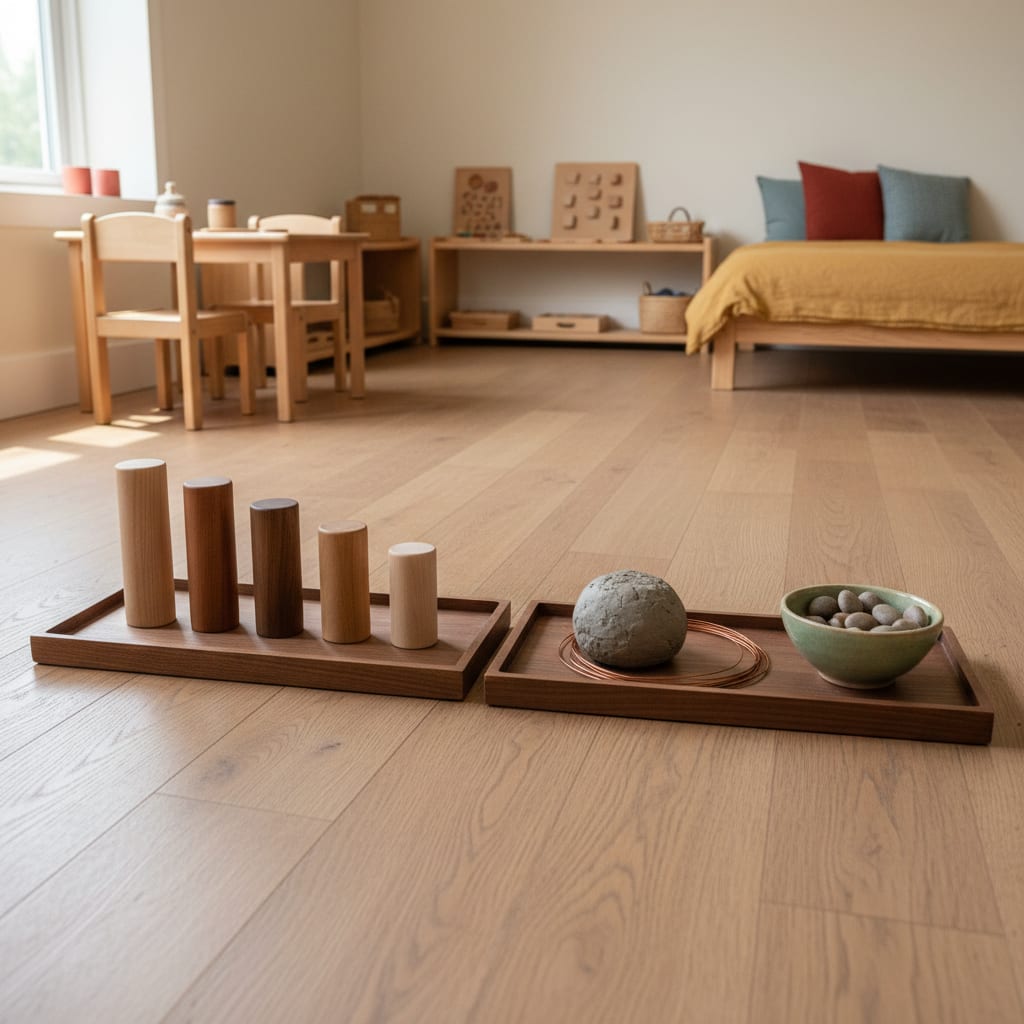
4. What “materials” means. Montessori materials are specific and sequenced. Reggio’s are open — clay, wire, light, paint, found objects — and are the atelierista’s domain. Buying loose parts does not make a home Reggio any more than buying a pink tower makes one Montessori, but the loose parts are at least cheap.
What actually transfers to a house
Honestly, the best of Reggio does transfer, as long as you stop calling it Reggio.
- The image of the child as capable. This is Reggio’s central claim and costs nothing. It is also, word for word, most of what Montessori means by respect for the child — see what “Montessori” actually means for how much overlap there really is.
- The environment as a teacher. Both approaches say this. A Montessori home does it with low shelves and reachable things; a Reggio-inspired home does it with light, mirrors, natural materials and space to leave a project out overnight. The second is a genuinely good idea and one Montessori homes are often too tidy to allow.
- Following the interest. If your three-year-old is obsessed with drains, build a fortnight around drains. No certification required.
What does not transfer is the machinery: several trained educators in the room daily, an artist-in-residence, a kitchen that is part of the pedagogy, and a coordinating group. If you find yourself trying to run all of that solo, you have taken on a job a city government funds.
Which one for which house
Choose the Montessori route if you want structure you can buy once and largely leave alone, if you have one adult and limited time, if your child likes finishing things, or if you want the day to run without you narrating it. Practically, that means a small shelf and a rotation — the starting point is in Montessori at home: where to start and the objects themselves in what Montessori toys actually are.
Lean Reggio-inspired if you are already the sort of adult who documents, if you have an art-tolerant surface and can leave work unfinished, if your child is a maker rather than a completer, and if you find sequenced materials joyless. In practice most homes I know end up with a Montessori skeleton and a Reggio attitude, which is a perfectly honest place to land.
If you are weighing a third option, the Montessori and Waldorf comparison sits beside this one; Waldorf differs from both on the question of fantasy, which neither of these two really fights about.
FAQ: Montessori vs Reggio Emilia
Is Montessori or Reggio Emilia better?
Neither, and any comparison that names a winner is usually attached to a school. They optimise for different things — Montessori for independence through prepared materials, Reggio for collaborative inquiry documented by adults. The real question is which one your household can actually run.
Can you do Reggio Emilia at home?
You can be Reggio-inspired at home. You cannot reproduce the approach, because Reggio Children’s own list of foundational elements includes several educators present daily, an atelier with a resident artist-educator, an in-school kitchen and a pedagogical coordinating group. Take the image of the child, the environment and the project work; leave the institution.
Are Montessori and Reggio Emilia opposites?
No. They agree that children are competent, that the environment teaches, that adults should observe more than instruct, and that early childhood is not a race. They disagree mainly about whether structure should live in the materials or in the adults.
Which is cheaper to run at home?
Reggio-inspired, by a distance — clay, paper, wire, light and found objects against a set of precision wooden materials. Montessori is cheaper in adult hours, though, which for most households is the scarcer currency.