Montessori Chores by Age: What Kids Can Really Do
In Montessori language, chores aren’t chores — they’re care of the environment, and the distinction is practical rather than precious. A chore is something a child does because you asked; care of the environment is a job that genuinely needs doing, handed over at the size their hands can manage, and left theirs. An eighteen-month-old puts their own dirty clothes in the basket. A three-year-old feeds the cat. A seven-year-old empties the dishwasher without a reminder. Below is what’s realistic at each stage, and the handover method that decides whether any of it sticks.
Real jobs beat token jobs
The single biggest predictor of whether a job survives is whether it’s actually necessary. Children can tell. Wiping a table that needed wiping lands differently from wiping a clean table so that a child can be seen to be helping, and the difference shows up within a week or two.
So: give away real work. If the plants need watering, that’s a job. If the recycling needs carrying out, that’s a job. Sorting a bag of pre-sorted objects into colors is an activity, and a fine one, but it isn’t a contribution and it won’t produce the thing you’re actually after — a child who notices the house needs running and considers themselves part of that.
Two consequences follow. You will get worse results for a while: the table stays streaky, the cat gets over-fed, the laundry comes out of the machine damp. And you have to accept the job actually being gone from your list, which is harder than it sounds.
Transport and imitation: 18 months to 2 years
At this age everything is carrying something from A to B, and the participation lasts about ten seconds. That’s fine — you’re building the habit of joining in, not the output.
- Dirty clothes into the laundry basket; diaper into the bin.
- Carrying their plate or cup to the counter after a meal.
- Putting shoes into a basket by the door.
- Wiping a spill with a small dry cloth, symbolically.
- Watering one plant with a tiny watering can you’ve filled.
- Putting a few toys back on the shelf where they came from, with you.
First jobs that stay done: 2 to 3 years
Two-year-olds want the real version of the job, not a version of it — which is inconvenient and also the whole opportunity.
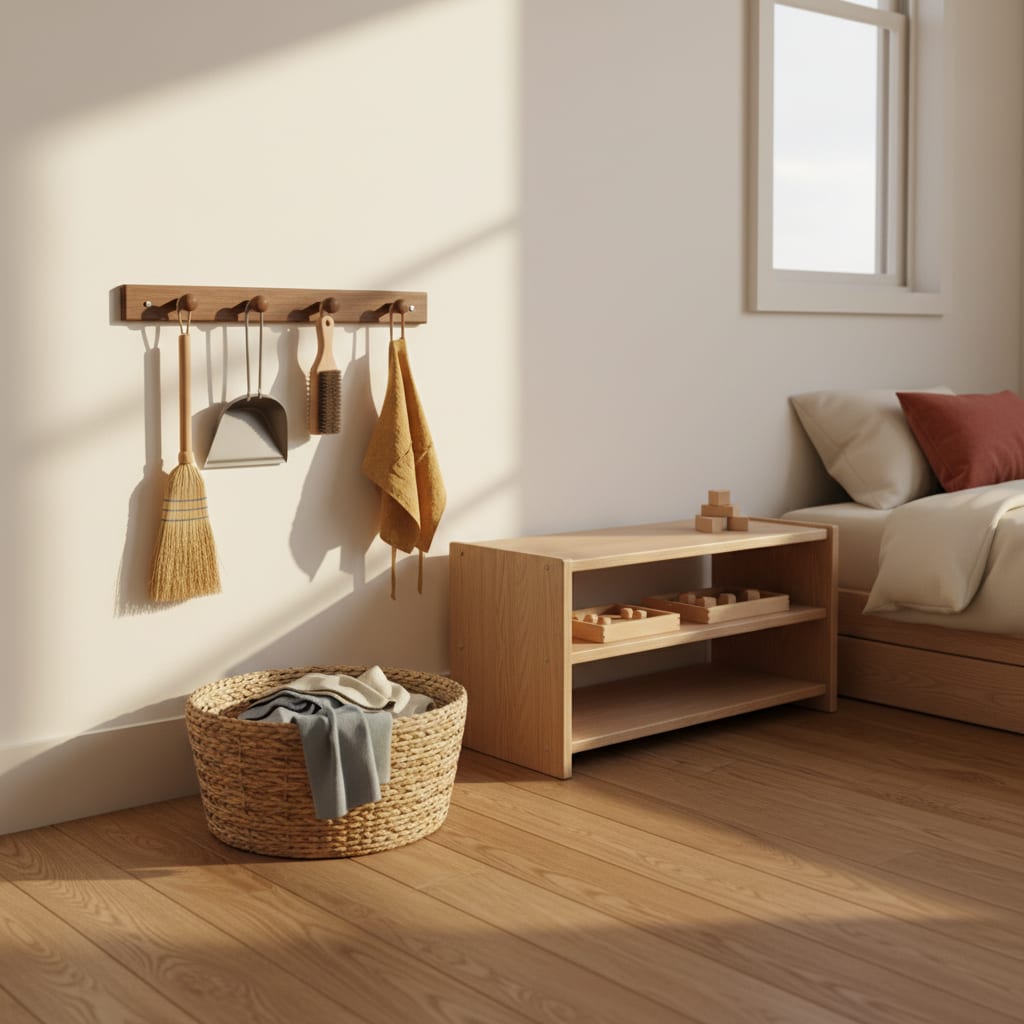
- Sweeping crumbs with a hand brush and dustpan. A real one: the Redecker horsehair hand brush and dustpan set is the sort of thing that lasts a decade and doesn’t feel like a toy, though any short-handled brush that a small hand can grip will do.
- Wiping the table after meals with a damp cloth wrung out for them.
- Washing vegetables in a bowl of water.
- Laying their own place at the table.
- Watering plants, now with a marked fill line so the plant survives.
- Feeding a pet with a pre-measured scoop.
- Putting clean socks and washcloths away in their drawer.
Sequences and a standing job: 3 to 4 years
Three is when a child can hold several steps in their head, which is what makes a standing job possible for the first time — the same task, theirs, every day.
- Setting the whole table, including a pitcher for everyone.
- Sorting laundry into lights and darks; matching and folding socks and tea towels.
- Loading their own dishes into the dishwasher.
- Dusting low surfaces and the baseboards, which are conveniently at their height.
- Watering all the houseplants as a round, with a small can and a cloth for drips.
- Tidying the shelf at the end of the day, which is much easier if the shelf is small — the argument behind our toy storage in a Montessori home approach.
Work the house depends on: 4 to 6 years
The jobs at this stage should be genuinely load-bearing, because that’s what makes them worth doing.
- Making their own breakfast: cereal, toast, fruit, and the washing-up after.
- Emptying the dishwasher, at least the bottom rack and the cutlery.
- Taking the recycling or compost out on the right day.
- Making the bed — badly, and increasingly less badly.
- Sweeping a whole floor with a child-height broom; using a small dustpan properly.
- Helping carry, unpack and put away shopping.
- Caring for a pet as a full routine: food, water, and noticing when the bowl’s empty.
Noticing without being told: 6 to 8 years
The shift here is from doing the job when reminded to seeing that the job needs doing, which is the real end point of the whole progression.
- Cooking a simple meal for the family with supervision, start to finish.
- Doing a load of laundry, from machine to folded pile.
- Vacuuming a room; cleaning a bathroom sink and mirror.
- Weeding, planting and watering a small patch of garden.
- Packing their own school bag and lunch.
- Looking after a younger sibling in small, defined ways — reading a book, helping with shoes.
Why sticker charts undercut the whole thing
A reward chart works — briefly, and then it becomes the reason for the work. Once a child is sweeping to earn a star, the sweeping is priced, and the price goes up. Montessori’s claim, and the one place I’d point you at people with more standing than me, is that the satisfaction of a job well done is a sufficient motivator if we don’t crowd it out; the practitioner writing on this that I return to most is The Kavanaugh Report, and Living Montessori Now collects a lot of the family-work material in one place.
What to do instead is unglamorous: notice the effect rather than praising the child. “The table’s clear, so we can eat” does more work than “good job”. And when the job is skipped, the consequence is the real one — the plant droops, the socks aren’t in the drawer — rather than a lost sticker.
Handing a job over in five steps
- Do it beside them for a week. Not narrating, just doing it together.
- Show it once, slowly, in near silence. Break it into visible steps, exaggerate the awkward bits.
- Give them the tools, stored where they can reach them. A job whose bucket lives on top of a wardrobe is not their job. Storage that makes this work is covered in organizing practical life supplies.
- Leave the room. The single most effective thing you can do.
- Don’t re-do it in front of them. If it genuinely has to be redone, do it later, and re-present the tricky step another day.
For the wider ladder — pouring, dressing, food preparation and grace and courtesy alongside these household jobs — see practical life activities by age, and for the food-work end of it, the Montessori kitchen for toddlers.
FAQ: chores in a Montessori home
What age should a child start doing chores?
Around eighteen months, with one-step transport jobs: laundry into the basket, plate to the counter, shoes into a basket. Genuine standing responsibilities — the same job every day, unprompted — usually become realistic around three.
Should Montessori children be paid for chores?
Family contributions generally aren’t paid, on the reasoning that running the house is something everyone in it does. Pocket money as a separate arrangement — for learning about money rather than as wages for the dishwasher — is a different question and a household call.
What if my child refuses?
Check the job first: is it real, is it the right size, are the tools reachable, and is it happening at a workable time of day. If all four are fine, hold the expectation calmly and without a reward, offer a choice between two jobs rather than a yes/no, and expect refusal to be a phase rather than a verdict.
How many jobs should a child have?
Fewer than you’d think. One standing daily responsibility that genuinely belongs to them beats a list of six that need supervising, and a single job done for a year builds far more than a rotating chart does for a month.