Montessori and Pretend Play: What the Method Actually Says
Montessori does not ban pretend play. What it does is put reality first for children under six: real tools rather than toy versions, books about the real world, and plenty of real experiences for a child’s imagination to build on. Montessori writers draw a line between imagination, which grows out of real experience, and fantasy, which has no basis in reality, and they are wary mainly of the second. At home, that means letting your child’s own make-believe happen, not adding a lot of fantasy for them, and offering the real version of whatever they are pretending.
Montessori educators do not fully agree with each other on this. I was a classroom assistant in a Montessori toddler community, not a trained guide, so I will show you what the sources say rather than rule on who is right.
Where the reality-first idea comes from
The classroom story is the one most often told. Simone Davies, an AMI-trained teacher who writes The Montessori Notebook, summarises it this way: when Dr Montessori put traditional toys in her classroom, “She found that children gravitated instead to the real thing. For example, rather than playing in a pretend kitchen, the children wanted to prepare real food.” So the toys went and practical life came in. That is why you rarely see a pretend corner in a Montessori classroom.
The concern about fantasy comes from the same writers. Davies quotes Montessori in 1919: the young child “cannot distinguish well between the real and the imaginary, between things that are possible and things that are merely ‘made up’.” Her own example is her son at about four, terrified by an audio book of Snow White, because to him the witch was real.
Imagination is not the same as fantasy
The Association Montessori Internationale’s question-and-answer page on imagination and fantasy separates the two. It describes imagination as the ability “to think about what could have happened in the past— or what could possibly happen in the future”, and says this ability “emerges usually during the 5–6-year-old period”. Fantasy, by contrast, “is not based on reality.”
The same page describes what the writer does when a child under six holds an imaginary tea party with an imaginary friend: “Do I stop the activity? NO”. Instead, they try “through presentations of ‘grounding’ activities” to connect the child with real life.
A second AMI article, Montessori, Imagination, and Young Children, pushes harder in the other direction. It says plainly that “Montessori was not opposed to children’s play or pretend”, that “spontaneous ‘pretending’ is a healthy indicator of the development of imagination”, and that “‘Don’t pretend!’ is the mental equivalent of, ‘don’t touch!’” It also says it is “neither necessary nor helpful to ‘teach’ the child to pretend or imagine.”
Read side by side, these two pages from the same organisation agree on the practical points:
- Don’t stop a child’s own pretend play.
- Don’t fill their world with adult-made fantasy.
- Give them plenty of real experiences to pretend about.
Where they differ is tone. One sees retreat into fantasy as a sign something real may be missing. The other sees pretending as healthy development that adults too often get in the way of.
What mainstream guidance says
Outside Montessori circles, pretend play is encouraged without much hesitation. The CDC’s 18-month milestone page suggests: “Encourage ‘pretend’ play. Give your child a spoon so she can pretend to feed her stuffed animal.” That is a very reality-based kind of pretending: a real spoon, a familiar act, copied from life. It sits comfortably with everything above.
This is one of the places where reasonable people disagree, which I touch on in is Montessori bad?. It is also one of the clearest differences from Waldorf, which protects fantasy play deliberately. The Montessori vs Waldorf comparison covers that side.
The play kitchen question
This is the most common version of the question at home. Davies’s answer is honest about real life. Dr Montessori would invite the child into real food preparation, she writes, but “I understand it can be difficult for parents to supervise their child in the kitchen all day, and perhaps there is an argument for them to do pretend play with a play kitchen. It’s really a personal choice.”
Her favourite example is a family who used the IKEA play kitchen as a real kitchen, with everything at the child’s height and real child-sized tools. That is a good middle path. A small wooden unit like the IKEA Duktig mini-kitchen can hold a jug of water, a real cup and a cloth just as easily as plastic food. If you would rather start with real work in the real kitchen, the Montessori kitchen for toddlers shows how to set that up.
My own house test: if the child keeps choosing it week after week without me selling it, it is earning its space. If not, it was a novelty.
The dress-up box and the costume question
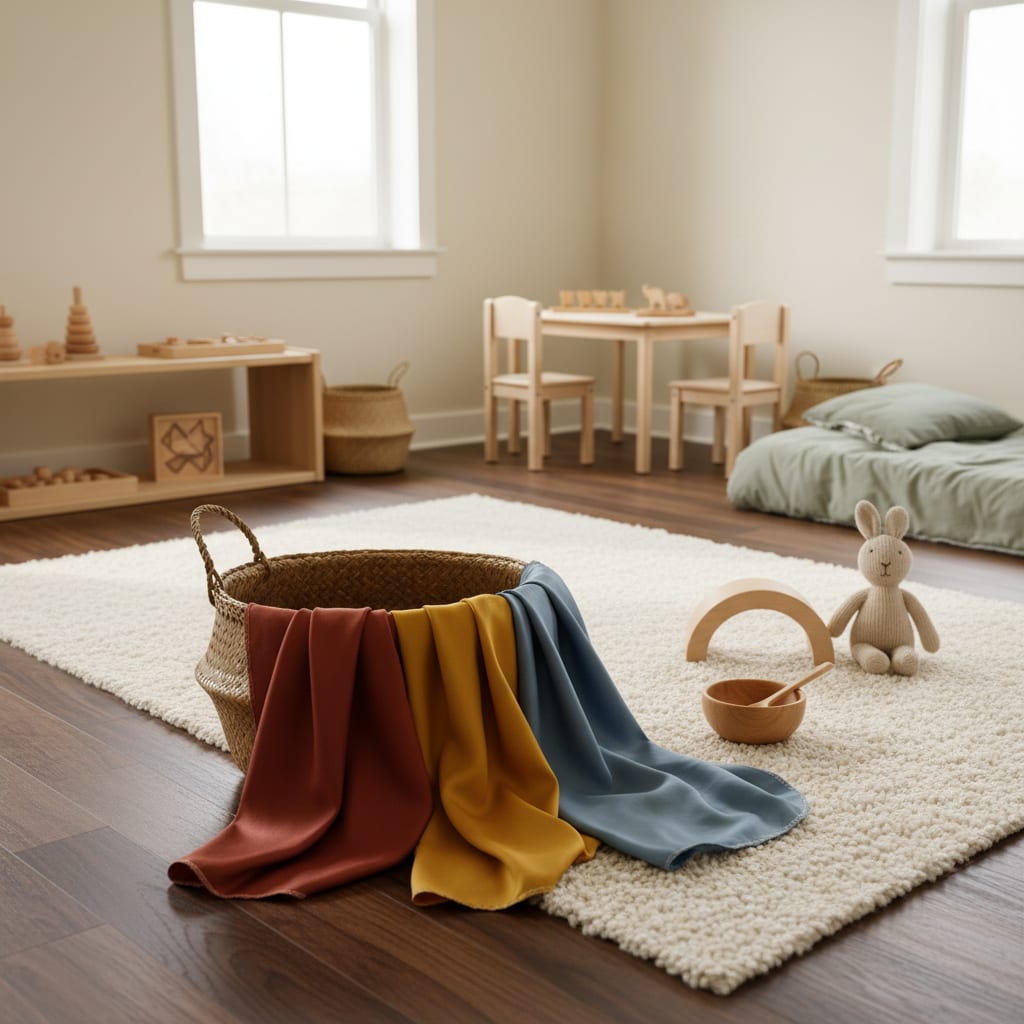
Davies describes a Montessori Congress lecture she attended that recommended “open ended materials like wooden blocks and scarves for pretend play, rather than a fireman’s outfit, or prescriptive make believe choices.” That is a useful rule of thumb for a dress-up basket:
- Open-ended beats prescriptive. A few large cloths, like a set of Sarah’s Silks playsilks, can be a cape, a tent, a river or a baby’s blanket. A branded character costume can only be that one character.
- Real roles beat fantasy roles for the very young. A child who has watched the mail carrier, the baker or a parent at work has something real to play out.
- Blocks are the classic open material. Davies keeps a block corner in her classroom even though blocks are “not standard Montessori materials”, because children use them for roads, zoos and buildings. A set of plain PlanToys unit blocks does the same at home.
This month the question tends to arrive dressed for Halloween. A reality-first family can still take part. A three-year-old dressed as a firefighter, a cat or a pumpkin is playing a real thing. Witches and monsters are the part that frightens many small children, so talk about it simply: these are people in costumes, just like the one they are wearing. You do not have to skip the night to stay true to the method.
Talking animals and fairy tales in books
Most picture books star bears in trousers and rabbits who talk. Davies’s approach is practical rather than strict: she mostly chooses realistic books, but reads fantasy ones “from time to time” and makes the difference into a game: “Do bears really talk/drive cars/wear clothes? Noooo.” I have pulled together realistic picks that actually get read in Montessori books for toddlers.
What I’d actually do at home
- Let your child’s own make-believe run. Feeding a doll, playing shop, putting the toy farm animals to bed: all of it is the child working out real life.
- Don’t teach fantasy, and go easy on the screen-made kind under five or six.
- Offer the real version alongside the pretend one: a real cloth after the pretend cleaning, a real snack to prepare after the toy kitchen.
- Choose open materials over single-purpose costumes and character toys.
- When something frightens your child, treat it as real to them and keep the answer simple.

FAQ: Montessori and pretend play
Does Montessori allow pretend play?
Yes. AMI’s own writers say not to stop a child’s spontaneous pretending. What Montessori classrooms avoid is replacing real work with toy versions, and introducing a lot of adult-made fantasy to children under six.
Why don’t Montessori classrooms have a pretend corner?
Because Montessori observed children choosing real tasks over toys, such as preparing real food instead of playing with a toy kitchen. Real practical-life work took the pretend corner’s place.
Is a play kitchen Montessori?
Not traditionally, but it is a personal choice. Simone Davies of The Montessori Notebook says there may be an argument for one when a parent cannot supervise real cooking all day. Many families stock theirs with real cups, jugs and cloths.
When does Montessori introduce fantasy?
Montessori writers generally suggest waiting until around five or six, when children can more easily tell made-up from real. Before then, keep the focus on real things and talk about fantasy simply when it comes up.