Bedtime After the Last Nap Drops: A Montessori Guide
When a child drops their last nap, bedtime almost always has to move earlier — commonly by thirty to sixty minutes — and it usually needs to stay there for weeks rather than days. A newly napless three-year-old is awake for twelve or thirteen straight hours, and all of that load now lands on one bedtime instead of two sleeps. The Montessori part of this isn’t a trick or a technique. It’s the rhythm and the room: a predictable evening sequence the child can mostly run themselves, in a space prepared well enough that they can.
Bedtime moves earlier, not later
Almost every family gets this backwards on the first try, reasonably enough. The child stopped napping, so they seem to have more awake time to fill, so bedtime drifts to 8:15 — and then takes ninety minutes, involves three exits and one meltdown, and ends at a 5:40 wake-up anyway.
The arithmetic runs the other way. Commonly cited guidance puts children aged three to five at roughly ten to thirteen hours of sleep in twenty-four. If a chunk of that was arriving as a ninety-minute afternoon nap and the nap is gone, the night has to absorb some of it. A child waking at 6:30 who needs somewhere near eleven hours is asleep by about 7:30 — which means in bed, lights low, well before that.
It doesn’t feel that way at 6 p.m. because overtiredness looks like energy. A child bouncing off the sofa at 6:45 and inconsolable at 7:05 does not need a later bedtime; that second-wind-then-collapse pattern is one of the clearest versions of what overtiredness actually looks like. Move in fifteen-minute steps, give each step three or four nights, and skip the dramatic 6:15 bedtime nobody in the house enjoys.
The two weeks that look like a regression
The nap drop is rarely clean. The honest picture is a stretch — often several weeks, sometimes a couple of months — where the child naps two days out of seven and is visibly done sleeping at noon on the other five. Three things happen during it, and none of them mean you got the bedtime wrong:
- A wrecked evening after a rogue nap. A 3 p.m. car sleep buys back enough sleep pressure to push settling out an hour or more.
- Earlier morning waking, temporarily. Parents who move bedtime earlier brace for a 5 a.m. start, and it does sometimes appear. It is usually overtiredness unwinding — the early-morning waking pattern has a handful of usual causes and a too-early bedtime is well down the list.
- A week of extra night wakings in a child who had been sleeping through for a year.
The instruction for all three is dull: hold one bedtime for at least a week before changing it. Observation before intervention is the classroom habit that transfers most cleanly to 2 a.m. — watch first, adjust one variable, watch again.
What the prepared room has to do now
A napless child goes to bed with more capacity left over, which changes what the room has to handle.
Darkness, which in August is the whole problem. A 7 p.m. bedtime in high summer means putting a child to bed in daylight. A lined panel such as NICETOWN’s 100% blackout curtains does the job on an ordinary rod, and any equivalent with a sewn-in liner works the same way. Half-measures don’t; a merely dim room reads as afternoon.
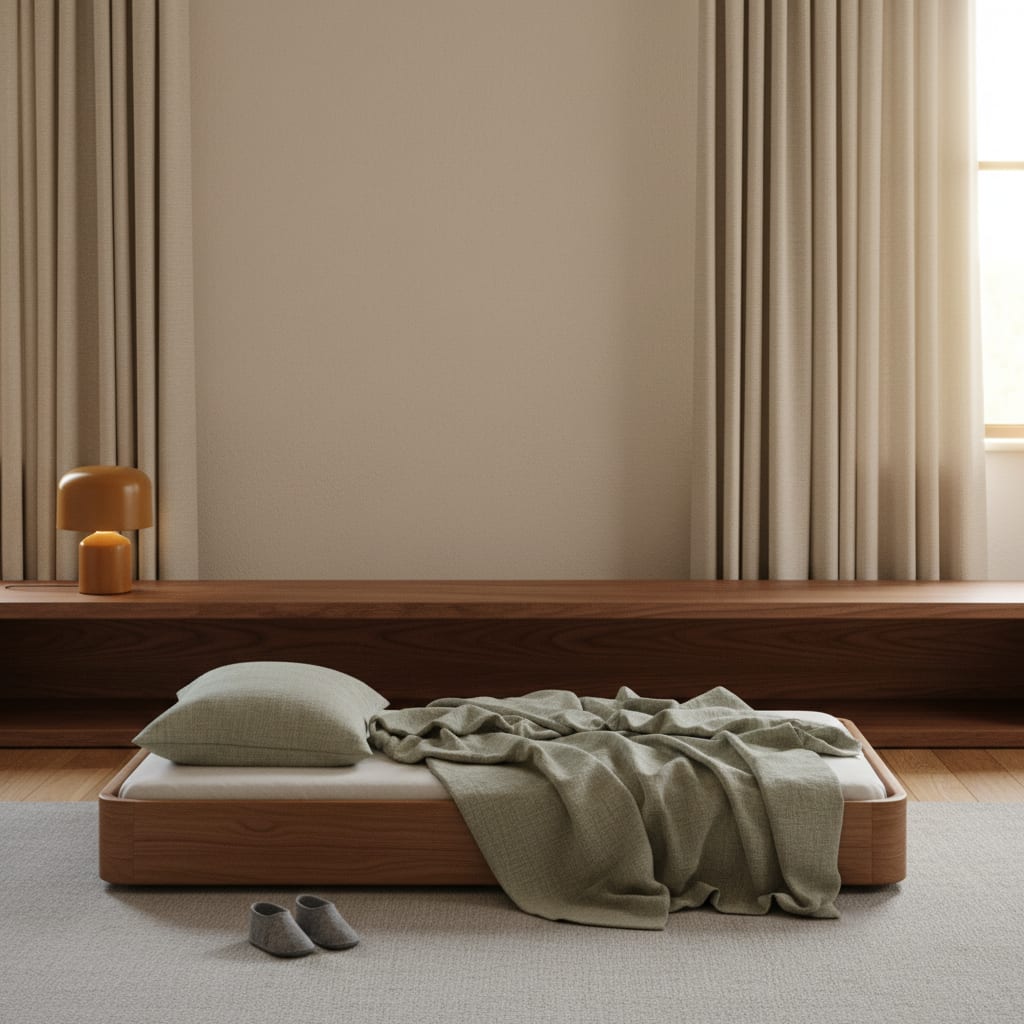
A bed the child can leave, and a room that’s safe when they do. This is the floor bed’s real trade, live at exactly this stage: furniture anchored, cords cleated or removed, no small parts within reach, the door question settled in advance. The full version is in the Montessori bedroom setup guide. A floor bed only makes sense when the room itself is the boundary.
Something legitimate to do in bed. A floor-level book basket and a lamp the child can switch off themselves turn “getting out of bed” into “reading until I’m done.” The child deciding when to stop is the point.
And the calm walk-back, still. Newly napless children test the door for a fortnight. The boring, wordless return in the floor-bed sleep playbook works here unchanged, just with more repetitions.
One boundary, plainly: all of this assumes a child well past their first birthday. Under twelve months, safe-sleep guidance points to a crib, bassinet, portable crib or play yard meeting federal infant-sleep standards, and a floor mattress is not one — the honest list is in what a Montessori floor bed actually requires.
A napless day’s rhythm, in order
Montessori rhythm is anchors, not a timetable — a few fixed points in the same order every day, with the child free to move between them at their own pace:
- Big movement in the morning, outdoors if at all possible. Physical output early is what makes an early bedtime physiologically plausible.
- Lunch, unhurried and at a consistent-ish time — the hinge of the day now that nothing else is.
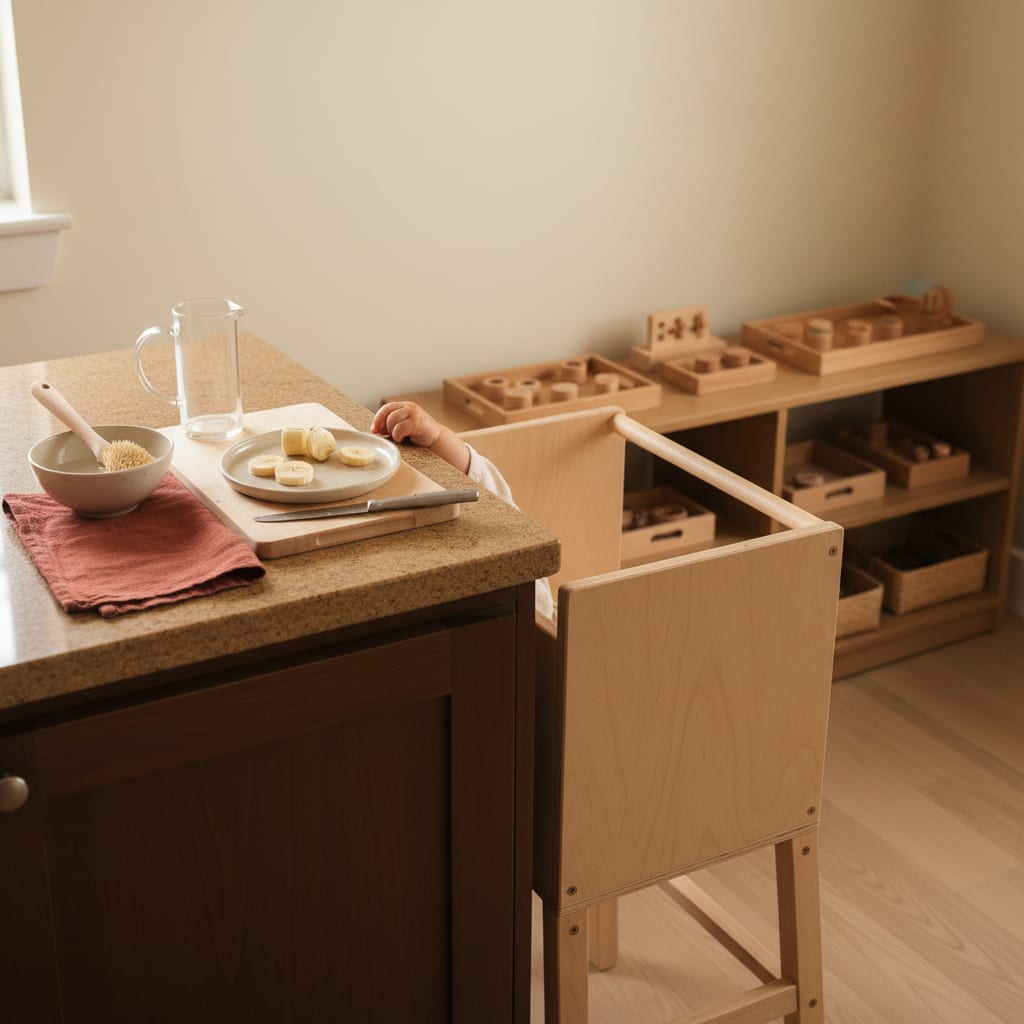
- Quiet time straight after. Thirty to sixty minutes of solo shelf work in a prepared space, which keeps the day survivable and does not require the child to sleep.
- Something out of the house mid-afternoon — but nothing involving a stationary car after about 3 p.m.
- Dinner earlier than feels normal. Around 5 p.m. beats 6, because it buys an unhurried hour afterwards instead of a sprint.
Then the evening sequence, short enough that the child can hold it in their head: bath, pyjamas from a drawer they can open, teeth, two books, lamp off. Same order every night, as much of it as possible done by them. What makes bedtime fast isn’t efficiency on your part — it’s the child knowing what comes next and being able to do it.
Guard the last hour: upright, low-stimulation, no screens, no car. A napless child at 5:30 is one still car journey away from a doze that costs you the evening.
When a rogue nap happens anyway
It will. Cap it rather than banning it — wake the child by around 3 p.m., forty minutes maximum — then push bedtime later by about thirty minutes, not two hours. Overcorrecting turns one accidental nap into three bad nights.
Expect the nap to reappear during illness, in the first fortnight of preschool, and after any big change at home. That is not backsliding — follow the sleep rather than the calendar.
 No nap, and no idea where bedtime goes?
Betteroo turns your child's age and real sleep data into a personalized day-by-day plan — where bedtime lands through the nap drop, and how to adjust it as the transition settles.
Take the 2-minute sleep quiz →
No nap, and no idea where bedtime goes?
Betteroo turns your child's age and real sleep data into a personalized day-by-day plan — where bedtime lands through the nap drop, and how to adjust it as the transition settles.
Take the 2-minute sleep quiz →
Snoring, long pauses in breathing, a child exhausted all day on an apparently adequate night, or total sleep well outside the usual range for the age are pediatrician questions, not rhythm questions. Ask them before rearranging the schedule again.
For household-level accounts of what a napless day actually looks like in a Montessori home — including the weeks that go badly — How We Montessori is the archive I’d hand a parent in the middle of it.
FAQ: bedtime after the nap drop
How much earlier should bedtime be after dropping the nap?
Usually thirty to sixty minutes earlier than the napping-days bedtime, reached in fifteen-minute steps over a couple of weeks. Work backwards from your child’s natural wake time and the sleep total they seem to need, rather than picking a clock time first.
Won’t an earlier bedtime cause early morning waking?
Mostly not. Early waking through a nap transition is more often overtiredness unwinding, too much light in the room, or a settling habit that needs a week of consistency. Hold the new bedtime for a full week before concluding it caused anything.
My child dropped the nap but won’t stay in bed — what do I do?
Treat it as a room-and-rhythm problem before a discipline problem: is the room dark enough, is bedtime early enough to avoid the second wind, and is there something they’re allowed to do in bed? Then calm, near-wordless walk-backs, repeated without negotiation.
Should I bring the nap back if bedtime is falling apart?
Only if the child is genuinely falling asleep on their own during the day. Re-imposing a nap that sleep pressure no longer supports usually pushes settling later — quiet time gives you the same midday reset without that cost.
What age do children stop napping?
Most drop the last nap somewhere between about two and a half and four, with a wide honest spread either side. The signals matter more than the age: consistently taking an hour to fall asleep at nap time, or napping fine and then not settling until 9 p.m.