Bassinet Outgrown: Crib or Floor Bed Next?
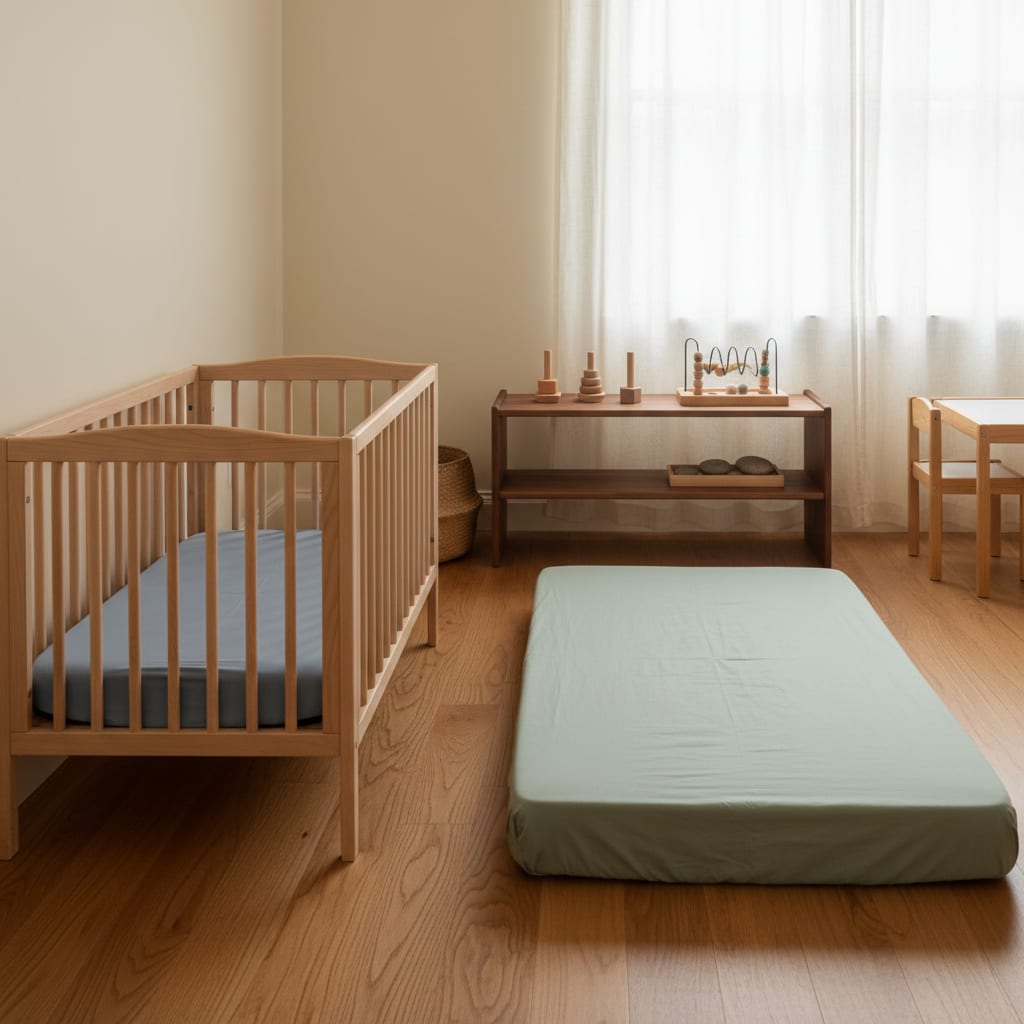
When the bassinet is outgrown — usually because the baby has hit the weight or length limit, or has started rolling or pushing up on hands and knees — the next sleep space for almost every family is a crib, not a floor bed. That is the honest Montessori answer, not a concession to convention. Safe-sleep guidance for the first year points to a product that meets federal infant-sleep standards, and a mattress on the floor isn’t one. The floor bed is a real destination; it is just usually the one after this one.
How you know the bassinet is done
Three signals, any one of which ends it:
- The manufacturer’s limit. Bassinets state a weight and often a length limit, and they vary a lot between models — check the actual sticker rather than a number you read somewhere. Many babies reach it somewhere in the four-to-six-month region, some much earlier.
- Rolling, or pushing up on hands and knees. This is the milestone that matters most. A baby who can push up can shift their position against sides that were never designed to contain that.
- Sitting up unassisted. Same reasoning, more obviously.
There is no benefit in stretching it. A bassinet used past its limits is not a smaller crib; it’s a product being used outside what it was tested for.
A crib, in practice
If you have been reading about floor beds and feel like the crib is a step backwards, it isn’t. What the crib buys at this stage is one specific thing: it is a sleep surface tested against a federal standard, with sides, in a room that a baby of this age cannot yet navigate on purpose.
The current safe-sleep picture is straightforward. Back to sleep, every sleep. A firm, flat, non-inclined surface. A fitted sheet and nothing else — no pillow, no loose blanket, no bumper, no positioner, no lounger. Room-sharing on a separate surface for at least the first six months. All of that is easier to hold in a crib than anywhere else, which is most of why it is the standard answer.
What it costs is a room that stays fairly conventional for a while. The Montessori parts you can have now are the parts that aren’t the bed: a low mirror by the movement mat, a floor-level view of the room, a changing arrangement at adult height but a dressing arrangement the child will grow into. The full version of that room is in Montessori infant room setup, and none of it requires the mattress to be on the floor.
What the floor bed would need instead
Not to strawman the alternative — it is a genuinely good arrangement, later. Here is what it actually asks for, so you can see why “later” is doing the work.
A floor mattress is not a regulated infant sleep product, so choosing it in the first year is a specific conversation with your pediatrician about your room and your mattress, not a default. It needs the whole room prepared to the standard a crib is held to: every piece of furniture anchored, cords cleated or removed, windows secured, outlets covered, no gap between the mattress and any wall or object, and a decision made in advance about the door. It needs a child who can get on and off the mattress deliberately rather than by accident, which typically means confident crawling or walking. And it needs an adult prepared to do calm, boring walk-backs for a fortnight.
That’s the honest list, expanded in what a Montessori floor bed actually requires, and the side-by-side comparison with a crib is in floor bed vs crib. Betteroo’s guide is a useful outside read on the same question if you’d rather not take one site’s word for it.
The Montessori argument for waiting
This is the part I’d want a Montessori-leaning parent to hear, because the method is usually invoked to argue the other way.
Freedom of movement is a real Montessori principle, and a floor bed is the sleeping expression of it. But the principle is always freedom the child can actually use. Montessori arrangements are matched to what a child can do now — you don’t put a five-month-old at a weaning table because a weaning table is philosophically correct. A six-month-old who cannot yet crawl off a mattress on purpose gains no independence from being on one. They gain a boundary they can breach accidentally, which is the opposite of a prepared environment.
The independence the method actually wants at this age is available elsewhere and free: floor time on a mat rather than a container, a low mirror, objects within reach, and an adult who watches instead of intervening. The bed catches up when the child does — usually somewhere between around 12 and 18 months, on the readiness signals set out in when to switch to a floor bed.
If the crib is the problem, not the bed
A lot of bassinet-to-floor-bed searching is really about a baby who has started fighting the new, bigger space. That’s a settling problem, and a floor bed does not solve it — it usually enlarges it.
The things that actually help at this transition are dull: keep the sleep surface’s feel consistent (same sheet, same sleep sack, same room temperature), move the crib into the room the bassinet was in rather than changing two variables at once, and do naps in the crib for a week before nights if you can. Betteroo’s guide on a baby who won’t settle in the crib works through the common causes in more detail than I can here.
And if the settling problem is really a timing problem — a last wake window that’s drifted wrong for a baby who just dropped to three naps — no bed fixes that. Change one variable, hold it a week, watch what happens.
 New bed, same tired evening?
Betteroo turns your baby's age and your preferred approach into a personalized, gentle day-by-day plan — wake windows, naps and a bedtime that fits the stage you're actually in.
Take the 2-minute sleep quiz →
New bed, same tired evening?
Betteroo turns your baby's age and your preferred approach into a personalized, gentle day-by-day plan — wake windows, naps and a bedtime that fits the stage you're actually in.
Take the 2-minute sleep quiz →
Planning the order, once
The sequence most of the families I’ve watched actually ran, and the one I’d plan for: bassinet in your room until a limit or a milestone ends it; crib, in your room, for as long as room-sharing suits you; crib in the child’s own room; floor bed once the child is walking confidently and the room has been prepared for it. Four moves, spread over a couple of years, with only one variable changing at a time.
You can skip a step — plenty of houses go from bassinet to a crib that never leaves the parents’ room, or from crib straight to a floor bed at eighteen months. What’s worth avoiding is doing two at once, because when it goes badly you won’t know which one to undo.
Snoring, pauses in breathing, pain on being laid flat, or a baby whose total sleep sits far outside the usual range for the age are pediatrician questions rather than furniture questions. Ask them first.
FAQ: moving on from the bassinet
When should a baby move out of a bassinet?
When they reach the manufacturer’s stated weight or length limit, or when they can roll over or push up on hands and knees — whichever comes first. Limits vary between models, so check the label on yours.
Can a baby go straight from a bassinet to a floor bed?
It’s not the standard recommendation. Safe-sleep guidance for the first year points to a crib, bassinet, portable crib or play yard that meets federal safety standards, and a floor mattress isn’t one of those — so it’s a conversation with your pediatrician rather than a default choice.
Is a crib un-Montessori?
No. Montessori matches the environment to what the child can actually do, and a baby who can’t yet get off a mattress deliberately gains nothing from being on one. Freedom of movement in the first year is served by floor time, a low mirror and reachable objects.
What age do most families move to a floor bed?
Usually somewhere between around 12 and 18 months, once the child is crawling or walking confidently enough to get on and off the mattress on purpose. Plenty of families start later with no cost to anyone.
How do I make the crib transition easier?
Change one thing at a time. Keep the sheet, sleep sack and room the same, put the crib where the bassinet was if you can, and try naps in it for a week before nights.