Pick Up Put Down Method: A Montessori-Home Guide

The pick up put down method is a responsive settling approach: you put your baby down awake, and if they escalate to real crying you pick them up, hold them until they’re calm — not asleep — and put them straight back down. Repeat as many times as it takes. Nobody is left alone to cry, and nobody is rocked all the way to sleep, which is the point: the baby does the last step themselves, with you standing right there. It suits roughly three to seven months best, it costs a great deal of parental patience, and it’s the method most often chosen by families who won’t do extinction.
I’ll say the usual thing first: I spent three years as an assistant in a Montessori toddler community, setting up the shelves rather than earning the diploma, and I am nobody’s sleep clinician. Anything medical, and anything about safe sleep in particular, goes to your pediatrician before it goes to a blog.
What the sequence actually looks like
The mechanics are simple enough to describe in six lines, which is not the same as easy.
- Run your normal wind-down and put the baby into their sleep space calm, drowsy, and awake. Awake is the whole method — if they’re asleep when they land, nothing has been learned by anyone.
- Wait through the grumbles. Fussing, squawking, and settling noises are not the cue. Give it a minute or two.
- Pick up when it becomes real crying. Hold them quietly against your shoulder — minimal talking, minimal bouncing, no lights.
- Put down as soon as they’re calm, not asleep. Ten to fifteen seconds of calm is usually enough. This is the step people get wrong: waiting for sleep turns the method back into rocking.
- Repeat. Ten times on a first night is ordinary. Twenty is not unheard of.
- Stop when they’re asleep, and expect fewer repetitions each night across roughly a week or two.
Some families find a middle setting works better: a hand on the chest and a low steady “shhh” before resorting to lifting, so the baby is disturbed less. Betteroo’s guide details those in-between steps and the night-waking version — worth reading before you start, not at 2 a.m.
The ages it suits — and the age it stops working
This method has a real window, and pretending otherwise wastes people’s weeks.
Under about three months, it doesn’t apply. Newborn sleep is biological, feeds are frequent, and the job is responsiveness, not method. Hold the baby.
Roughly three to seven months is the sweet spot: old enough for some self-settling capacity, light enough to lift eighty times without injuring your back, not yet mobile enough to treat the lift as a game.
Past about eight months, it gets hard fast. A mobile, opinionated baby stands up the moment you put them down, and the lift becomes stimulating rather than soothing. Most families then do better with a stay-and-support approach — sit beside the sleep space, hand on the mattress, retreat further every few nights.
Two things that make it stop working at any age: illness or teething (pause, resume when it’s over), and doing it inconsistently. Pick-up-put-down on Monday and rocking to sleep on Tuesday teaches an intermittent-reward pattern, which is the most persistent thing you can teach.
Why it sits well in a Montessori house
Montessori doesn’t have a sleep doctrine, and I’d be suspicious of anyone who says it does. What it has is a set of commitments that this method happens to honor: the child does the final step of their own work; the adult prepares the conditions and then stays out of the way; observation drives the response rather than a fixed script.
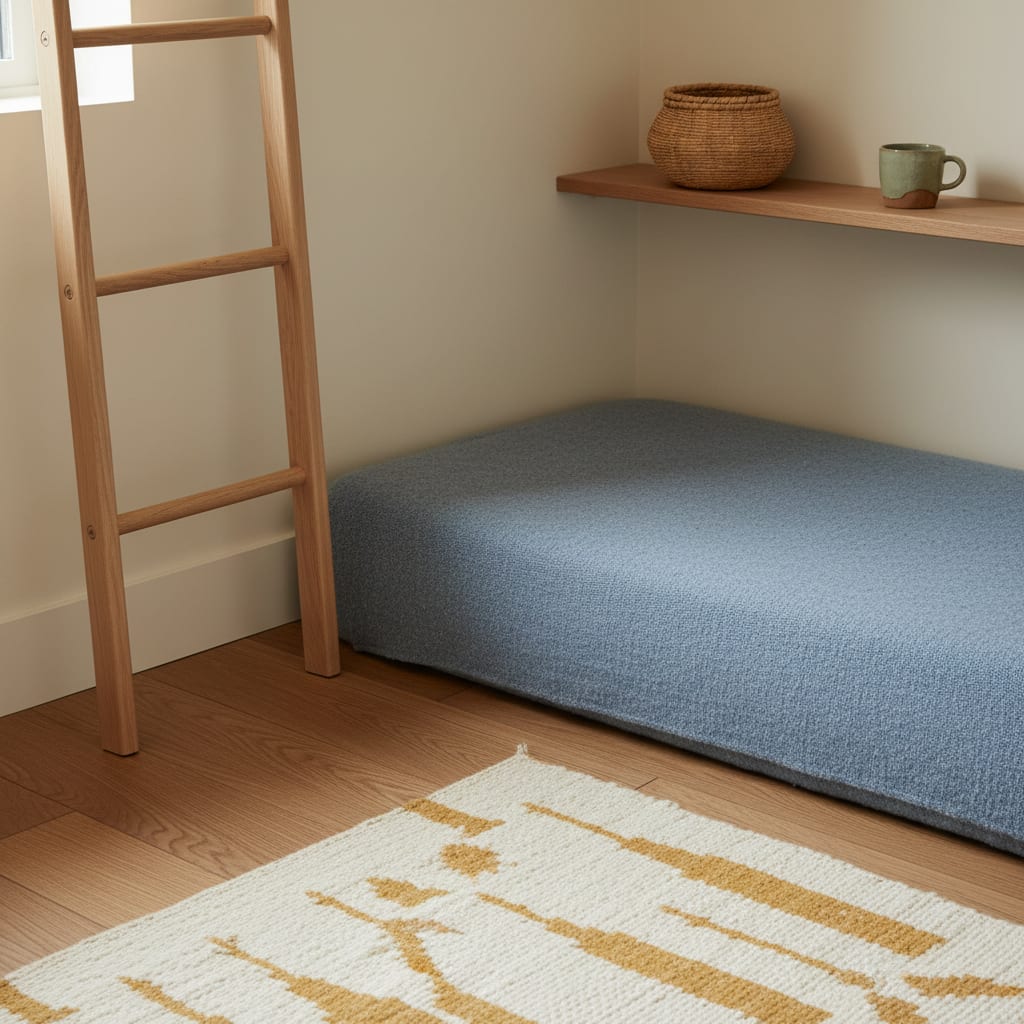
There’s a practical fit too. In houses using a floor mattress, the put-down is undramatic — no rail to clear, no lowering a sleeping body eight inches into a crib — and you can sit or lie beside the mattress between repetitions rather than looming over it. If you’re building that room, our Montessori infant room setup covers the zones and the honest budget.
Safe sleep is not negotiable in either setup: back to sleep, on a firm, flat surface, bare — no pillows, bumpers, or loose blankets — and room-share without bed-sharing for at least the first six months. A floor bed is not a workaround for any of those rules, and if your infant’s sleep surface isn’t a crib, bassinet, or play yard meeting current safety standards, that’s a conversation to have with your pediatrician rather than with the internet.
 A plan that never says cry it out
Betteroo builds a personalized, responsive sleep plan around your baby's age and your approach — the wake windows and bedtime that make settling possible in the first place.
Take the 2-minute sleep quiz →
A plan that never says cry it out
Betteroo builds a personalized, responsive sleep plan around your baby's age and your approach — the wake windows and bedtime that make settling possible in the first place.
Take the 2-minute sleep quiz →
What it costs, honestly
Three things, and you should price them before night one.
Your back and your evening. Forty-five minutes of repetitions is a normal first night. Two adults trading off is the difference between a method you sustain and one you abandon on night three.
Slowness. Gradual approaches generally take weeks where extinction methods claim days. A family expecting three nights will read week two as failure and quit right before the payoff — which is why we wrote gentle sleep training myths: slow is a feature, inconsistency is the actual failure.
A schedule that has to be right underneath it. No settling method survives an overtired baby. If wake windows are too long, the crying isn’t a settling problem — it’s a physiology problem wearing a settling costume.
The alternatives, without the sales pitch
Pick-up-put-down is one option among several, and the honest position is that families choose differently for good reasons.
- Stay-and-support / chair method — you remain in the room, offering less and less physical help, moving further away every few nights. The natural successor once a baby is too heavy or too mobile to lift repeatedly.
- Gradual fading of an existing habit — shortening the rock, the feed, or the hold by a little each night. Slowest of all, and the gentlest on everyone.
- Graduated extinction (checks at intervals) and full extinction — faster, and not something I’ll disparage. Across the research reviews, structured sleep-training methods generally come out as effective, with no evidence of lasting harm to children or the parent-child bond; Betteroo’s summary of what the major studies show is a level-headed read. Families who won’t use those methods are making a values choice, not a scientific correction, and it’s worth being clear-eyed about that distinction.
Whatever you choose, the layer underneath is the same one that makes a floor bed work later: a predictable rhythm the child slowly takes over, which is the argument running through floor beds and independent sleep.
FAQ: the pick up put down method
What is the pick up put down method?
A responsive settling method: put the baby down awake, pick them up if they cry, hold until calm — not asleep — then put them straight back down, repeating as needed. The baby falls asleep themselves, with a parent present throughout.
What age is pick up put down best for?
Roughly three to seven months. Younger babies need responsiveness rather than method; past about eight months, most babies are too heavy and too mobile for repeated lifting to be soothing, and a stay-and-support approach works better.
How long does pick up put down take to work?
Most families see improvement across one to two weeks, with the number of repetitions falling each night. First sessions of thirty to sixty minutes are normal. If nothing has shifted after two consistent weeks, check the schedule before changing methods.
Is pick up put down the same as no-cry sleep training?
No. There will be crying — the difference is that a parent responds to it and the baby is never left alone. “No tears” is a marketing phrase; responsive is the accurate one.
Does pick up put down work for night wakings?
It can, using the same sequence, though many babies under six months still need one or more night feeds. Feed when a feed is genuinely due, and use the method for the wakings that clearly aren’t hunger.