The Montessori Work Cycle at Home (What Actually Happens)
A Montessori work cycle is an uninterrupted stretch in which a child chooses their own work, does it to completion, puts it away, and chooses again. In an accredited school that stretch is long and protected. At home, with an eighteen-month-old in the room, it is usually forty minutes with two collapses in it — and that is not a failed work cycle, it is what the work cycle looks like when there is one adult, one shelf and a sibling. What follows is the school definition, sourced, and then the honest version.
What the schools actually specify
The American Montessori Society lists the uninterrupted work period as one of its five core components, and describes the cycle itself as choosing an activity, completing it, cleaning up and returning the materials to their proper place, and experiencing a sense of satisfaction. Its published minimums are program standards for schools: a minimum of two hours daily for infant and toddler programs, and for Early Childhood a minimum of two hours daily four days a week with three hours daily five days a week as optimal.
Two things follow from reading that carefully. The first is that “three hours” is an optimum for an accredited classroom, not a target for a living room — it is a staffing and timetabling standard, in the same register as class size. The second is that the definition never mentions duration as the point. What is being protected is the uninterruptedness: the child gets to reach the end of their own idea.
The five phases, and where the home version breaks
Montessori trainers usually describe the classroom cycle in phases, and it is worth knowing them because the fourth is the one adults ruin.
- Settling in. Wandering, watching, touching things, doing nothing much. It looks like time-wasting and it is not.
- Easy work. Something already mastered — the same puzzle, the same pouring tray. This is warm-up, and it is meant to be beneath them.
- False fatigue. A slump. Noise rises, focus drops, children drift, someone gets silly. In a classroom of twenty-five this is loud and unmistakable.
- The great work. If nobody intervenes at phase three, the room goes quiet and the long, deep, absorbed work happens here.
- Winding down and tidying. Materials go back; the child is noticeably calmer than they were an hour ago.
Everything I saw in three years as an assistant in a toddler community turned on phase three. Guides are trained to sit on their hands through it. Parents are not, and neither was I at home — false fatigue at 10:15 on a Tuesday looks exactly like this isn’t working, let’s go to the park, and going to the park deletes phase four. I have done it dozens of times. It is the single most useful thing to know about the work cycle, and it is almost never the thing that gets written down.
What it honestly looks like in a flat
Here is what I can report from a two-bedroom flat with a four-year-old and an eighteen-month-old, offered as observation and nothing more.
It is one stretch, and it is in the morning. Breakfast ends, the shelf is already set, and there is a bounded window before the nap. Nobody in this house has ever run a second cycle in the afternoon; the attention isn’t there.
It runs forty to ninety minutes, not three hours. The eighteen-month-old’s own cycles are much shorter than that — five or ten minutes on one thing is a real cycle at that age, repeated many times.
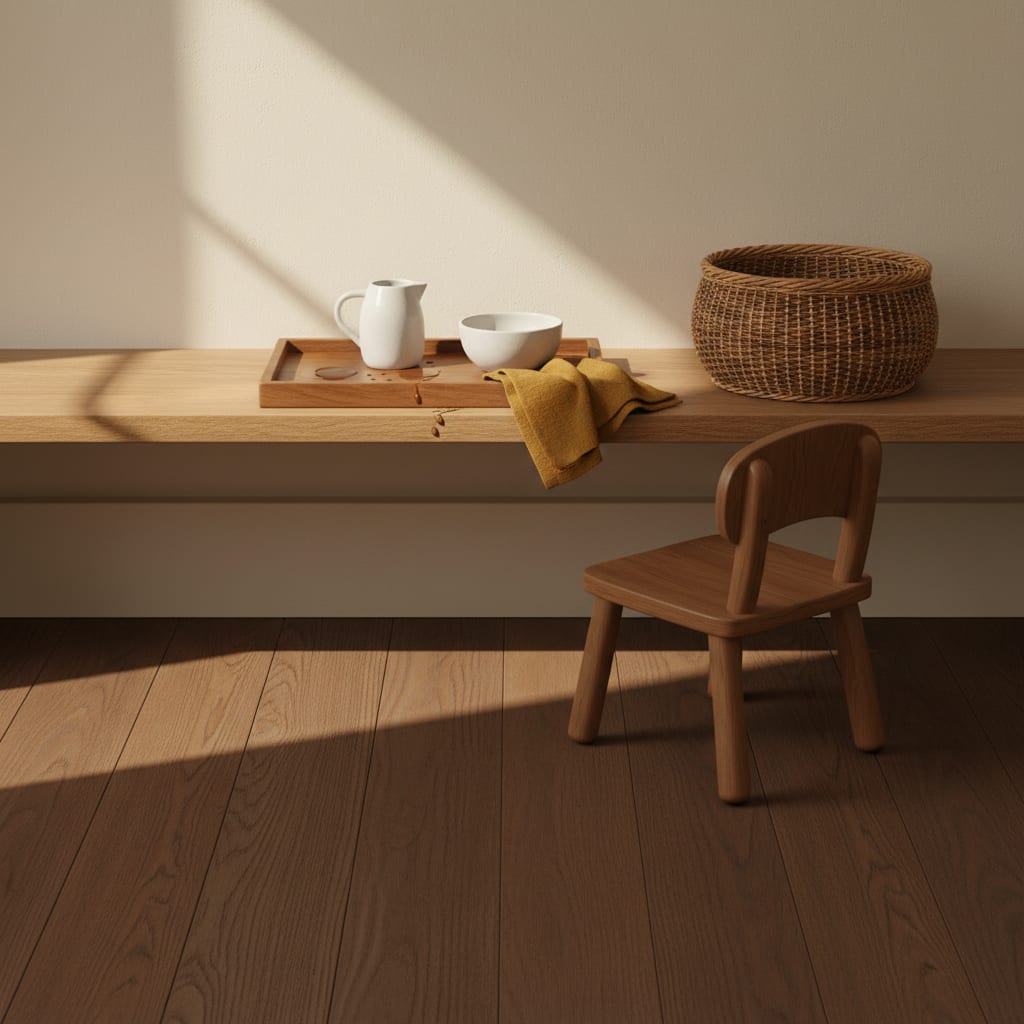
The two children do not run on the same clock. The four-year-old’s great work usually arrives about the time the toddler’s fourth cycle collapses, which is the central logistical problem of a mixed-age house and has no elegant solution. What helps is a toddler-height activity that survives being abandoned — water, a basket of cloths, a low drawer of real kitchen things — placed within sight of where the older child is working.
It ends when the nap arrives, so its real length is a sleep question. How much morning you have is set by when the nap lands, which is a wake-window matter rather than a Montessori one; Betteroo’s chart of typical wake windows is the more useful reference for that half of the problem.
Three days in five, it doesn’t happen. Appointments, weather, a cold, a delivery. The cycle is a thing you make possible, not a thing you achieve daily.
The four conditions that actually produce one
Having tried and failed at this repeatedly, the variables that seem to matter are unglamorous.
- The shelf is set the night before. A cycle that begins with an adult tidying does not begin. What goes on it is the whole question — the working version is in the Montessori shelf guide.
- Nobody announces it. No “right, work time.” The child walks in and the room already suggests something.
- No adult praise mid-cycle. “Good job!” across a room ends concentration as reliably as a doorbell. This is the same mechanism described in helping a child concentrate.
- The adult has somewhere to be. Sitting and watching a child expectantly is an interruption. Folding laundry in the same room is not.
What it is not
It is not homeschooling, and it is not a timetable. There is no curriculum inside a work cycle at eighteen months — the work is pouring, carrying, matching, wiping, opening and closing, and it maps onto ordinary household jobs more than onto anything school-shaped. If you want the age-by-age version of what actually goes in it, that is practical life activities by age.
It is also not the whole day. The afternoon in this house is a nap, then outside, then a slower stretch that has more in common with Montessori quiet time than with work.
FAQ: the Montessori work cycle at home
How long should a Montessori work cycle be at home?
As long as the child’s attention actually runs, which at home is commonly forty to ninety minutes for a preschooler and a series of much shorter repeats for a toddler. AMS’s two- and three-hour figures are minimum and optimal program standards for accredited schools, not household targets.
What is false fatigue in a Montessori work cycle?
The slump partway through — noise up, focus down, children drifting — that arrives before the deepest work does. Trainers treat it as a phase to sit through rather than a signal the session is over. At home it is usually the moment an adult suggests going out, which ends the cycle just before the good part.
Can you have a work cycle with a toddler and an older child together?
Yes, imperfectly. Their cycles will not synchronise. The practical fix is a toddler-height, abandonable activity in the same room as the older child’s work, and accepting that the older child’s long stretch will sometimes get cut short.
What if my child never gets absorbed in anything?
Look at the shelf before the child: too many choices, everything too easy or all of it too hard, and nothing that involves water, transfer or a real job. Then look at the interruptions — including praise, questions and photographs. Absorption is usually being prevented rather than failing to appear.
Do you need Montessori materials for a work cycle at home?
No. The cycle is a rhythm, not a shopping list. A jug, a tray, a cloth, a low shelf and a bounded morning will produce one; a full set of classroom materials without the uninterrupted time will not.