Toddler Plays in the Mirror at Night: A Montessori View
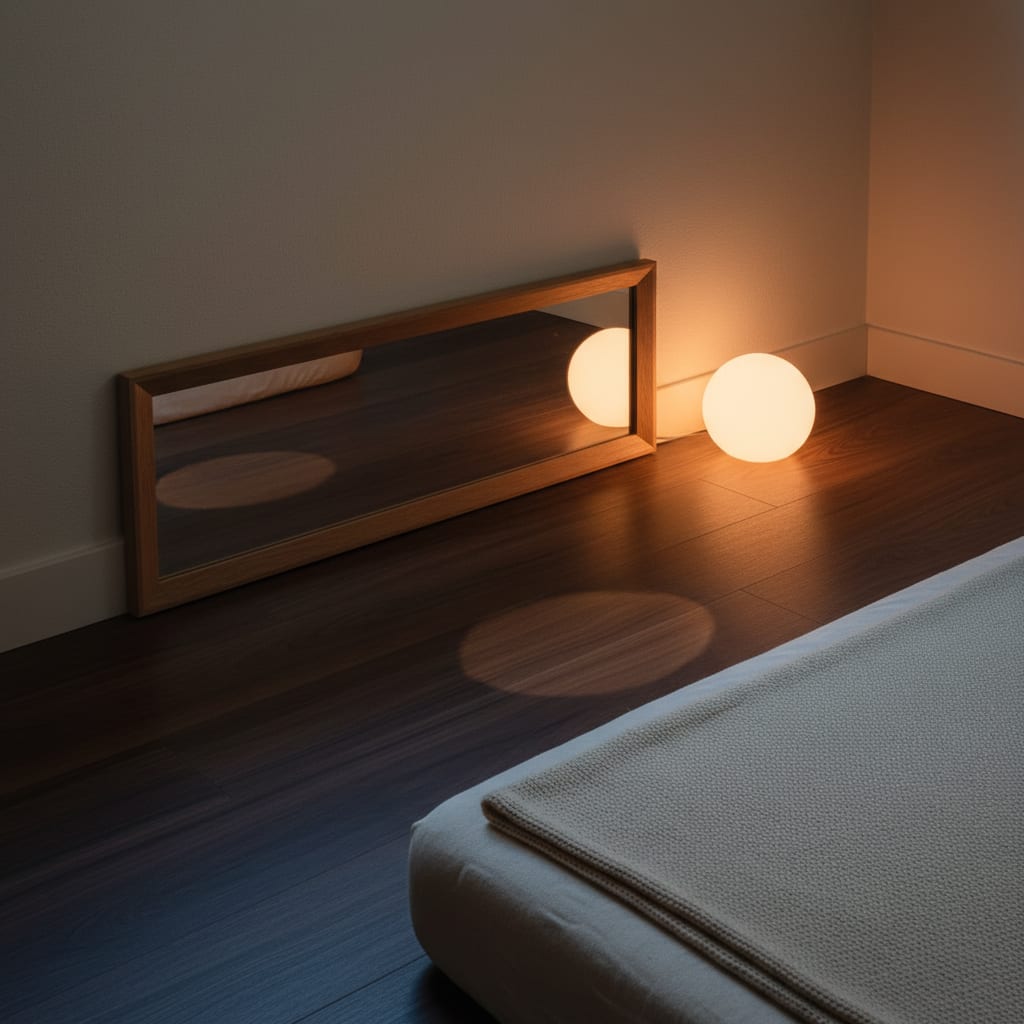
If your toddler wakes in the night and crawls or walks over to the floor mirror to play, the room is doing what it was set up to do. It just happens to be 2 a.m. The Montessori fix is to change the room, not to start a nightly battle. Move the mirror out of the bed’s line of sight, or out of the sleep room altogether. Keep any night light from shining into it. Answer the waking calmly, the same way every time. And treat the mirror as a safety item, because a child awake at night is unsupervised: acrylic or shatter-resistant, and fixed to the wall, never leaning.
I’m not a trained Montessori guide. The Montessori point here comes from Nicole Kavanaugh of The Kavanaugh Report, the development notes from an open psychology textbook, and the safety points from the American Academy of Pediatrics.
Why the mirror wins at 2 a.m.
A low mirror is one of the classic pieces of a Montessori baby space. In her post Babies and Mirrors, Kavanaugh calls it “a staple in a Montessori baby environment” and writes that it “helps babies to concentrate on their own movements, and eventually to coordinate them.” That is exactly why it works by day. It is also why it can wake a child up at night.
The same post makes the point this whole article rests on: “a mirror should not be placed next to a baby’s floor bed because it is too stimulating to the baby.” Often nobody planned it: the mirror went in beside the baby’s mat, and the floor bed arrived next to it later.
The child’s age changes what they see in it. OpenStax’s Lifespan Development textbook sums up the classic mirror test. From 6 to 12 months a baby “shows social interest in a potential playmate”. From 12 to 18 months, the reaction is “wariness, avoidance, and confusion”. Between 18 and 24 months the child “reveals self-recognition by touching their own nose.” The book adds that before eighteen months, “the face is perceived as that of a stranger or potential playmate.” So a one-year-old who wakes up and finds the mirror isn’t admiring themselves. They’ve found company, and company is hard to leave.
Every child wakes; the mirror decides what happens next
Waking briefly in the night is normal. Betteroo’s toddler night-waking guide puts it simply: everyone surfaces briefly between sleep cycles. A child who sees a dark, dull room rolls over. A child who sees movement in a mirror an arm’s length away has a reason to get up. A floor bed means nothing stops them.
So the question is what the room offers at the moment of waking.
Where the mirror belongs
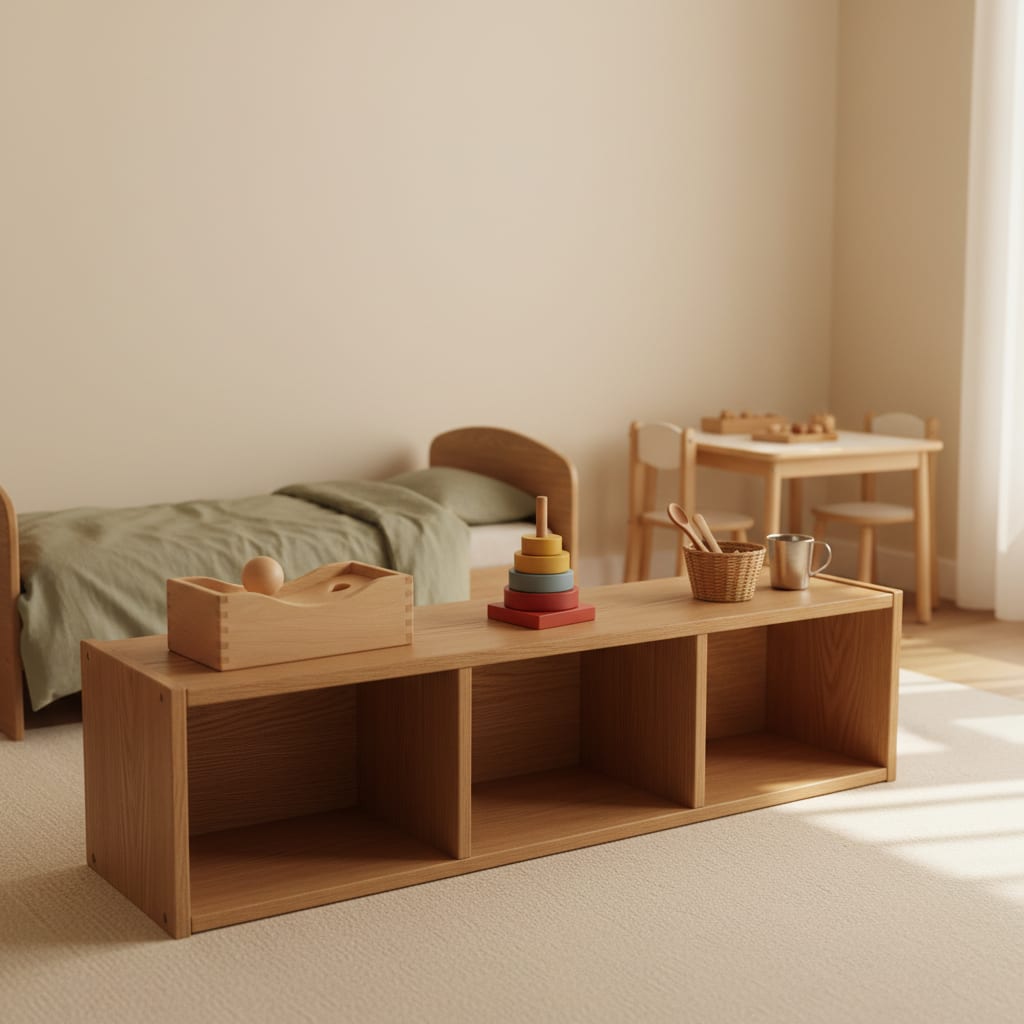
Montessori rooms work by giving each area one job. Our Montessori bedroom setup splits a toddler’s room into sleep, dressing and books-and-work zones. A mirror has a real place in that room for dressing and for babies, as long as it sits away from the bed. In order of how much they change:
- Out of the bed’s sightline. Look at the room lying down at mattress height. If you can see the mirror from the pillow, so can your child. Moving the mirror to the dressing wall, or turning the bed so it faces a plain wall, is often enough.
- Into the movement area, not the sleep room. For babies, the mirror’s real home is beside the mat, as in a Montessori infant room on a normal budget. If the bedroom is too small to keep the two apart, put the mirror and mat in the living room. The bedroom then becomes a room for sleep and dressing.
- Smaller, at the dressing spot. For a child over two, a small mirror at the clothing hooks gives them what they actually use it for: seeing their own buttons and hair.
Removing the mirror for good is rarely needed. It just needs to be somewhere the child chooses to visit, not something they wake up next to.
Check the light and the reflection
A mirror in a dark room only matters if there’s light to reflect. Lie at the child’s height again, at night, with the room as it really is. Look for a hallway light under the door, a streetlight through the curtains, or a night light shining into the mirror and bouncing back toward the bed.
If your child needs a night light, keep it dim and warm, low down, and pointed away from the mirror. An amber plug-in like the GE SleepLite gives a glow that’s enough to find the bed without lighting up the room.
Make the mirror safe for unsupervised hours
By day an adult is nearby. At night nobody is, so check everything twice:
- Acrylic or shatter-resistant only. Kavanaugh used “a shatter-resistant mirror from IKEA” and notes that “acrylic mirrors can also work” if glass worries you, as long as the image doesn’t distort. If you’re buying, a framed acrylic floor mirror such as the KRAND 3-position mirror with pull-up bar is the kind made for a baby’s movement area. Fix it to the wall with metal anchors, as below.
- Fixed to the wall, never leaning. The AAP’s page on preventing furniture tip-overs says: “Secure all furniture and mirrors with anti-tip devices.” It suggests metal anchors such as “L” brackets, because “plastic can become brittle over time and break.” Kavanaugh’s own mirror leaned against the wall while her baby barely moved, and she planned to mount it as he got moving. A toddler who gets up at night is past that stage.
- Nothing heavy above the bed. Betteroo’s room-setup guide advises nothing heavy hung above the bed, mirrors included, since anything mounted there could fall.
- Check the fixings every month. Children pull on mirrors and on the bars attached to them. Look for loose screws and for cracked or sharp edges.
If your child is under 12 months and sleeps on a floor bed, the whole room is their sleep space. The full list is in our floor bed safety checklist. Safe-sleep guidance from the AAP still comes first: on the back, on a firm, flat surface, with nothing loose in the bed.
When your child is up and playing
Even after the mirror has moved, a few nights of habit may follow. Handle them the same way every time:
- Wait a moment. The same Betteroo night-waking guide notes that “many toddlers resettle in under a minute.”
- Go in dim and dull. No overhead light, no talking about the mirror, no “who’s that?” game. Walk them back to bed with one short line: “It’s sleeping time. Your bed is here.”
- Leave the mirror alone at night. Covering it or taking it down in front of the child can turn it into a game. Make the change in the daytime, ideally with the child helping to hang it in its new spot.
- Look at the schedule. That guide lists “a nap that ends too late” and “more total daytime sleep than the child needs” among the usual causes of night waking. A child who plays happily for an hour at night may simply not be tired enough.
 Up and playing at 2 a.m.?
Betteroo builds a gentle, personalized sleep plan around your child's age, naps and wake-up time, so night wakings get shorter without a fight.
Take the free sleep quiz →
FAQ: the mirror and night waking
Should a Montessori mirror be in the bedroom?
It can be, for dressing or for a baby’s movement area. It shouldn’t be next to the bed or visible from it. Kavanaugh warns that a mirror beside a floor bed is “too stimulating.”
What age do children recognize themselves in the mirror?
Usually between 18 and 24 months, according to the mirror-test summary in OpenStax’s Lifespan Development. Younger babies tend to treat the reflection as another child.
Is an acrylic mirror safe for a toddler’s room?
Acrylic or shatter-resistant mirrors are the usual Montessori choice, fixed to the wall with metal anchors as the AAP advises, and checked often. Never leave a mirror leaning where a child can pull it over.
My toddler still plays at night after we moved the mirror. What now?
Keep your response dull and identical for a week or two, and look at nap timing and total daytime sleep. If night waking continues or worries you, ask your pediatrician.