Montessori at Home: Where to Actually Start
Start with access, not activities. The first useful Montessori change in a house is almost always physical and boring: move something the child needs down to their height so they can get it without you. Water, coat hooks, a step at the sink, a shelf with four things on it. That’s the beginning. You do not need materials, printables, a room repaint or a reading list to start — you need one week of watching, one shelf, and a decision to stop doing one thing for your child that they could do themselves.
Watch for a week before you buy anything
Observation is the load-bearing skill in this method, and it is also the free one. Before you order a single wooden object, spend a week noticing three things:
- What your child does when nobody suggests anything. Not what they play with when prompted — what they drift to.
- Where the friction is. Which twenty moments a day involve you fetching, lifting, opening, pouring, wiping or carrying something a taller person wouldn’t need help with.
- What they can nearly do. The edge of ability is where the interest lives. A child who can nearly pour is bored by a rattle and defeated by a jug.
That week will tell you more about what to change than any shopping list will. It is also the habit that keeps working for years — helping a child concentrate is mostly a matter of noticing when they already are, and not interrupting it.
Build one shelf, not one room
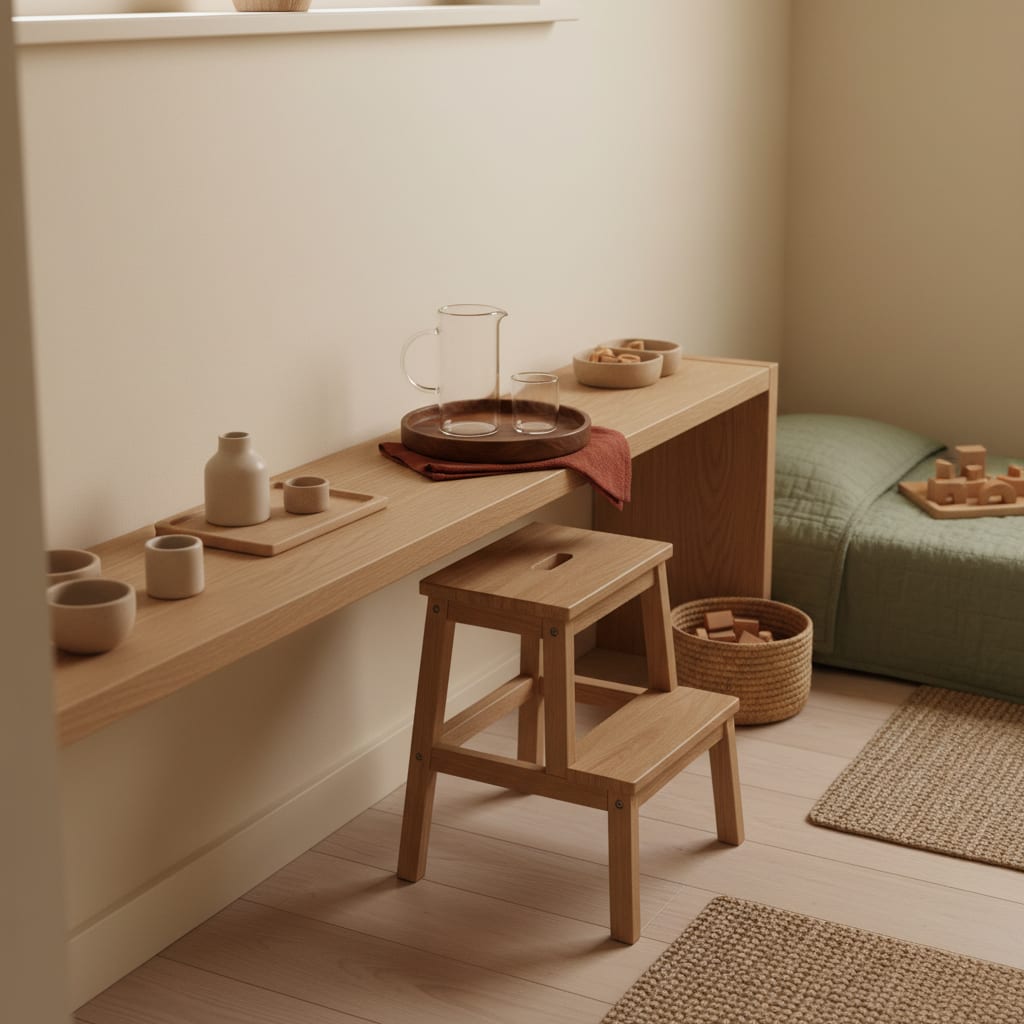
The room comes later, if ever. Start with a single low shelf — a bookcase turned on its side works — holding four to six things, generously spaced, all of which your child can carry to a floor space and use without you.
What goes on it, roughly: one thing with a puzzle-like right answer, one open-ended building material, one language item such as a basket of real objects or a few good books face-out, one fine-motor work, and one thing that’s the current obsession. Everything else in the house goes into closed storage. That is the entire system, and the toy rotation system is just how you keep it fresh afterwards.
The reason this works is subtraction. A child who can see six things chooses; a child who can see sixty scans. The shelf is not a display, it’s a menu.
The four access changes that pay first
These are the ones I’d do in the first fortnight, in this order:
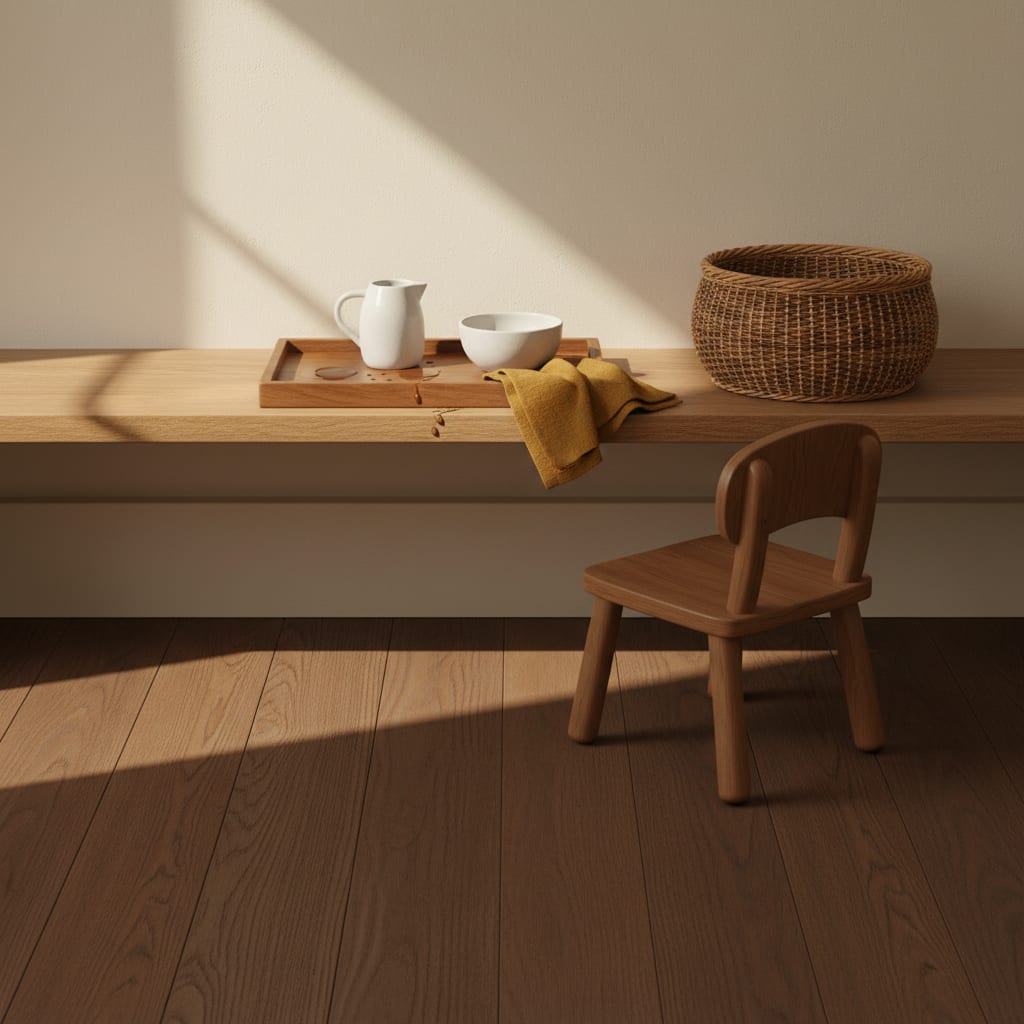
- Water they can serve themselves. A small jug and a small real glass on a low shelf or the bottom of the fridge, with a cloth beside it. Real glass, because a child treats glass carefully and plastic tells them nothing. Spills are the lesson, not the failure.
- A step at the sink. Hand-washing, tooth-brushing and helping with dishes all unlock at once. This is the highest-value object in most houses.
- Clothes at child height. The bottom two drawers of the dresser, handed over completely, plus two or three weather-appropriate choices reachable and the rest stored away.
- A low hook by the door. Coat on, coat off, without an adult. Care of self starts as furniture placement.
None of that is a purchase beyond the step. All of it changes the shape of a morning.
Hand over one job completely
The month-two move, and the one people find hardest: pick one task you currently do for your child and stop doing it. Not “help less” — stop.
Choose something small, daily, and visibly useful to the family: putting their own laundry in the basket, carrying their plate to the counter, watering a plant, refilling the dog’s bowl. Show it slowly and silently once, hands only, then leave it alone. It will be done badly for a fortnight. That fortnight is the work — the temptation to redo it in front of them is the thing to resist, because a rewashed plate teaches “you can’t”, which is the opposite of the whole exercise.
When that job is genuinely theirs, add a second. A realistic sequence by age is in practical life activities by age.
What to skip in the first month
- The shopping. Almost every expensive first purchase is bought before the observation week and turns out to be aimed at the wrong ability. The word “Montessori” on a box means nothing legally or educationally — there’s no certification behind it. What the word actually means is worth reading properly before you spend on it.
- The room repaint. The aesthetic is not the method. A calm room helps; a beige one is not a prerequisite.
- Printables and worksheets. Almost nothing in early Montessori is on paper. It’s hands, objects and real work.
- Doing all of it. Families that start with a whole-house overhaul are the ones I’ve watched give up by week three. One shelf and one hook survive.
How to tell it’s working
Not by how the room photographs. Three honest signals:
- Longer stretches at one thing. Concentration lengthening is the outcome the method is actually aiming at.
- Fewer “help me” requests for things they can do — often accompanied by an insistent “me do it”, which is inconvenient and exactly right.
- You are doing less. If the change made more work for you permanently, it was set up wrong. Two chaotic weeks then less work is the correct shape.
Where to read people further along
I’m a former classroom assistant, not a certified guide, and this site’s job is partly to point at people with more standing than me. Worth your time: The Kavanaugh Report for real-house documentation, How We Montessori for by-age shelf photos, Montessori in Real Life for the toddler years, and Living Montessori Now as an index to almost everything else. For the doctrine itself, go to the training organisations directly — AMI and AMS — rather than to blogs, including this one.
FAQ: starting Montessori at home
What is the first thing to do for Montessori at home?
Lower something. Pick one thing your child needs daily — water, their coat, their clothes — and move it to a height they can reach unaided. Then spend a week watching where the rest of the friction is before you change anything else.
What age should you start Montessori at home?
Any age, including newborn, though the changes look different: a low mirror and a floor space for a baby, access and real work from around a year, longer independent projects from three. There’s no window you can miss.
Do you need to buy Montessori materials to start?
No. The classroom materials are designed for a trained guide and a full sequence; at home the equivalent is real objects, real tasks and access. A jug, a step, a cloth and a low shelf outperform a boxed set for the first several months.
How long does it take to see a difference?
Access changes show up within days — a child who can reach their coat starts putting it on. Concentration and independence build over months, unevenly, and usually go backwards during illness, moves and new siblings.