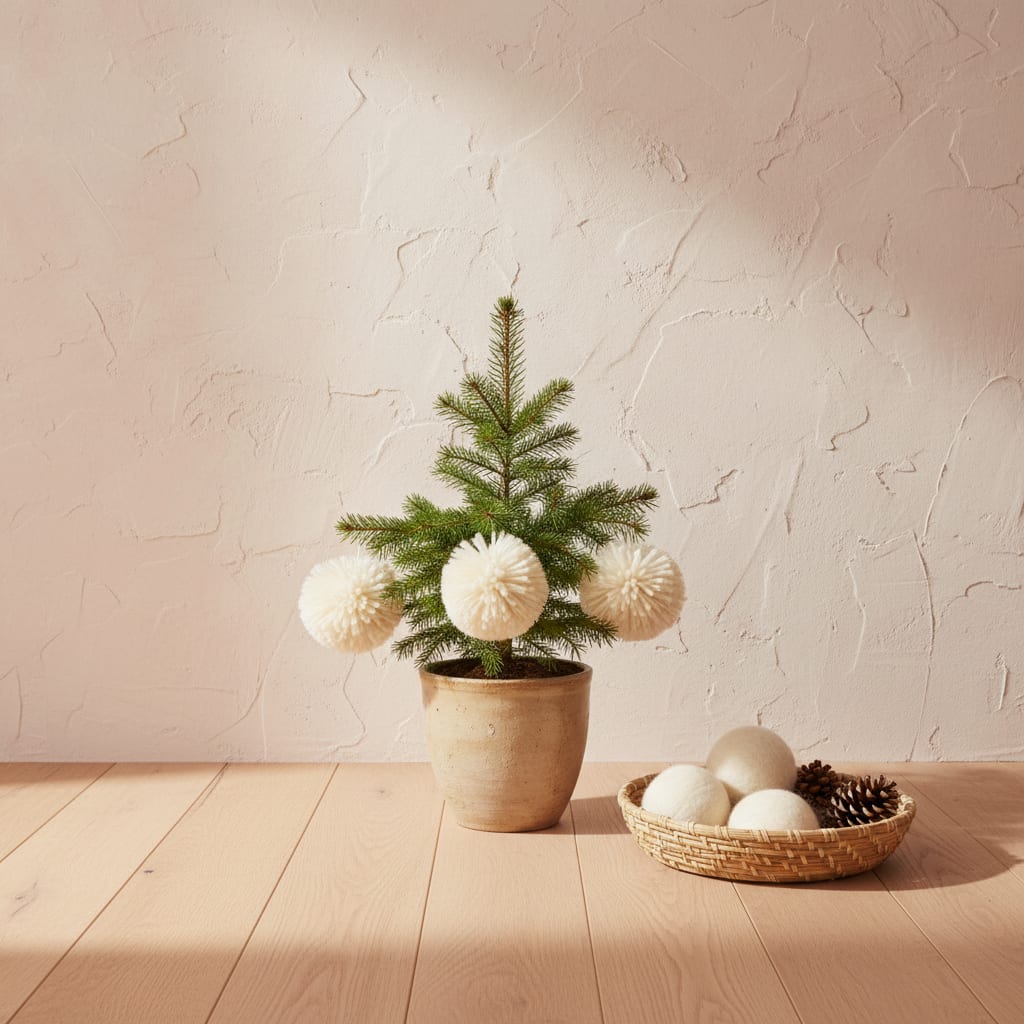
A Montessori Christmas tree is a small tree a young child can decorate, undecorate and look after alone: a tabletop tree (real or artificial) or a felt wall tree set at child height, a basket of unbreakable ornaments, and permission to take them off and start again as often as they like. The family tree stays for looking and smelling, with breakables hung high. Set it up so the whole job, from basket to branch and back, needs no adult hands. Before anything else, make it safe: a stable base, nothing breakable within reach, and no button batteries anywhere a child can get at.
I was an assistant in a Montessori toddler community, not a trained guide. The idea of a child’s own tree isn’t mine. Nicole Kavanaugh of The Kavanaugh Report has written about it for years, and I credit her below.
Why a tree of their own
Toddlers want to touch the Christmas tree. That’s not naughtiness; it’s how they learn about anything beautiful and new. The Montessori answer is not “don’t touch” but “here is one you can touch.”
Kavanaugh describes exactly this in The Easiest Toddler Christmas Tree. Her children help decorate the family’s real tree, but after that “the tree is only for exploring with our eyes (and noses!)”, and they use it to practise “patience, waiting and self control.” The toddler gets a tree of his own instead: “a small tree (you choose the size you want for the space) and a basket of pom-poms!” She uses a 24-inch tree with large pom-poms, and says it works because “it is so independent. He doesn’t need any help getting these on or off.”
That is the whole principle in two sentences. One tree is for care and waiting. The other is for the child’s own work.
Safety comes first
Nemours KidsHealth’s holiday safety page, medically reviewed, has the rules that matter most for a child’s tree:
- “Let kids decorate within their reach with non-breakable items. Hang breakable decorations and ornaments, lightbulbs, and tinsel out of kids’ reach.”
- For a real tree, keep it “watered, as a dry tree can more easily catch fire”, “secured in a sturdy stand so that it doesn’t tip over”, and “away from all heat sources”.
- “If you use an artificial tree, be sure it’s labeled ‘fire-retardant.’”
- Some holiday plants “(like mistletoe, holly, bittersweet, Jerusalem cherry, and amaryllis) are toxic if eaten.”
- “Be especially careful of electronic toys and remote controls with button batteries, which are very dangerous if swallowed.”
Two more points from me. First, battery-powered ornaments and light-up felt trees put a battery compartment at toddler height, so I’d leave them out entirely. Second, if your child still mouths things, the ornaments need to be large. Kavanaugh uses large pom-poms; small ones are a choking risk for a child who tests everything with their mouth.
Choosing the tree
You need something stable, sized to the child, and simple enough that the decorating is the interesting part.
- A small tabletop tree on a low, steady table or straight on the floor. An unlit artificial tree around two feet tall, like the Northlight 24-inch mini balsam pine in its burlap base, is close to the size Kavanaugh describes.
- A small real tree in a pot, if you want the watering job (see below). Check the base is wide enough not to tip when a toddler pulls on a branch.
- A felt wall tree. These are sold everywhere as “Montessori Christmas trees”. They can work well for a younger toddler, since there’s nothing to tip over. But “Montessori” on a felt tree is a seller’s label, not a certification; no such certification exists. Judge it by the same test as anything else: can your child do the whole job alone?
Ornaments a child can manage
Pick ornaments for the hands that will use them:
- Large pom-poms, which grip the branches without any hook, as in Kavanaugh’s version.
- Wooden or fabric ornaments on ribbon loops, big enough for a toddler to slide over a branch tip.
- Shatterproof balls on loops, for an older toddler.
- Natural things: a few pine cones tied with ribbon, cinnamon sticks bundled with string, dried orange slices.
Keep only a small number in the basket, perhaps eight to twelve. A child who can finish the job is more likely to come back to it.
Undecorating is the work
The adult goal is a finished tree. The child’s goal is the doing. So the most important part of a Montessori tree is that it comes undone easily. A child may put every ornament on, take them all off, and start again. That’s the work cycle at its purest: choose it, do it, put it back.
Make the reset simple. The basket lives next to the tree, and “putting it away” means ornaments back into the basket and the basket back in its place. Show this once, slowly, without many words, the same way you would present any work on the shelf. Then step back.
Caring for a real tree
A real tree, even a small potted one, gives a toddler a daily job: watering it. A small jug with a little water, a cloth for drips, and a moment each morning. The KidsHealth reason is real, as a dry tree catches fire more easily, so this is genuine care of the environment, not pretend.
Our Montessori Advent calendar already includes watering the tree as one of its daily jobs, so the two fit together well. For other ages and jobs, see practical life activities by age.
Sharing the family tree
A child’s own tree doesn’t mean the family tree is off-limits. A few changes make it easier for everyone:
- Low branches soft, high branches precious. Fabric and wooden ornaments down low; glass, heirlooms and lights up high, as KidsHealth advises.
- Decorate together once. Give the child a few unbreakable ornaments of their own to hang on the family tree. Then it becomes a looking tree.
- Name it. “This one is for looking and smelling. Your tree is for touching.” The rule is easier to keep when the alternative is close by.
If you’d like more ideas for the month, Betteroo has a longer list of short December activities for little ones, and our own 15 days of Montessori for the holidays gathers ideas from Montessori bloggers.
 A busy December, and bedtime?
Betteroo builds a gentle, personalized sleep plan around your child's age and naps, so visits, lights and late evenings don't undo it.
Take the free sleep quiz →
FAQ: Montessori Christmas tree
What is a Montessori Christmas tree?
A small tree set up so a young child can decorate and undecorate it alone: child height, a stable base, and a basket of unbreakable ornaments. It’s a practical life work, not a special product.
What age is a toddler Christmas tree for?
Most families start once a child is walking and reaching, from around a year old, and keep it through the preschool years. Choose ornaments for your child’s stage, especially if they still put things in their mouth.
Are felt Christmas trees Montessori?
They can be used in a Montessori way, but the label means nothing on its own. A felt tree with large pieces a child can place and remove alone fits the idea. One with tiny parts or a battery light doesn’t.
Should my toddler touch the big Christmas tree?
Let them help decorate it with unbreakable ornaments, then treat it as a tree for looking. Keep breakables, lights and tinsel high, and give them their own tree to touch.