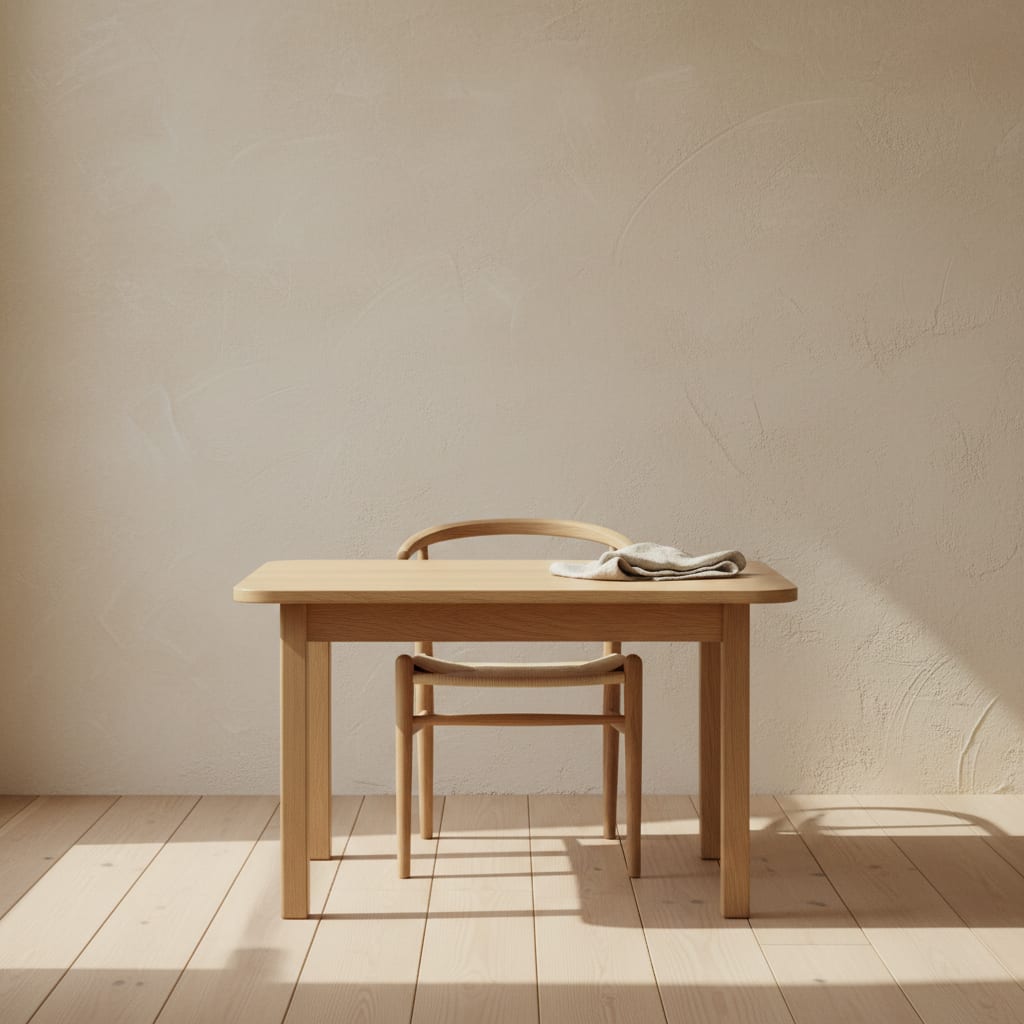
A Montessori table and chair for a toddler is a small work table and a chair sized so the child sits with feet flat on the floor and knees bent at about 90 degrees, with a tabletop roughly 8 inches above the seat. To size one, sit your child on a stool or step with their feet flat, measure from the floor to the back of the knee, and buy the chair closest to that number. Then pick the table to match the chair, not the other way round. The point is a child who can pull out the chair, sit, work and leave on their own.
I was an assistant in a Montessori toddler community for three years and I’m not a trained guide or an ergonomist. The sizing method below comes from Community Playthings, a maker of nursery and classroom furniture, and the Montessori framing from the American Montessori Society.
Why the size matters more than the style
The American Montessori Society’s core components page says well-prepared Montessori environments “contain appropriately sized furniture.” That is the whole brief. A Montessori table is not a style of table. It’s a table that fits the child who uses it.
A toddler at an adult table is kneeling on a chair, standing on a rung or perched with feet dangling, and can’t get in or out without help. A toddler at a table that fits can do a puzzle, eat a snack or pour water with their whole body steady, and leave when they’re done. Community Playthings’ chair and table height guide opens with the same idea: “comfort equals concentration and contentment.” A US dealer’s copy of the guide quotes a Cornell ergonomist, Alan Hedge: “Children should never sit for prolonged periods in the wrong size chair with their feet dangling.”
This is also the next step after a weaning table. The Montessori weaning table is built for a baby’s first meals, usually from when they sit unsupported until about two and a half. The table in this post is the one that follows, for a two- or three-year-old’s work, art and snacks.
How to measure your child
You need a tape measure, a low step or stool, and two minutes when your child is willing to sit still.
- Shoes off. Shoes add height, and most toddlers are barefoot or in slippers at home.
- Sit them so their feet are flat. Use a low stool or a stack of books until their feet rest flat on the floor and their thighs are level.
- Check the angles. Hips, knees and ankles should all be at about right angles. This is the same rule as the weaning table and every other Montessori seat.
- Measure floor to the back of the knee. That number is your seat height.
- Add about 8 inches for the table. Community Playthings’ rule: “In most cases, table tops should be 8 inches above the chair seat.” It allows a little leeway for toddlers.
If you only remember one thing: choose the chair first. The US copy says it plainly: “Chair seat height is the most important calculation you can make.” A table that is a little high can be lived with for a while. A chair that leaves feet dangling can’t.
A sizing table you can work from
The US copy of Community Playthings’ guide pairs chair seat heights with table heights. Here are the smaller sizes, which cover most toddlers and preschoolers:
| Chair seat height | Table top height |
|---|---|
| 5 in | 12 in |
| 6 in | 13 in |
| 6½ in | 14 in |
| 8 in | 16 in |
| 10 in | 18 in |
| 12 in | 20 in |
The smallest sizes run a little under the 8-inch gap, which is the toddler leeway the guide mentions. Use your measurement, not your child’s age, to choose a row. Children of the same age can be several inches apart in leg length, and the guide itself describes its age chart as recommendations.
What a good Montessori table and chair look like
Once the size is right, the rest is about whether the child can use it alone.
- A chair light enough to move. The child should be able to pull it out, sit, and push it back in. Heavy chairs stay where an adult left them.
- A chair without arms, or with low ones. Arms that reach the tabletop stop the chair sliding in.
- No tipping. Push down on the edge of the table and the back of the chair. A toddler will lean on both.
- Rounded corners and a plain top. Printed tops and built-in games compete with whatever the child is working on.
- A surface that wipes clean. Water, paint and snack all end up on it.
- Room around it. The child needs space to walk up, pull out the chair and leave without squeezing past furniture.
As a worked example, the ECR4Kids Bentwood Chair with an 8-inch seat is a light birch chair the listing marks for 2-3 years, sold as a pair. Paired with a table about 16 inches high, it matches the 8-inch row above. For an older or taller child who measures closer to 10 inches, the ECR4Kids Three Rung Ladderback Chair with a 10-inch seat is a plain wooden classroom chair, also a pair. Measure first: the right chair is the one that matches the tape, whatever the listing’s age range says.
Adjustable, or buy twice?
A table bought for a two-year-old will be too low by four or five. You have three honest options.
- Buy adjustable legs. Some classroom tables have legs that move up in steps. Buy the table once and change the chair as the child grows.
- Buy the chair and table separately. Chairs are the cheaper part to replace. A table that’s a little low for a four-year-old still works for floor-height art.
- Reuse what you have. A low coffee table, a sturdy bench or a cut-down table can do the job if the chair matches it. Plenty of families never buy a matched set.
There is no such thing as a certified Montessori table, whatever a listing says. Judge it on the fit and the checks above.
Where to put it
Put the table where the child’s work actually happens. In many homes that’s the living room or near the kitchen, not a separate playroom. A table near the kitchen becomes the place to wash vegetables, spread butter or have a snack, and our guide to the Montessori kitchen for toddlers shows how a low table fits into a working kitchen corner. In a play space, set it near the low shelf so materials go from the shelf to the table and back again. The Montessori playroom post walks through that layout.
Keep the table clear between uses. A table covered in yesterday’s work isn’t an invitation to start something new.
Teaching the table
A two-year-old won’t know what the table is for until someone shows them. The Montessori way is to show it slowly, once, at a calm time.
- Pulling out the chair. Show how to pull it out with two hands, sit, and push it back in when you stand up. Practise it as its own small lesson.
- Carrying work to the table. A tray or a basket from the shelf, carried with two hands, set down, then returned when finished.
- Wiping up. A small cloth kept nearby, so spills are the child’s to deal with.
Expect the chair to be pushed in about half the time for a while. That’s normal.
 A table that fits the day. A plan that fits the night.
Betteroo builds a gentle, personalized sleep plan around your toddler's age, naps and bedtime, so the evening runs as smoothly as the morning's work.
Take the free sleep quiz →
FAQ: Montessori table and chair
What height should a Montessori table and chair be?
Sized to the child: the chair seat at the height of the back of the knee with feet flat on the floor, and the table about 8 inches higher. For many toddlers that lands around an 8-inch seat and a 16-inch table, but measure your own child.
What age is a Montessori table and chair for?
Most families add one around the second birthday, after the weaning table, and use it through the preschool years. Adjust the chair, or buy the next size, as the child grows.
Do I need a separate table if I have a weaning table?
Not always. If the weaning table has a seat that can be raised, as a flippable cube chair can, it may do both jobs for a while. Once the child’s knees sit higher than their hips, it’s time for the next size.
Can my toddler use a learning tower at the counter instead?
For kitchen work at counter height, yes; our learning tower guide covers that. A low table is still useful for anything done sitting down: puzzles, drawing, snacks and slower work.