Montessori Toilet Learning: A Calm, Child-Led Guide
Montessori toilet learning treats using the toilet as a skill a child acquires — like walking or self-feeding — rather than a training program an adult runs. In practice that means: start offering the potty casually in the sensitive window (often somewhere around 12–24 months, earlier than mainstream “readiness” advice), prepare a bathroom the child can use alone, switch to underwear or trainers so wetness is felt, treat accidents as information rather than failure, and skip rewards entirely. No sticker charts, no three-day bootcamp, no pressure. It’s slower-looking and calmer-feeling, and it was one of the most-read topics on this site in its first life — this is the rebuilt version.
Learning, not training
The word swap isn’t preciousness. “Training” frames the adult as the actor and the child as the trained; “learning” frames the child as the actor and the adult as the one who prepares the conditions. Everything else in the Montessori approach falls out of that flip: the child’s body, the child’s timeline, the adult’s job being setup and calm.
Fair hedge before we go on: I spent three years assisting in a toddler community where toilet learning was daily work, but I’m not a certified guide, and the doctrine here comes from people who are. The Montessori Notebook — Simone Davies, AMI-trained, whose toddler book has the best chapter on this — and Montessori in Real Life both cover the philosophy properly. What follows is the home-logistics layer: what the bathroom needs, what to say, and what the middle weeks actually look like.
When to start
Montessori observation (see Montessori sensitive periods for what the term does and does not mean) puts a sensitive period for toileting earlier than the mainstream “wait for readiness” window — commonly somewhere in the 12-to-24-month range, when toddlers are keenly interested in the bathroom, in wet and dry, and in doing what you do. Starting “late” is fine and common; the point isn’t a deadline, it’s that waiting for a child to announce readiness at three sometimes means missing the season when the interest was free.
Starting looks boringly low-key: a potty exists in the bathroom, the child sits at natural moments (before the bath, after waking) if they want to, diaper changes move to standing in the bathroom so the child participates. No event, no announcement. If your child has constipation issues, withholding, or you’re getting pushback that feels bigger than resistance, loop in your pediatrician — some toileting struggles are medical, and no method fixes those.
Prepare the bathroom, not the child
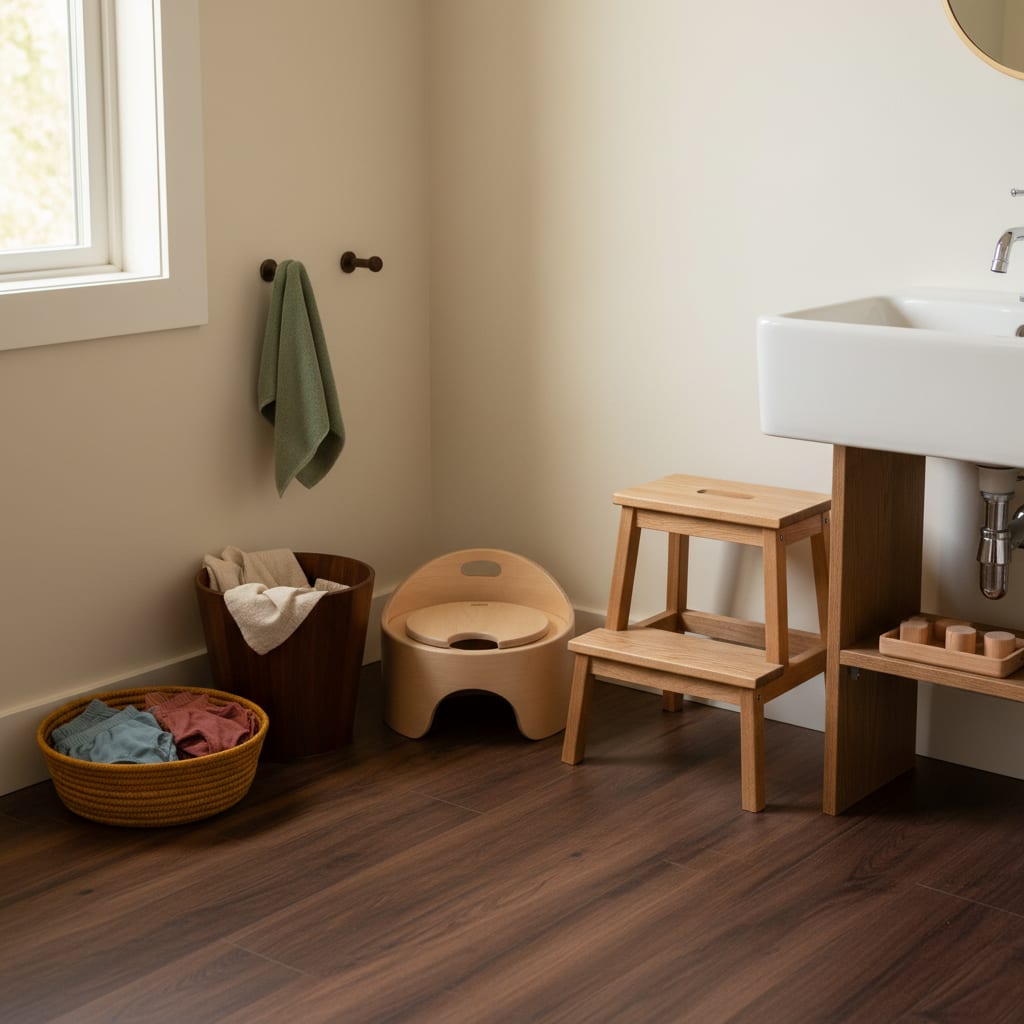
This is the part I can claim actual expertise in, because it’s shelf-work. The child needs to be able to run the whole sequence alone:
- A floor-level potty, always in the same spot (a plain one like the BabyBjörn Smart Potty) — or a seat reducer plus a sturdy step stool if your child prefers the real toilet. Basic potties run roughly $10–25; fancy doesn’t help.
- A step stool at the sink, like the Dreambaby step stool, for the non-negotiable handwashing finale — which toddlers usually consider the best part.
- A low basket or drawer of underwear and spare trousers the child can reach, because changing wet clothes is part of the work.
- A small hamper for wet things and a stack of cleanup cloths where the child can get them — accidents end with the child helping restore, not with a rescue.
- Clothes that cooperate: elastic waists only. Overalls and onesies are toilet-learning sabotage.
The same setup logic as every other practical life station: everything needed, nothing extra, all reachable. The rest of the sink (hands, teeth, hair) is in the Montessori bathroom setup.
Underwear, accidents, and what to say
Once the child is sitting sometimes and interested, most Montessori homes move to cotton underwear or thin trainers (such as Gerber’s training pants) during awake hours — not as a test, but because a child cannot learn from sensations a modern diaper is engineered to erase. Wet cotton is instant, honest feedback.
That means accidents, and accidents are the curriculum. The script is short and flat: “You’re wet. Let’s get dry clothes.” No sigh, no celebration of the alternative, no shame — and genuinely no sighing, which is the hard part in week two. The child helps: wet things to the hamper, cloth on the puddle, dry clothes on. Restoring is learning; being whisked away and re-diapered is not.
Skip rewards and lavish praise. The dry-pants sticker chart moves the point of the exercise from “my body, my skill” to “your approval,” and it tends to collapse exactly when the novelty does. The satisfying alternative that costs nothing: “You did it. You must feel comfortable.” Naps and nights are a separate, later, physiological story — staying dry asleep isn’t a skill to teach, so most families keep sleep diapers until they’re reliably waking dry.
The middle period — using the potty sometimes, refusing others, one triumphant week then a rainy regression — lasts weeks to months and is normal. It’s a skill acquisition curve, not a pass/fail event. Regressions cluster around disruptions (new sibling, moving, illness); respond by re-simplifying and re-calming, not restarting a “program.” Concentration on any self-mastery work, toileting included, grows in the same soil — a calm rhythm and an adult who doesn’t hover — which I’ve written about in helping your child concentrate.
FAQ: Montessori toilet learning
What age does Montessori toilet learning start?
Casual potty exposure often begins around 12–18 months, with real underwear-wearing commonly somewhere between 18 months and about two and a half. Every child’s window differs — the method is to follow interest, not the calendar, and starting later works too.
Is Montessori toilet learning the same as the 3-day method?
No. Three-day methods are intensive adult-led events; toilet learning is a gradual child-led process with a prepared bathroom and no deadline. Both have fans; they’re built on opposite premises, and mixing them mid-stream mostly confuses everyone.
Do you use rewards in Montessori toilet learning?
No — no stickers, treats or applause campaigns. The working theory is that mastery of one’s own body is the reward, and external prizes redirect the motivation and then expire. Calm acknowledgment replaces celebration.
What about naps and nighttime?
Sleep dryness is physiological and arrives on its own schedule, often much later than daytime skill. Most families use diapers for sleep without ceremony until mornings are consistently dry, and mention persistent concerns to their pediatrician.