Montessori Topponcino: What It Is and Whether You Need One
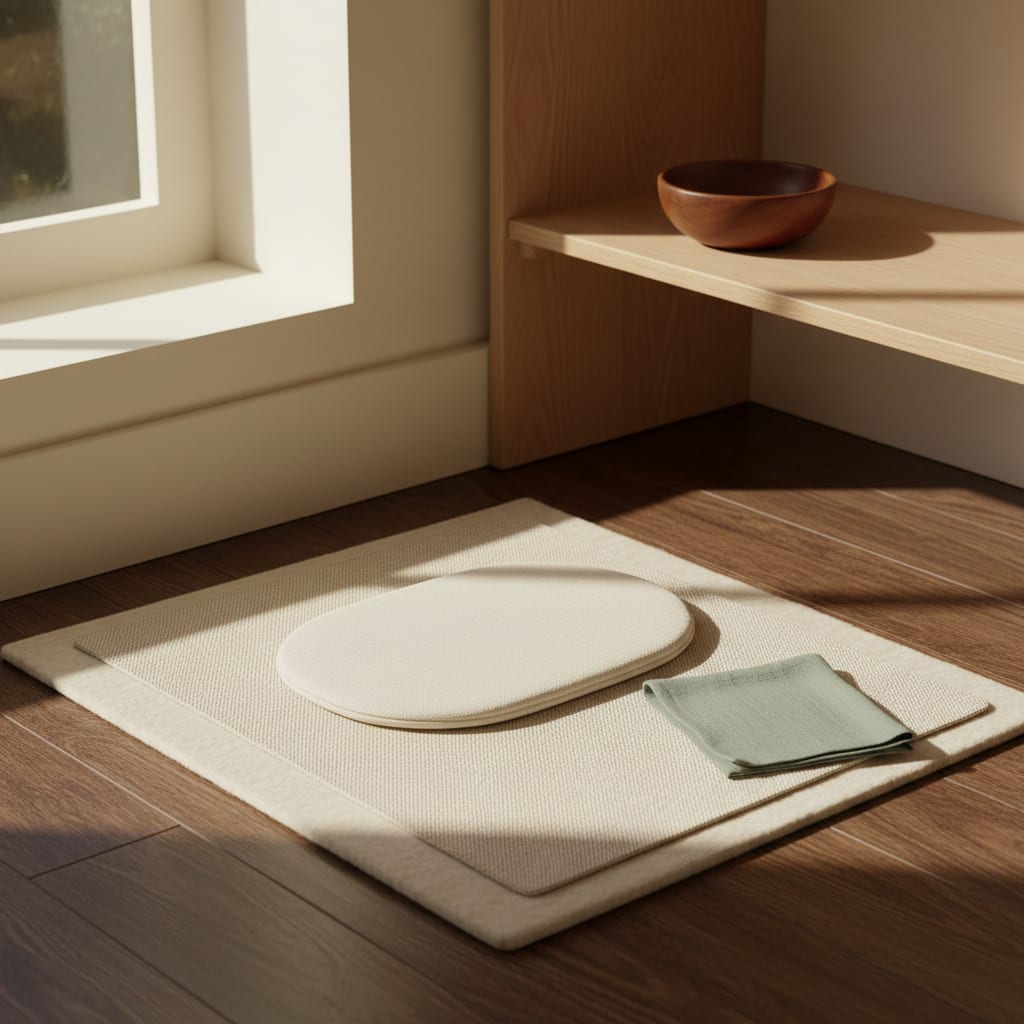
A topponcino is a small, quilted oval pad that a newborn lies on while being held, carried and passed from one person to another. It comes from the Montessori infant tradition, and its whole job is consistency: the same surface, texture and smell, whoever is holding the baby. It is useful in the first weeks, especially for older siblings and nervous relatives. It is not a sleep surface: when your baby is put down to sleep, they go on their own firm, flat, bare mattress, without the pad.
I was a classroom assistant in a Montessori toddler community, not an infant specialist, and I hold no guide’s diploma. What follows sets the Montessori writing on topponcini next to the American Academy of Pediatrics’ safe-sleep guidance, and where they pull apart, this site follows the AAP.
Where the topponcino comes from
The word is Italian. Carine Robin’s The Montessori Family gives it as “little pillow” and says it “has been part of Montessori Assistants to Infancy (A to I, birth to three year) program since its inception in Rome, Italy in 1949”. That is the AMI training for birth to three; the same page notes that, unless you trained for birth to three, “you would probably never have heard of the topponcino.”
Nicole Kavanaugh, who writes The Kavanaugh Report, describes it as “a small oval pad, that a baby uses when being moved from one area to another,” and as “your baby’s first environment (outside of your own arms) after birth.” She links it to the Montessori idea of “points of reference”: a newborn orients by a few familiar things, such as your voice, your smell and their own hands. A pad that smells like home, and is always under them, is one more.
What it is actually good for
The case the Montessori writers make is practical, not mystical:
- Passing the baby around. The pad gives a stiff, even surface under the whole body, so the head and back are supported without anyone having to think about it. The Montessori Family quotes a grandfather who, “because of the topponcino,” felt comfortable holding a newborn for the first time.
- Older siblings. Living Montessori Now’s Deb Chitwood calls it “a safer way for a sibling to hold the new baby” in her post on welcoming a new baby. She adds that it “still needs to be used with young siblings with lots of supervision.” A preschooler on the sofa with a newborn on a pad is still a preschooler holding a newborn: sit next to them.
- Moving an awake baby to the movement mat. Lift the baby on the pad, lower the pad to the floor, then slide the pad out or let the baby lie on it for a few minutes of awake time while you watch.
- A familiar smell. Montessori families often sleep with the cover for a few nights before the birth so it carries a parent’s smell. It is harmless, and it is not something any study has measured, so take it as tradition, not evidence.
Kavanaugh notes it is used most “for the first 6-8 weeks of life.” After that, babies get long, heavy and wriggly, and the pad becomes a play mat, then a memento.
The one rule: it is not a sleep surface
This is the line where some Montessori writing and pediatric guidance disagree, and it matters more than anything else on this page.
Some well-loved Montessori families let their babies sleep on the topponcino. Kavanaugh writes plainly that she and her partner are “personally comfortable” with it and invites readers to “make your own decisions.” The topponcino’s original description, quoted on The Montessori Family, even praises it for letting a baby be “easily put down after falling asleep without being awakened.”
The AAP’s parent’s guide to safe sleep points the other way:
- “Choose a firm, flat sleep surface for sleep.”
- “Keep soft objects & loose bedding out of your baby’s sleep area.” The list that follows includes “pillows and pillow-like toys” and “mattress toppers”.
- “Don’t use products for sleep that aren’t specifically marketed for infant sleep. Examples include Boppy pillows and Dock-a-Tots.”
A padded, quilted holding pad placed on top of a crib or floor-bed mattress is close enough to a topper or a pillow that I would not use it in the sleep space. The way I use it: hold the baby on it, carry them on it, and when a sleeping baby is going down, lift the baby off the pad and onto the bare mattress, on their back. If that wakes them, it wakes them. Your pediatrician is the right person to ask if you are unsure about any product in your baby’s sleep area.
Two related cautions from the same AAP page are worth repeating here because a topponcino makes long holds comfortable. Do not fall asleep holding a baby on a sofa or armchair: the AAP says the risk of sleep-related infant death is “up to 67 times higher when infants sleep with someone on a couch, soft armchair or cushion.” And when the pad is on the floor for awake time, stay in the room.
If the real problem is that your baby wakes the moment they leave your arms, a pad will not solve it. Betteroo’s guide on why the lowering into the crib wakes a baby so reliably explains the timing: babies fall into light sleep first, and if you “move them during the first 15 to 20 minutes” the change in position and warmth “reliably wake them”. Waiting for heavy limbs and slow breathing does more than any product.
Buy, DIY or skip?
Skip it if you mostly wear your baby in a sling or carrier. The Montessori Family notes that some babywearing parents “didn’t see the point,” and that is a fair verdict. A baby carried against you already has a constant point of reference.
Make one if you sew. It is a thin oval of cotton batting quilted so the filling cannot shift, plus a removable washable cover. Kavanaugh’s post says they “can also be DIYed.” Keep it thin and firm, with no loose stuffing or ties.
Buy one if you want it ready-made. The Topponcino Company’s original topponcino is the best-known. Its Amazon listing describes it as a holding, feeding and tummy-time pad, not a sleep product. A second washable cover is worth having, because newborns leak. Ignore any seller claims you cannot check, and treat it as a holding pad whatever the packaging says.
Where it fits in a Montessori infant room
A topponcino belongs with the movement zone and the people, not the bed. The room’s zones (sleep, movement, feeding, care) are laid out in a Montessori infant room on a normal budget, and the first things to put near the mat are in Montessori toys for 0-6 months. If you use a floor bed, the same rule applies there: the floor bed safety checklist keeps the sleep surface bare, and a topponcino is no exception.

FAQ: the Montessori topponcino
What is a topponcino used for?
Holding, carrying and passing a newborn on one consistent, supportive surface, and moving an awake baby to the movement mat. Montessori families use it mainly in the first six to eight weeks.
Can a baby sleep on a topponcino?
This site’s answer is no. The AAP says babies should sleep on a firm, flat surface with no pillows, pillow-like items or mattress toppers, and should not sleep on products not made for infant sleep. Lift your baby off the pad before putting them down. Ask your pediatrician if you are unsure.
Is a topponcino worth it?
It is worth it if several people will be holding the baby, especially young siblings or grandparents. If you mostly use a carrier, you can skip it.
How long do you use a topponcino?
Mostly for the first six to eight weeks. After that it usually becomes a small mat for awake floor time.