Montessori Toys for 6 Month Olds (Up to 12 Months)
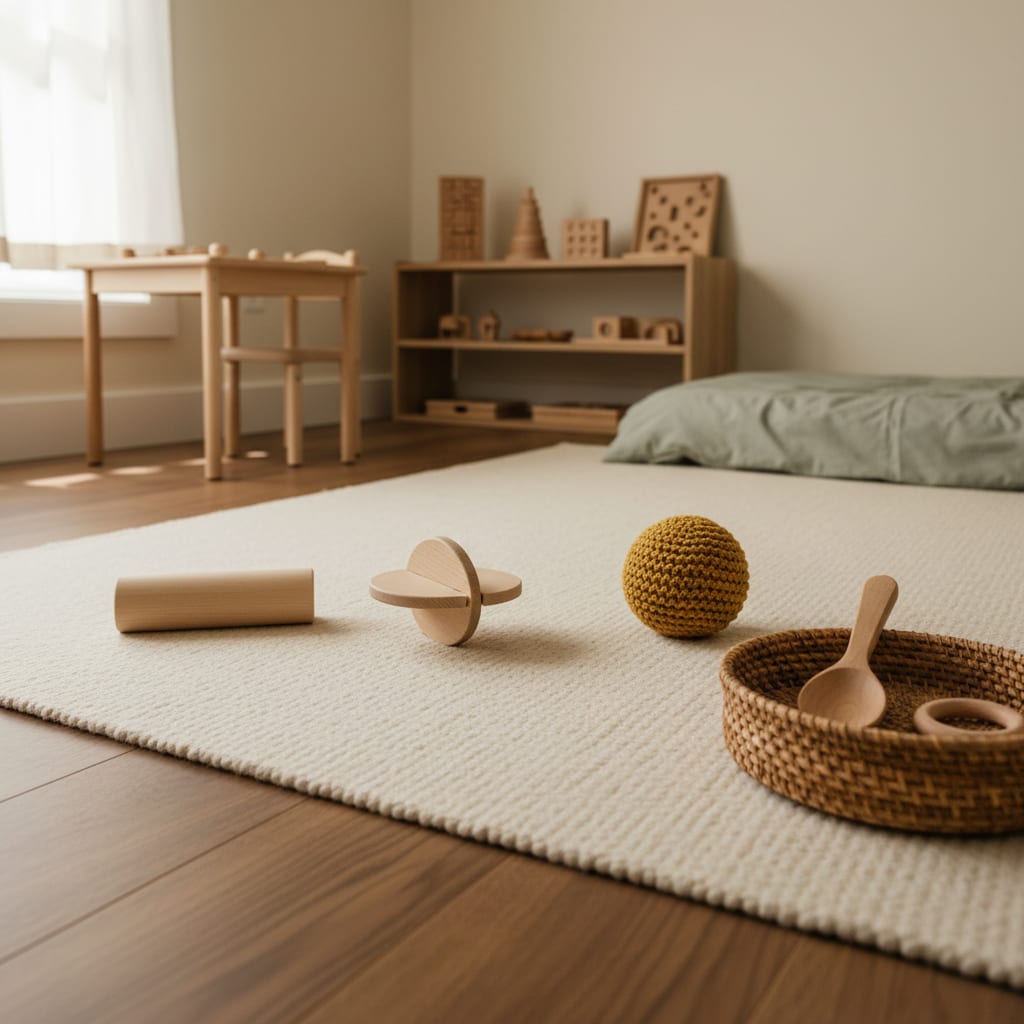
The best Montessori toys for 6 month olds, and for the whole half-year up to the first birthday, follow the body rather than the calendar: something that rolls away to chase once your baby creeps, something to pass hand to hand while sitting, a treasure basket of real household objects, an object permanence box when things start “vanishing”, and something sturdy to pull up on. Offer three or four at a time on a low shelf or the edge of the mat. Every piece has to be too big to choke on, and that rule comes before anything else on this page.
I was an assistant in a Montessori toddler community and I have no guide’s diploma, so treat this as a parent’s shelf list checked against pediatric milestone pages and the American Montessori Society’s own parent guides, not as doctrine.
First, the choking floor
From about six months, everything goes in the mouth. The CDC’s 6-month checklist lists it as a milestone in its own right: “Puts things in her mouth to explore them.” So the first job of any toy at this age is to be too big to swallow.
The American Academy of Pediatrics’ choking-prevention page puts it bluntly: “Balloons, balls, marbles, pieces of toys and foods (small round objects) cause the most choking deaths.” Its household list includes “Small balls”, “Toys with small parts” and “Toys that can be squeezed to fit entirely into a child’s mouth”, and it asks parents to “Follow the age recommendations on toy packages.”
For a Montessori shelf that means:
- No beads, coins, pom-poms or small stones in a treasure basket or posting work, however natural they look.
- Check homemade pieces the way you would check a bought one: does anything come off, splinter or squash small?
- The older sibling’s shelf is not the baby’s shelf. The AAP notes that “Many choking incidents happen when older brothers or sisters give dangerous foods, toys or small objects to a younger child.”
What this half-year is actually for
Six to twelve months is the movement half-year. Most babies go from leaning on their hands to sit, to crawling, to pulling up on furniture, and the hand goes from a whole-fist grab to a fingertip pinch. The CDC’s “Learn the Signs. Act Early.” checklists are a fair map. The CDC defines a milestone as something “most children (75% or more) can do by a certain age”, so treat these as a floor most babies have crossed, not a target.
| CDC milestone (CDC wording) | Listed by | What it asks of the shelf |
|---|---|---|
| ”Reaches to grab a toy she wants” | 6 months | One interesting thing placed just out of reach on the mat |
| ”Leans on hands to support herself when sitting” | 6 months | Something light and graspable to hold while balancing |
| ”Moves things from one hand to her other hand” | 9 months | Interlocking discs, a rattle, a wooden ring |
| ”Looks for objects when dropped out of sight (like his spoon or toy)“ | 9 months | The object permanence box |
| ”Bangs two things together” | 9 months | Two blocks, two wooden spoons, two cups |
| ”Puts something in a container, like a block in a cup” | 1 year | A bowl and some big pieces; a first posting box |
| ”Pulls up to stand” | 1 year | A low, heavy, anchored piece of furniture, not a toy |
| ”Picks things up between thumb and pointer finger, like small bits of food” | 1 year | Mealtimes, not tiny toys (more on this below) |
The milestone wording comes from the CDC’s 6-month, 9-month and 1-year checklists. If your baby is well behind them, that is a pediatrician conversation, not a shopping one.
The shelf, by milestone
Sitting and reaching (around 6 to 8 months)
- A rolling bell or rolling rattle. A wooden cylinder with a bell inside rolls a short way when batted and keeps chiming, which turns “reach” into “go and get it”. The Lovevery Montessori Rolling Rattle is the well-known one. Put it just past your baby’s fingertips on the mat and let them work at it.
- Interlocking discs. Two flat wooden discs joined at the middle: easy to grab, interesting to turn, the classic first hand-to-hand toy. JE JOUE’s interlocking discs are the plain version I would choose.
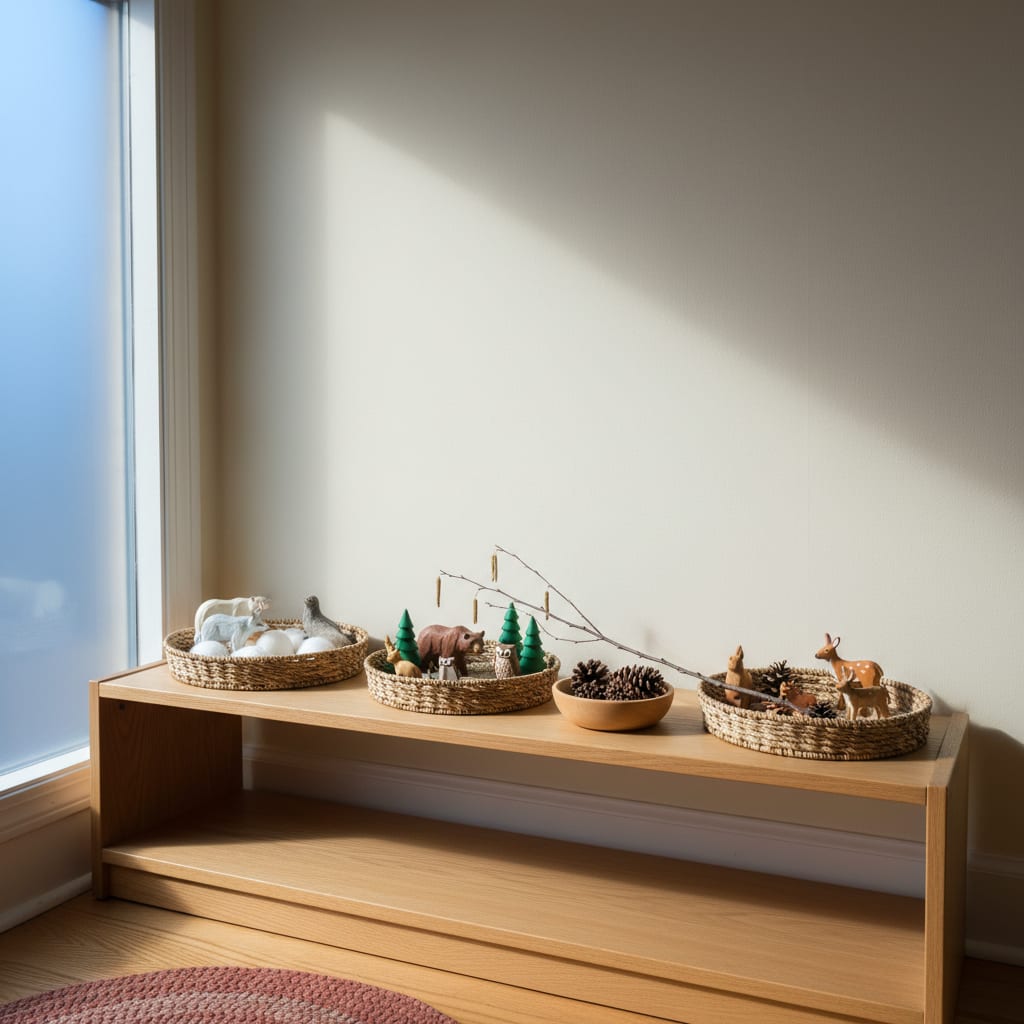
- A treasure basket. The American Montessori Society’s parent guide to activities for 6-month-olds describes it as “a low basket filled with 8-10 natural, real-world objects of different textures, weights, and temperatures for the baby to explore freely”, and adds: “Do not direct or hand them objects.” A wooden spoon, a small metal whisk, a wooden ring, a soft knitted ball. Its own list also includes a pine cone and a smooth stone. I leave out anything that could shed pieces or is small enough to fit in a mouth, so in my house the stone was a large one or none. Swap one or two objects a week.
Crawling and hand to hand (around 8 to 10 months)
- Two things to bang together. Two wooden blocks, two spoons, two nesting cups. Banging is a CDC 9-month milestone, and it is loud, and that is the point.
- A ball worth chasing. A soft fabric or knitted ball, big enough to fail the choking test by a wide margin, rolled just ahead of a new crawler.
- The object permanence box. A ball goes in the hole, disappears and rolls out into the tray. It matches the CDC’s “Looks for objects when dropped out of sight” almost word for word. The Adena Montessori object permanence box is the one this site already uses as its example. Show it slowly once, then leave it on the shelf. If your baby is not interested yet, put it away for two weeks.
Pulling up and first containers (around 10 to 12 months)
- Something heavy to pull up on. A low shelf, a sturdy ottoman or a wall bar. Whatever it is must be anchored or too heavy to tip, because a baby pulling to stand puts their whole weight on the top edge. The rest of the room, floor mirror included, is in a Montessori infant room on a normal budget.
- Putting in and taking out. A wide bowl and three large blocks, then a simple posting box. At this age the job is “in”, then “out”, then “in” again, many times.
And the pincer grip?
The fingertip pinch usually arrives late in this half-year. Betteroo’s guide to how the grip moves from raking to a fingertip pinch says it “usually develops between about 9 and 12 months”, and notes that it “gets daily practice once your baby moves from starting solids to finger foods.” That is the Montessori answer too. The pinch is practised at the table, with soft food pieces and an adult there, not with small toys left on a shelf, which would collide with every choking rule above.
How to set it out
Three or four things at a time, on a low shelf or along the edge of the movement mat. The same AMS guide suggests “A low shelf with 3-4 objects rotated weekly prevents overwhelm.” Watch which object your baby returns to, and keep that one out while you swap the others. The fuller rotation system on this site works the same way at every age; at six months the only difference is that the shelf is three things long.
The test for any toy is the same one this site uses at every age: the baby acts, the toy responds. A rolling bell rolls because a hand hit it. A button that plays a song rewards the button. The longer version of that test is in what makes a toy Montessori.
What I would skip
- Seated baby walkers. This is the one firm “no” on this list, and it is not a Montessori opinion. The AAP’s page on baby walkers says “There are no benefits to baby walkers”, that “walkers can actually delay when a child starts to walk”, and that the AAP “has called for a ban on the manufacture and sale of baby walkers with wheels”. A push wagon a walking child holds on to is a different object, and it belongs on the 1-year-old shelf.
- Stationary activity centres, mostly. The AAP lists these as the safer alternative to walkers, so they are not a safety problem. My objection is the Montessori one: an hour in a seat is an hour not spent rolling, pivoting and crawling on the floor.
- Light-up, talking “activity” toys. They are not harmful. The toy does the work and the baby watches.
- Boxed 6-to-9-month kits, unless you want the curation. They are well made, and you are paying someone to choose. Everything above is cheaper to put together yourself.
If your baby is younger than this page, start with Montessori toys for 0-6 months, where the mobiles and first rattles live.

FAQ: Montessori toys for 6 to 12 month olds
What are the best Montessori toys for a 6 month old?
A rolling bell, interlocking discs, a treasure basket of large household objects and a soft ball. Add the object permanence box when your baby starts looking for things that drop out of sight.
How many toys should a 6 month old have out?
Three or four at a time, rotated weekly. The AMS parent guide uses the same number.
Are Montessori toys safe for babies who put everything in their mouth?
Only if every piece is too big to swallow and nothing can break off. Follow the age label, skip beads and small stones in homemade work, and keep older siblings’ pieces out of reach.
When should I introduce an object permanence box?
When your baby starts looking for things that fall out of sight, which the CDC lists by 9 months. Some babies take to it earlier. If it is ignored, put it away for a couple of weeks.